Mains: GSIII – Economy | Infrastructure
Why in News?
India is set to raise ₹1,000 crore through its maiden blue bond under Sagarmala to fund sustainable maritime infrastructure, with SEBI recognising blue bonds as a sustainable finance instrument.
What are Blue Bonds?
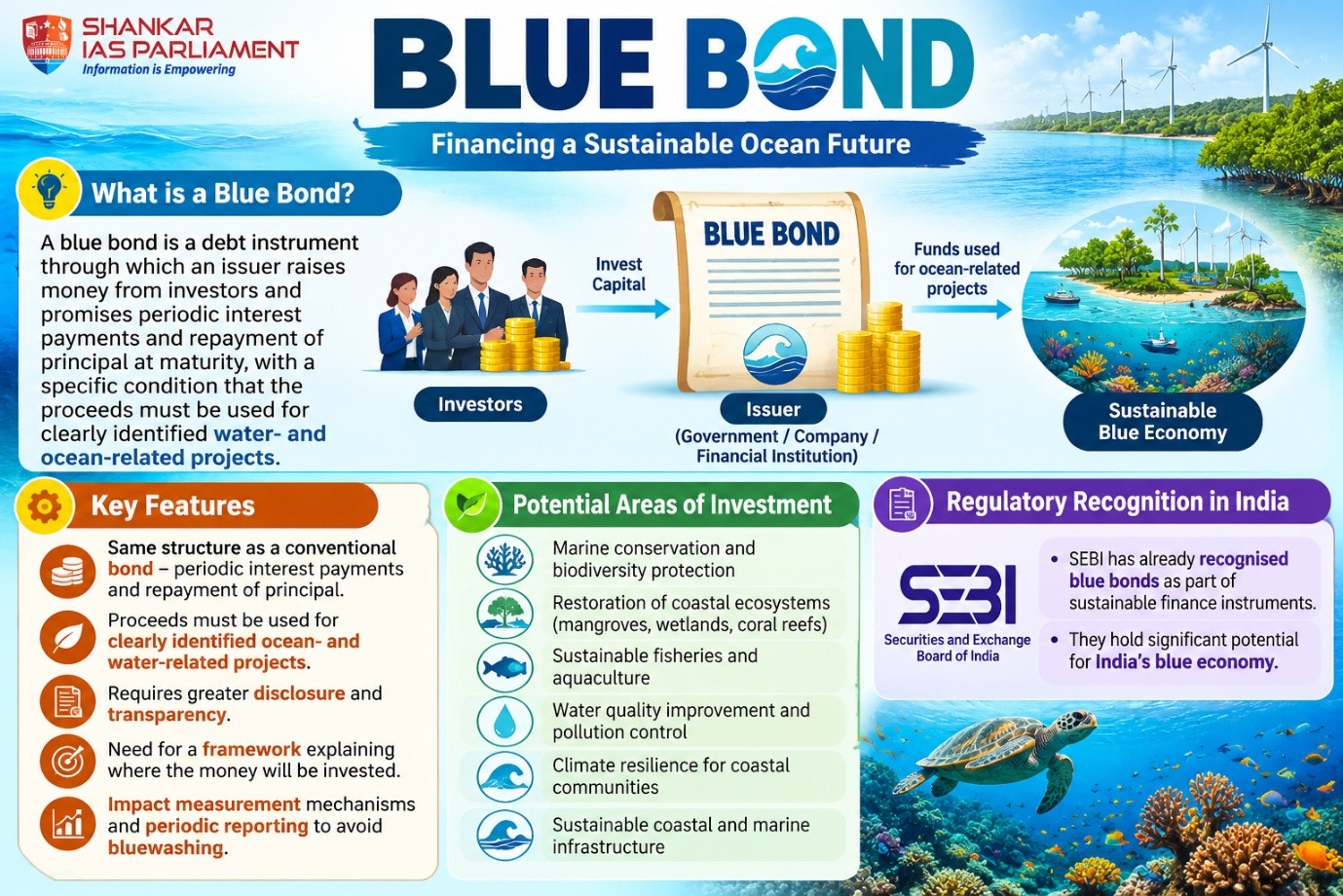
- Blue bonds – These are debt instruments whose proceeds are earmarked for ocean- and water-related sustainable projects, while following the basic structure of conventional bonds.
- They can finance:
- Sustainable ports and shipping.
- Inland waterways and coastal transport.
- Fisheries and coastal livelihoods.
- Marine conservation and pollution control.
- Sustainable coastal tourism.
- Greater disclosure, impact measurement and periodic reporting are required to prevent “bluewashing”.
What is Blue Bond Significance for India?
- Diversifying Infrastructure Finance – India's long-gestation infrastructure has traditionally depended on bank loans, budgetary support and conventional bonds.
- Blue bonds can diversify these funding sources and attract sustainability-oriented investors.
- Better Asset-Liability Management – SMFCL provides infrastructure loans with maturities of around 12 years, while its existing borrowing tenure is shorter.
- Long-duration bonds can therefore improve asset-liability matching.
- Financing Sustainable Maritime Infrastructure – India has a coastline of about 7,500 km, and nearly 95% of trade by volume moves through maritime routes.
- Blue finance can support Electrification and energy efficiency in ports, Shore-power facilities, Cleaner cargo handling and logistics, Inland water terminals and coastal shipping.
- Thus, blue bonds can link infrastructure development with environmental sustainability.
|
Global Blue-Bond Market
|
- The global blue-bond market has expanded rapidly, with cumulative issuance crossing $15 billion by mid-2025, according to the World Bank.
- Seychelles issued the first sovereign blue bond in 2018 with World Bank support.
- Belize restructured around $553 million of external commercial debt in 2021, creating fiscal space for marine conservation.
- The Nordic Investment Bank issued an early institutional blue bond in 2019.
- The Asia-Pacific region has become an important market for blue and water-labelled bonds.
- These examples show how debt instruments can combine development financing with marine conservation.
|
Why Do Blue Bonds Lag Behind Green Bonds?
- Lack of standardisation – There is no universally accepted blue taxonomy comparable to established green-bond standards.
- Difficulty in impact measurement – Outcomes such as biodiversity improvement, coral restoration and fish-stock recovery are difficult to quantify.
- Limited investment-ready projects – Many countries have ocean strategies but lack sufficiently developed projects capable of attracting large-scale finance.
- Narrow investor base – Blue bonds continue to depend significantly on specialised impact investors rather than mainstream institutional investors.
- Risk of bluewashing – Weak monitoring and disclosure can undermine the credibility of blue-labelled projects.
|
India’s Emerging Pipeline
|
- India’s blue-bond ecosystem remains at an early stage.
- The proposed water-infrastructure financing by Vadodara Municipal Corporation indicates that blue finance could expand beyond marine projects to broader water-related sustainability.
- The Andaman and Nicobar Islands also offer potential applications in sustainable ocean-economy development.
- Challenges – The global interest-rate environment may increase borrowing costs and affect investor appetite. Hence, successful issuance will require:
- Sound financial fundamentals.
- Realistic pricing.
- Transparent use of proceeds.
- Credible environmental outcomes.
- Robust impact reporting.
|
What measures can be taken?
- Develop a Clear Blue Taxonomy – India should establish clear and measurable criteria for identifying eligible blue projects, aligned with global sustainable-finance principles.
- Strengthen Monitoring and Disclosure – Independent verification, impact assessment and periodic reporting should be strengthened to prevent bluewashing.
- Build an Investment-Ready Project Pipeline – Government agencies should develop bankable projects in:
- Sustainable ports.
- Fisheries.
- Coastal infrastructure.
- Inland waterways.
- Marine conservation.
- Waste and wastewater management.
- Mobilise Institutional Investors – Appropriate regulatory and risk-management frameworks can encourage insurance companies, pension funds and other long-term investors to participate.
- Integrate Blue Economy Strategy – Blue bonds should form part of a broader strategy combining economic growth, marine conservation, coastal livelihoods and climate resilience.
What lies ahead?
- India’s maiden blue bond can help bring the ocean economy into mainstream capital markets.
- Its immediate financial scale may be modest, but it can establish a new model for financing sustainable maritime infrastructure.
- The long-term potential of blue bonds will depend on standardisation, credible impact measurement, transparency and a strong pipeline of investment-ready projects.
Reference
The Hindu| Blue Bonds



