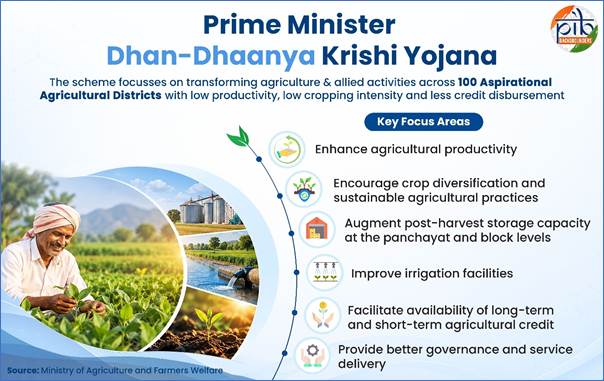
Core Overview
- Approved and Launched – Approved by Union Cabinet on 16th July 2025; formally launched by the Prime Minister on 11th October 2025 (Celebrating 1st Anniversary on 11th October 2026).
- Duration – 6-year initiative (2025–26 to 2030–31).
- Target Area – 100 Aspirational Agricultural Districts across all States and Union Territories (every State has at least 1 designated district).
- District Selection Criteria –
- Low agricultural productivity.
- Low cropping intensity.
- Lower agricultural credit disbursement.
- Proportionate share of net cropped area and operational holdings per State/UT.
- Convergence Model – Integrates 36 Central Schemes across 11 Ministries/Departments, supplemented by State schemes and CPSE Corporate Social Responsibility (CSR) participation (mandated by DPE for FY 2026–27 and 2027–28).
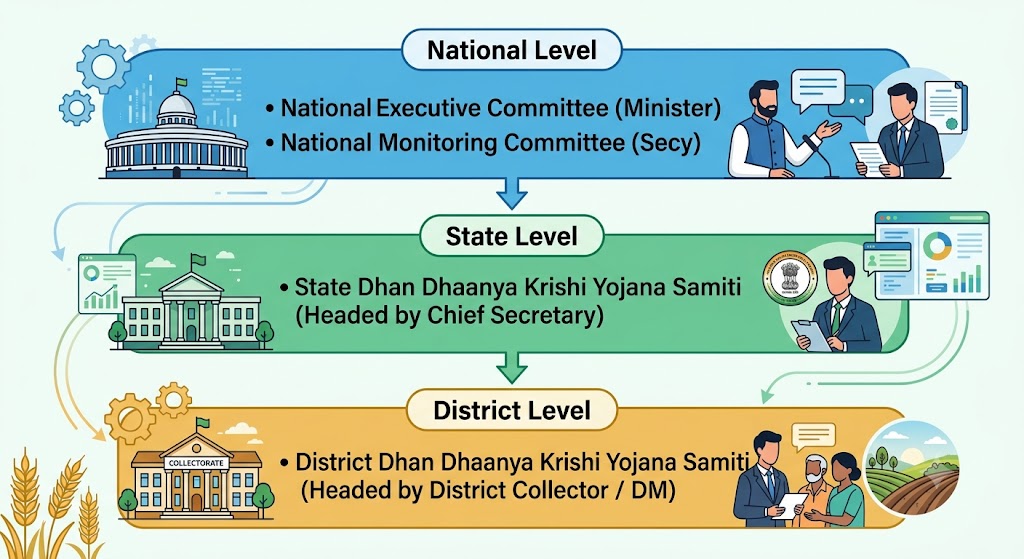
Three-Tier Administrative Governance Structure
- District Level – District Dhan Dhaanya Krishi Yojana Samiti (headed by DM/Collector) formulates and executes District Action Plans (DAPs).
- State Level – State Dhan Dhaanya Krishi Yojana Samiti (headed by Chief Secretary) reviews and integrates DAPs into state annual budgets.
- National Level –
- National Executive Committee – Chaired by the Union Minister for Agriculture and Farmers Welfare.
- National Monitoring Committee – Chaired by the Secretary, Department of Agriculture and Farmers Welfare (DAandFW).
Performance Metrics and Digital Monitoring Engine
- Tracking Framework – 121 total indicators across 36 converged schemes (74 Output Indicators and 47 Outcome Indicators).
- PM-DDKY Dashboard – Operational since late October 2025; publishes monthly output-based rankings for all 100 districts.
- Macro Performance Jump (April 2026 vs August 2026) –Overall average composite score rose from 18.85 to 46.89 (an improvement of +28.04 points).
|
Objective
|
April 2026 Score
|
August 2026 Score
|
Growth
|
|
Enhancing Agricultural Productivity
|
1.50
|
8.08
|
+6.58
|
|
Crop Diversification and Sustainable Practices
|
4.08
|
10.18
|
+6.10
|
|
Post-Harvest Storage Capacity
|
2.14
|
5.19
|
+3.05
|
|
Irrigation Infrastructure
|
1.38
|
4.91
|
+3.53
|
|
Agricultural Credit Access (Short and Long Term)
|
2.40
|
6.53
|
+4.13
|
|
Governance and Service Delivery
|
7.41
|
12.05
|
+4.64
|
Gadchiroli (Maharashtra) — Local Value Addition
- FPO – Desaiganj Farmers Producer Co. Ltd. (800 farmer members).
- Intervention – Built a 3 MTPH rice processing unit and a 900 MT storage warehouse for the indigenous Jay Sri Ram rice variety.
- Financial Impact – Achieved a turnover of Rs.1.24 crore in FY 2025–26 through direct local processing.
Tumakuru (Karnataka) — International Market Integration
- FPO – Tiptur Farmer Producer Co. Ltd. (750 farmer members).
- Intervention – Direct B2B supply chain partnership for Ball Copra with a French multinational corporation.
- Financial Impact – Generated Rs.1.60 crore turnover in FY 2025–26; aggregated 138+ tonnes of copra valued over Rs.1.9 crore (by Sept 2026).
Jaisalmer (Rajasthan) — Climate-Smart Micro-Irrigation
- FPO – Jaisalmer Krishi Fed Producer Co. Ltd. (1,236 farmer members).
- Intervention – Executed Integrated Pest Management (IPM) cumin farming over 2,000 acres paired with solar-powered sprinkler irrigation across 500 acres.
- Impact – Reduced water usage, lowered diesel costs, and boosted crop yields in arid climate conditions.
Key Takeaways
- Shift to Data-Driven Governance – Monthly indicator-based rankings ensure administrative accountability at the District Collector level.
- FPO Sangam Collaboration – The inaugural PM-DDKY FPO Sangam (Dec 2025) connected 72+ FPOs across 15 States to scale peer-to-peer learning in organic/natural farming, oilseeds, and digital agriculture.
- Sustainable Institutional Foundation – Year 1 completes the baseline architecture (DAPs, dashboard monitoring, and multi-ministry convergence), creating a scalable model for inclusive regional agricultural development through 2031.
Reference
PIB



