Mains: GS III – Environment Pollution and Degradation
Why in News?
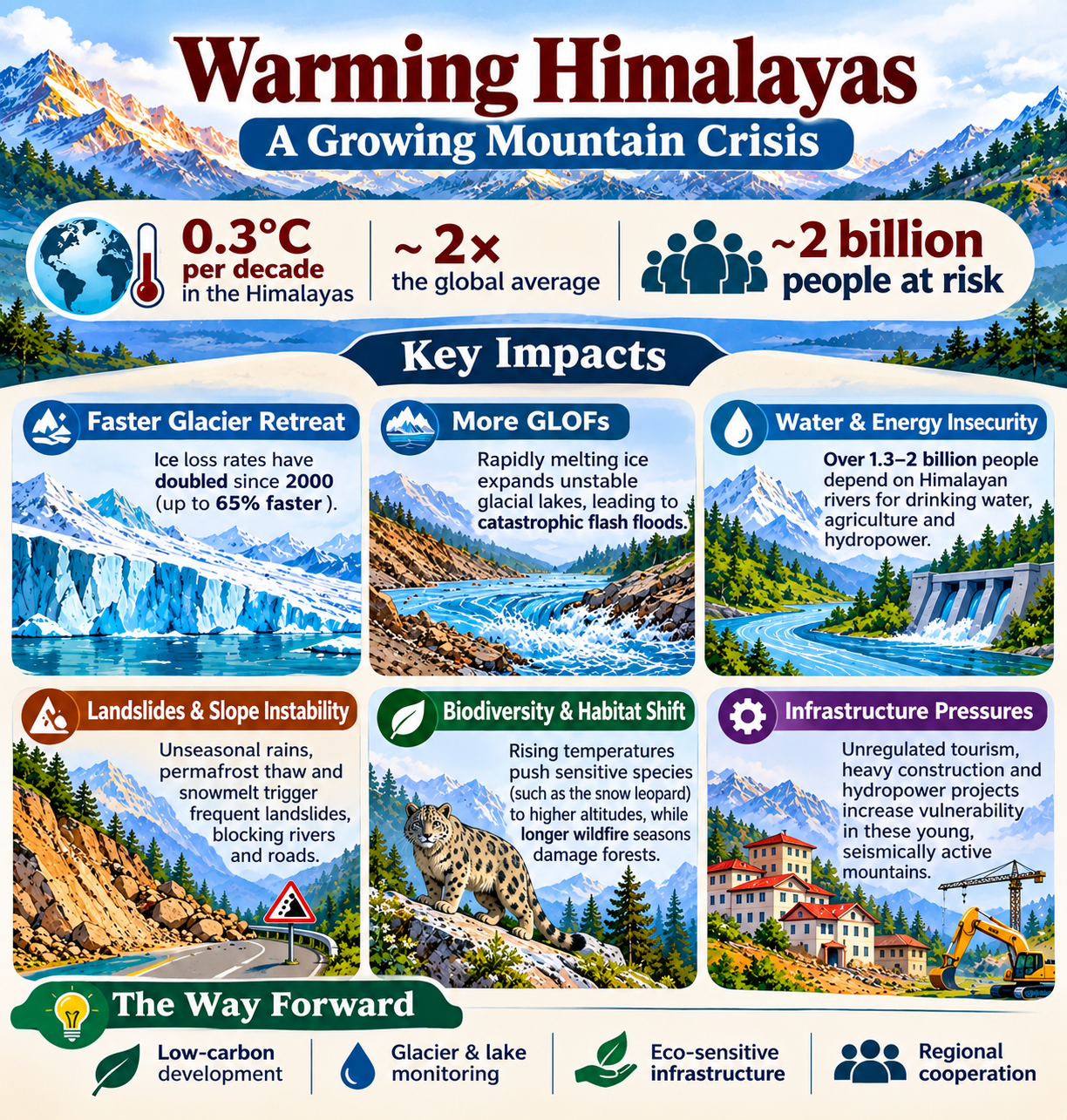
Recently, The Intergovernmental Panel on Climate Change (IPCC) and the World Meteorological Organization (WMO) have warned that warming in the high mountains of Asia is occurring at 0.3°C per decade, nearly twice the global average.
What is the scientific evidence of accelerated warming in the Himalayas?
- Twice the Global Average Warming – The high mountains of Asia stretching across the Hindu Kush, Karakoram, and Himalayan ranges, are warming at 0.3°C per decade, which is nearly twice the global average rate.
- Doubling of Ice-Loss Rates – Research released in March 2026 by the International Centre for Integrated Mountain Development (ICIMOD) revealed that ice-loss rates across the Hindu Kush Himalaya (HKH) have doubled since 2000.
- Regional Disparities in Warming – Studies in the Journal of Earth System Science indicate that warming is not uniform; the Western Himalayas are warming consistently faster than central and eastern stretches, with extreme spikes in winter and night-time minimum temperatures.
- Cascading Disasters – Catastrophic events, such as the severe Nepal floods triggered by a massive rock-and-ice avalanche from the Langtang Himal demonstrate the growing existential vulnerability of the region.
How do rising temperatures destabilize glaciers and permafrost?
- Thermal Profile Shift and Subglacial Lubrication – Glacial ice temperatures have risen from historical norms of − 6°C to − 20°C up to nearly −2°C, making them highly susceptible to rapid melting.
- Surface meltwater pools and plunges through vertical shafts (moulins) to the bedrock, forming a pressurized liquid layer that lubricates glaciers and accelerates downslope sliding.
- Melting of Permafrost ("Geological Cement") – Permafrost permanently frozen ground or rock acting as natural cement holding steep rock walls together is thawing due to rising temperatures.
- This thawing triggers massive rock avalanches, landslides, and debris flows.
- High-Altitude Flash Floods – When colossal sections of ice and rock collapse into river valleys (such as the Langtang avalanche damming the Lhende Khola), sudden dam breaches unleash devastating, concrete-like debris flows that travel hundreds of kilometres downstream as "inland tsunamis".
Why must current development and hydropower models in the Himalayas be rethought?
- Vulnerability of Mega-Infrastructure – Traditional civil engineering models ignore the changing geological reality of retreating glaciers and thawing permafrost, putting major infrastructure and downstream communities at constant risk.
- Flaws in Hydropower Projects Above High Altitudes – Committees such as the Avay Shukla Committee and the Ravi Chopra Committee have consistently recommended restricting major hydropower projects and subjecting construction activities above 2,200 meters to rigorous expert review.
- Risks of Unviable River-Linking Projects – Fragile ecological undertakings—such as the proposed Chenab-Beas river-linking project involving an 8.7-km tunnel through the steep Pir Panjal Range in Lahaul and Spiti at 3,140 meters elevation pose severe environmental threats to fragile high-altitude ecosystems and should be avoided.
What policy and technological measures are required for climate-resilient development?
- Moratorium and Rigorous Reassessment – Implement a temporary moratorium on major development projects in the Indian Himalayan Region (IHR) until each project is rigorously re-evaluated for environmental impact, hazard-averseness, and climate resilience.
- Advanced Early Warning and Surveillance Systems – Deploy high-altitude satellite and drone surveillance to monitor cliff fracturing, permafrost thaw, and glacial lake expansion in real time.
- Install acoustic and hydrological sensors along glacier-fed rivers to provide immediate flash-flood warnings to downstream settlements.
- Scientific River Flood Zoning – Restructure flood zoning policies based on valley slopes – steep slopes require infrastructure to be positioned much higher above riverbeds, while gentler slopes require specialized horizontal zoning.
- Cross-Border Regional Cooperation – Establish shared, real-time data exchange networks across Himalayan nations (Hindu Kush-Karakoram-Himalaya commons) to manage transboundary disaster risks collectively.
Reference
The Hindu | Warming Himalayas



