Why in News?
The Supreme Court referred the 2023 Election Commissioners appointment law to the CJI for consideration by a five-judge Constitution Bench following a split verdict by a two-judge Bench.
How are Election Commissioners appointed?
- Election Commission of India (ECI) – Article 324 of the Constitution vests the superintendence, direction and control of elections in the ECI.
ECI is an autonomous constitutional body established on 25 January 1950. Its foundational authority is enshrined in Part XV (Articles 324 to 329) of the Constitution of India.
- Election commissioner’s appointment – Constitution does not prescribe a detailed mechanism for appointment of the CEC and ECs.
- Constitution provides that they shall be appointed by the President, subject to any law made by Parliament.
- Interim mechanism prescribed by SC
In Anoop Baranwal v. Union of India (2023), the Supreme Court noted the absence of a parliamentary law governing appointments and prescribed an interim mechanism.
- Until Parliament enacted a law, appointments were to be recommended by a 3-member committee comprising:
- Prime Minister
- Leader of Opposition in Lok Sabha
- Chief Justice of India
- Chief Election Commissioner and Other Election Commissioners (Appointment, Conditions of Service and Term of Office) Act, 2023 – Replaces the CJI with a Union Cabinet Minister nominated by the Prime Minister.
- Present Selection Committee – Prime Minister + Union Cabinet Minister nominated by PM + Leader of Opposition
- Thus, the executive has 2 representatives in a 3-member committee, while the Opposition has one.
- Issue – The selection process questions raised over the balance between democratic accountability and functional autonomy.
- Split Verdict – The 2 judges agreed on the need to refer the matter to the CJI but differed on why a larger Bench was necessary.
To know more in detail, click here
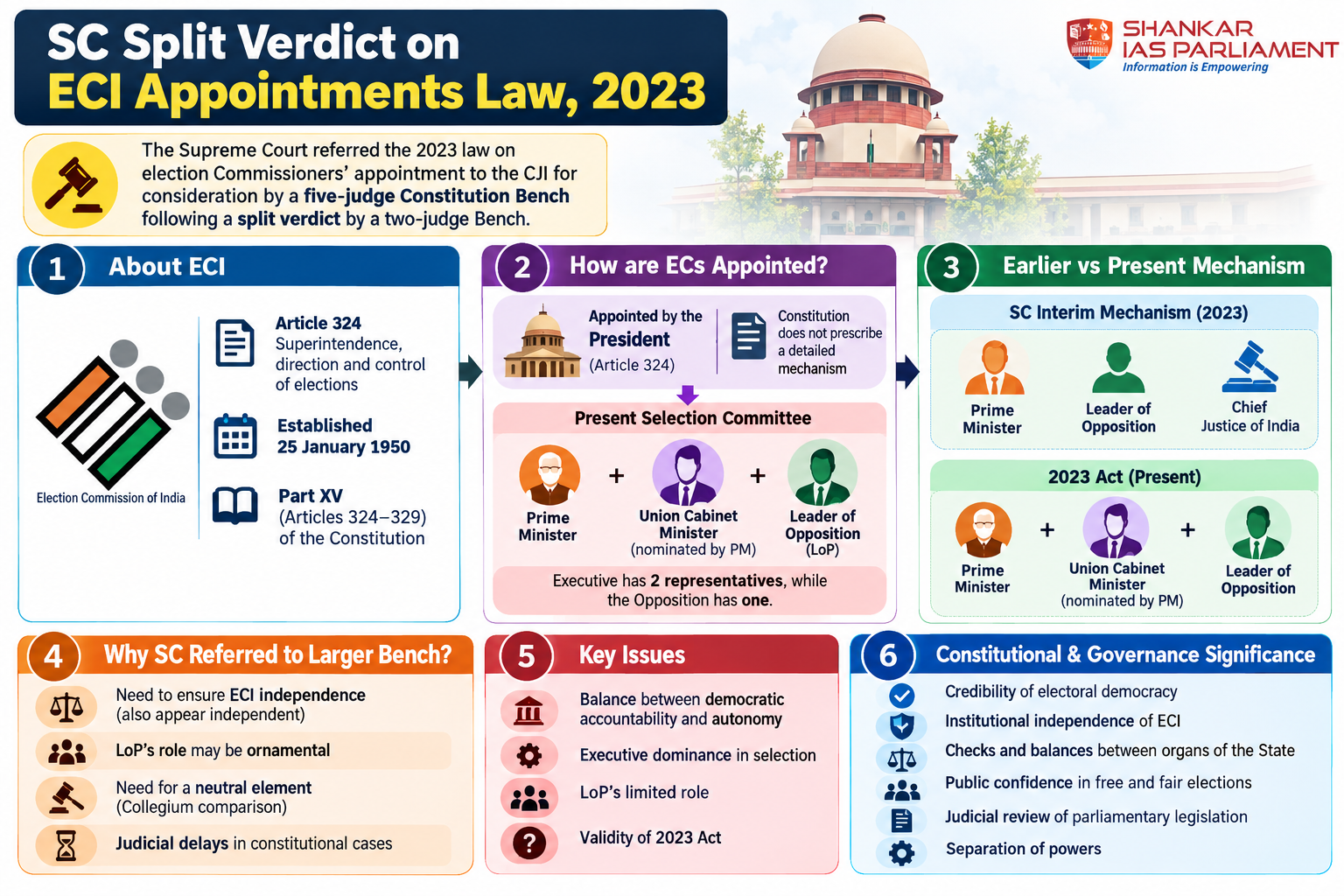
Why the Supreme Court did Refer it to Larger bench with CJI?
- ECI Independence – The ECI must not only be independent but also appear independent to maintain public trust.
- Leader of opposition’s Role – With the PM and his nominated Minister forming two of three members, the LoP’s role may become largely ornamental.
- Collegium Comparison – It questioned the government’s comparison with the judicial collegium and stressed the need for a neutral element in EC appointments.
- Judicial Delays – Both opinions flagged delays in constitutional cases and suggested faster Constitution Bench hearings.
What is its Constitutional and Governance Significance?
- Electoral democracy – The ECI is responsible for administering elections, making its institutional credibility fundamental to representative democracy.
- Constitutional independence – It may clarify Parliament's power to prescribe an appointment mechanism is subject to constitutional requirements of institutional independence.
- Checks and balances – The dispute highlights the importance of preventing excessive concentration of appointment power within one organ of the State.
- Public confidence – Free and fair elections require not only actual impartiality but also public confidence that electoral institutions are impartial.
- Judicial review of parliamentary legislation – The Constitution Bench ruling could clarify the extent to which the judiciary can examine Parliament's design of appointments.
- Separation of powers – The case raises the broader question of how the legislature, executive and judiciary should participate in appointments to institutions that are expected to function independently of all three.
What could be done?
- A robust appointment mechanism for Election Commissioners should seek to ensure:
- Institutional independence of the ECI.
- Broad-based participation in the selection process.
- A meaningful role for both government and Opposition.
- Transparency and clearly defined eligibility criteria.
- Greater public confidence in the appointment process.
- Timely adjudication of major constitutional questions.
- A balance between democratic accountability and functional autonomy.
What lies ahead?
- The Constitution Bench will examine the balance between Parliament’s power, executive role and ECI independence.
- The focus will be on ensuring electoral credibility, institutional autonomy and public confidence.
- The verdict may shape the future appointment process of Election Commissioners.
Reference
- The Indian Express| EC appointment law
- The Indian Express| Why 2023 Election Commissioner appointment law controversial?



