Why in News?
The leaders of the 11-member BRICS bloc adopted the New Delhi Declaration.
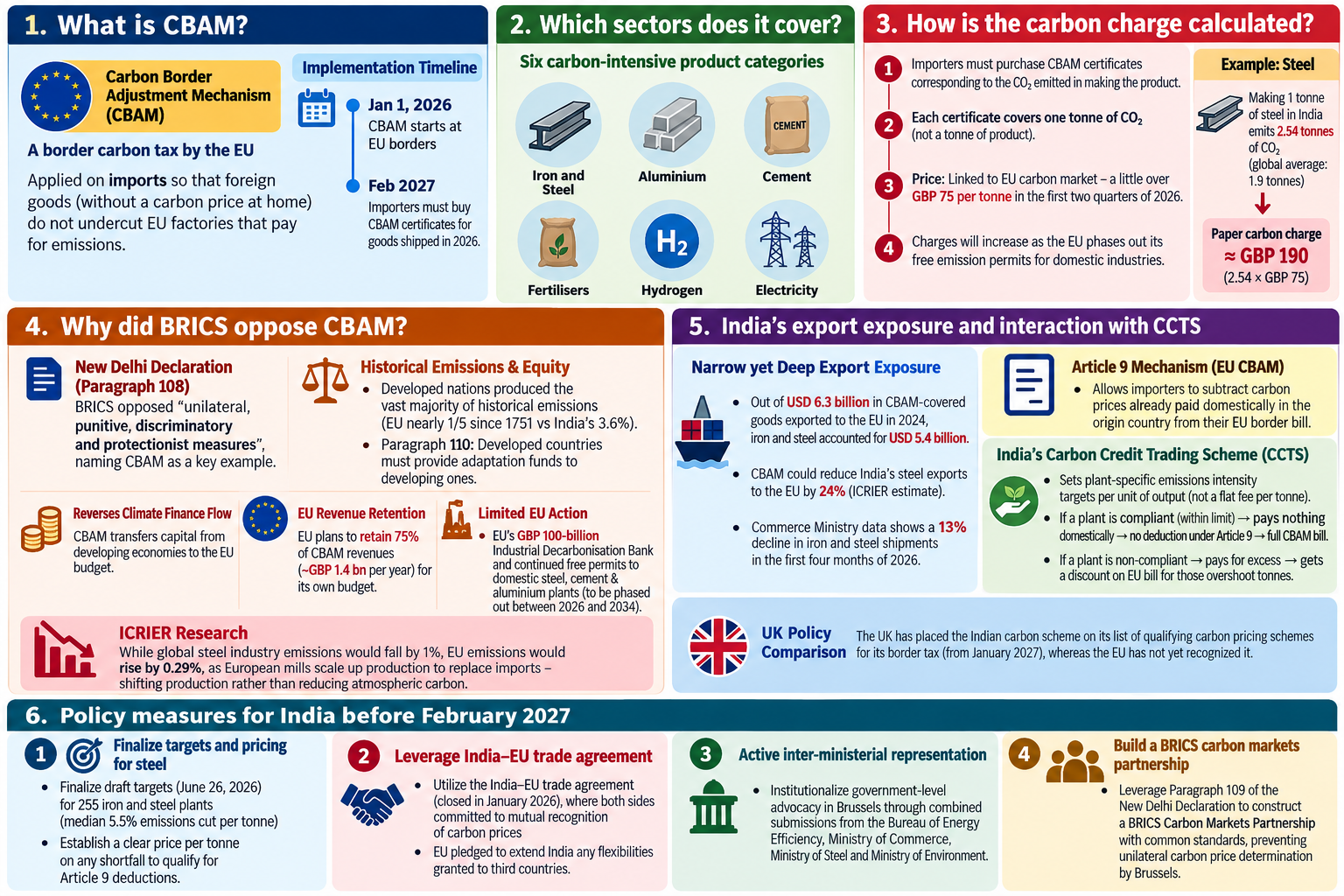
What is CBAM, which sectors does it cover, and how is the carbon charge calculated?
- CBAM – A border carbon tax by the EU.
- Applied on imports so foreign goods (without carbon price at home) don’t undercut EU factories that pay for emissions.
- Implementation Timeline – Starts Jan 1, 2026 at EU borders.
- Importers must buy certificates from Feb 2027 for goods shipped in 2026.
- Sectoral Coverage – Covers six carbon-intensive product categories – Iron And Steel, Aluminium, Cement, Fertilisers, Hydrogen, And Electricity.
- Pricing and Certificate Mechanism –
- Importers must purchase CBAM certificates corresponding to the carbon dioxide released in making the product.
- Each certificate covers one tonne of carbon dioxide, not a tonne of the product.
- Certificates track the EU carbon market and cost a little over GBP 75 per tonne in the first two quarters of 2026.
- Eg : Making a tonne of steel in India emits 2.54 tonnes of CO2
 (against a global average of 1.9 tonnes), meaning a tonne of Indian steel carries a paper carbon charge of roughly GBP 190.
- Charges will increase as the EU progressively withdraws free emission permits from its own mills.
Why did the BRICS bloc oppose CBAM in the New Delhi Declaration?
- Paragraph 108 Position – The 11-member BRICS bloc adopted the New Delhi Declaration, explicitly opposing "unilateral, punitive, discriminatory and protectionist measures" naming CBAM as a key example.
- Inversion of Climate Finance and Equity –
- Developed nations produced the vast majority of historical emissions (e.g., EU member states produced nearly a fifth of CO2 emitted since 1751, compared to India's 3.6%).
- Paragraph 110 of the declaration reiterates that developed countries must provide adaptation funds to developing ones.
- CBAM reverses this flow, transferring capital from developing economies to the EU budget.
- Revenue Retention by the EU – Brussels plans to retain 75% of CBAM revenues (about GBP 1.4 billion a year) for the EU budget.
- Simultaneously, the EU has proposed a GBP 100-billion Industrial Decarbonisation Bank and continues to provide free emission permits to its domestic steel, cement, and aluminium plants (to be phased out between 2026 and 2034).
- ICRIER Research – It demonstrates that while global steel industry emissions would fall by 1%, EU emissions would actually rise by 0.29% as European mills scale up production to replace imports, shifting production rather than reducing atmospheric carbon.
What is India's export exposure, and how does its Carbon Credit Trading Scheme (CCTS) interact with Article 9 of CBAM?
- Narrow yet Deep Export Exposure – Out of USD 6.3 billion in CBAM-covered goods India exported to the EU in 2024, iron and steel accounted for USD 5.4 billion.
- ICRIER estimates CBAM could reduce India’s steel exports to the EU by 24% (Commerce Ministry data already shows a 13% decline in iron and steel shipments during the first four months of 2026).
- The Article 9 Mechanism – Article 9 of the EU CBAM regulation allows importers to subtract carbon prices already paid domestically in the origin country from their EU border bill.
- The Structural Paradox of India's CCTS –
- Unlike the EU model (which charges a flat fee per emitted tonne), India's Carbon Credit Trading Scheme (CCTS) sets plant-specific emissions intensity targets per unit of output.
- A compliant plant that stays within its intensity limit pays nothing domestically, leaving zero payment for the European importer to subtract under Article 9, forcing it to pay the full CBAM bill in Europe.
- Conversely, a non-compliant plant that exceeds its limit pays for the excess in India, receiving a discount on its European bill for those overshot tonnes.
- Comparison with UK Policy – The UK treasury placed the Indian carbon scheme on its list of qualifying carbon pricing schemes for its own border tax starting January 2027, whereas the EU has not yet recognized it.
What policy measures can India execute before February 2027 to mitigate the negative impact?
- Target Setting and Pricing for Steel – Finalize draft targets issued by the Environment Ministry on June 26, 2026, for 255 iron and steel plants (which outline a median emissions cut of 5.5% per tonne) and establish a clear price per tonne on any shortfall to qualify for Article 9 deductions.
- Leveraging Bilateral Trade Agreements – Utilize the India-EU trade agreement closed in January 2026, where both sides committed to mutual recognition of carbon prices and the EU pledged to extend India any flexibilities granted to third countries.
- Active Inter-Ministerial Institutional Representation – Institutionalize government-level advocacy in Brussels through combined submissions from the Bureau of Energy Efficiency, Ministry of Commerce, Ministry of Steel, and Ministry of Environment, matching the high-level participation of countries like Brazil.
- Building a BRICS Carbon Markets Partnership – Leverage Paragraph 109 of the New Delhi Declaration to construct a BRICS Carbon Markets Partnership with common standards, preventing unilateral carbon price determination by Brussels.
Reference
Indian Express | CBAM



