Prelims: Current events of national and international importance | Polity
Why in News?
A Supreme Court Bench of Justice Dipankar Datta and Justice Satish Chandra Sharma delivered a split verdict on referring challenges to the CEC & EC Appointment Act, 2023.
Background of the Legal Challenge
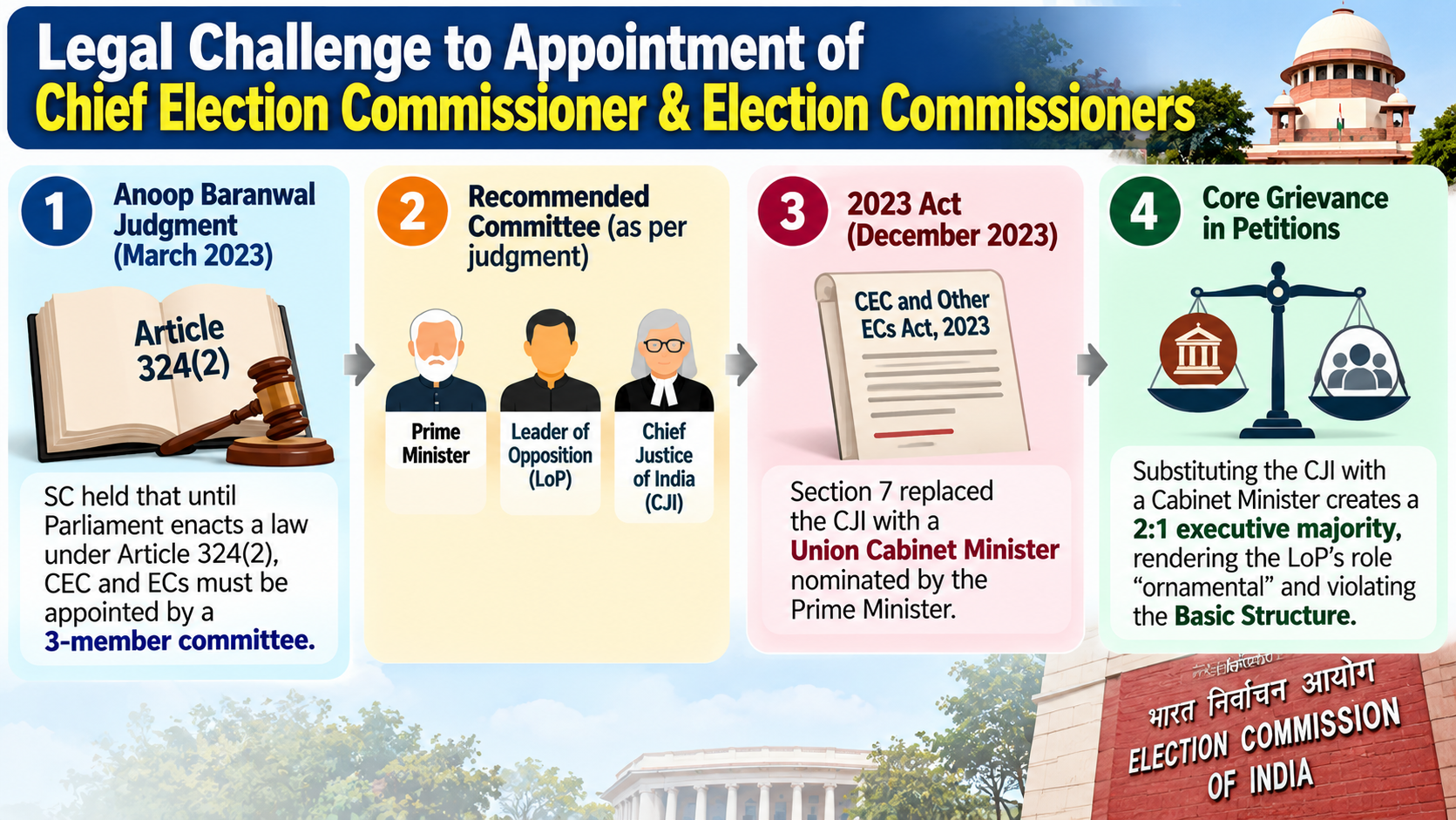
- The Anoop Baranwal Precedent (March 2023) - A 5-judge Constitution Bench ruled that until Parliament enacted a law under Article 324(2).
- According to the law the Chief Election Commissioner (CEC) and Election Commissioners (ECs) must be appointed by the President on the advice of a 3-member committee comprising
- The Prime Minister of India.
- The Leader of the Opposition (LoP) in Lok Sabha (or leader of the largest opposition party).
- The Chief Justice of India (CJI).
- Enactment of the 2023 Act - In December 2023, Parliament enacted the CEC and Other ECs Act, 2023.
- Section 7 of the Act replaced the CJI on the Selection Committee with a Union Cabinet Minister nominated by the Prime Minister.
- Core Grievance in Petitions - Petitioners argued that substituting the CJI with a Cabinet Minister creates a permanent 2:1 executive majority (PM + Cabinet Minister vs. LoP).
- It renderes the LoP's presence "ornamental" and violating the Basic Structure doctrine (specifically, free and fair elections and institutional independence under Article 324).
Divergent Views in the Split Verdict
Opinion of Justice Dipankar Datta (Against Reference)
- Settled Constitutional Principles - Held that a reference under Article 145(3) was unnecessary because the core constitutional principles governing the independence of the ECI were already authoritatively settled in the Anoop Baranwal (2023) judgment.
- Executive Dominance - Observed that an appointment panel with a 2:1 executive advantage fails the "perception test" of neutrality.
- Rule of Law - Reaffirmed that "ours is a government of laws, not of men," and insulating the ECI from exclusive executive control is vital for democratic legitimacy.
Opinion of Justice Satish Chandra Sharma (In Favor of Reference)
- Substantial Question of Law - Held that whether Parliament can exclude a neutral constitutional functionary (CJI) and replace them with an executive nominee involves a substantial question as to the interpretation of the Constitution.
- Article 145(3) Mandate - Emphasized that under Article 145(3) of the Constitution, any case involving a substantial question of constitutional law must be determined by a bench of not less than 5 judges.
Key Institutional Directives
- Bypassing the 3-Judge Step - Standard procedure dictates that a split 2-judge bench refers the matter to a 3-judge bench.
- However, both judges unanimously agreed that sending the case to a 3-judge bench merely to decide whether to refer it to a 5-judge bench would cause procedural friction.
- They referred the matter directly to the CJI for a Constitution Bench.
- Concern Over Pendency of References - The bench expressed grave concern over constitutional references remaining unresolved for 5 to 20 years, acknowledging the petitioners' fears regarding prolonged litigation.
- Suggestion for a Permanent Bench - Requested the CJI to consider establishing a permanent 5-judge Constitution Bench within the Supreme Court to hear and dispose of substantial constitutional interpretations expeditiously.
Constitutional Significance
|
Article 324(2)
|
Highlights the delicate balance between Parliament's power to legislate the ground rules for ECI appointments and the judicial enforcement of independence.
|
|
Basic Structure Doctrine
|
Tests whether executive supremacy in appointing electoral regulators undermines "Free and Fair Elections"—a recognized core feature of the Indian Constitution.
|
|
Article 145(3)
|
Re-examines the threshold for when a case presents a "substantial question of law" requiring a Constitution Bench versus a regular Division Bench.
|
Reference
SCO Observer | SC delivers split verdict



