Prelims: Current events of national and international importance | Defence
Why in News?
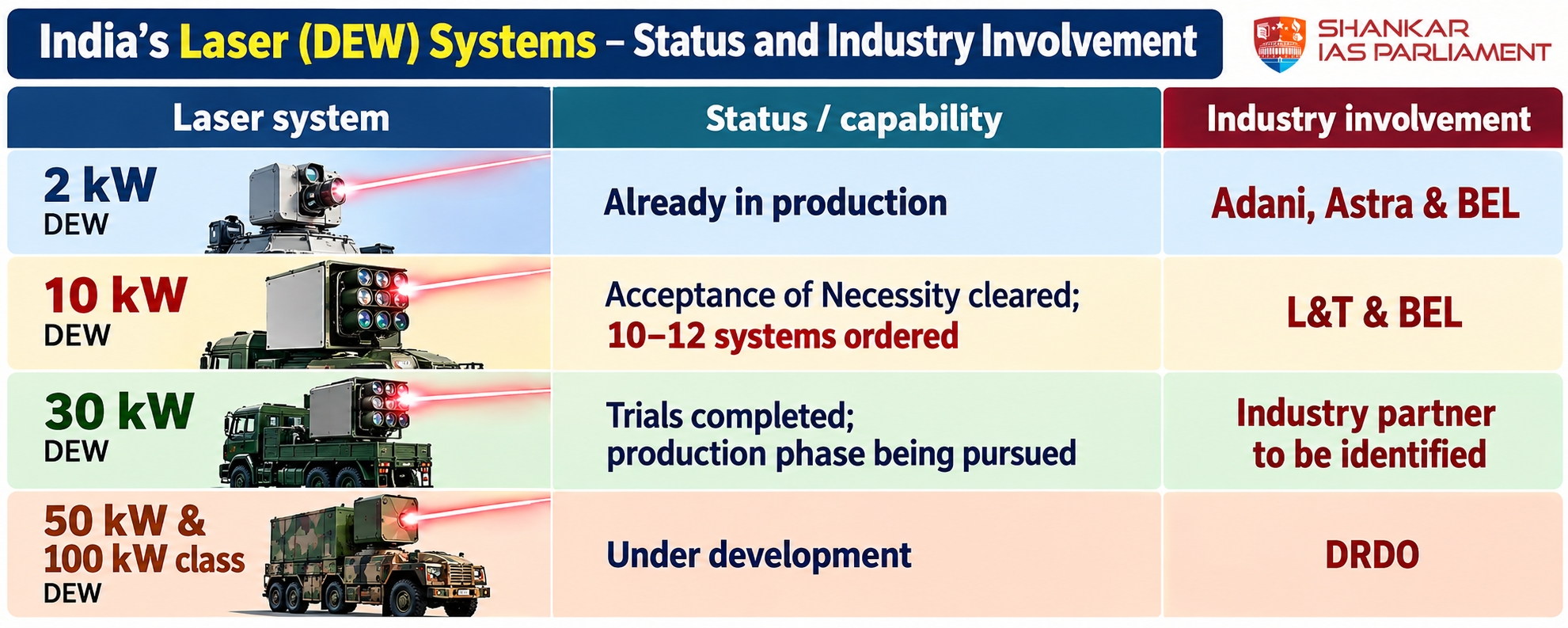
Recently, the DRDO is transitioning its indigenous 30 kW-class laser-based Directed-Energy Weapon (DEW) from the trial phase to production.
India’s 30 kW Laser System
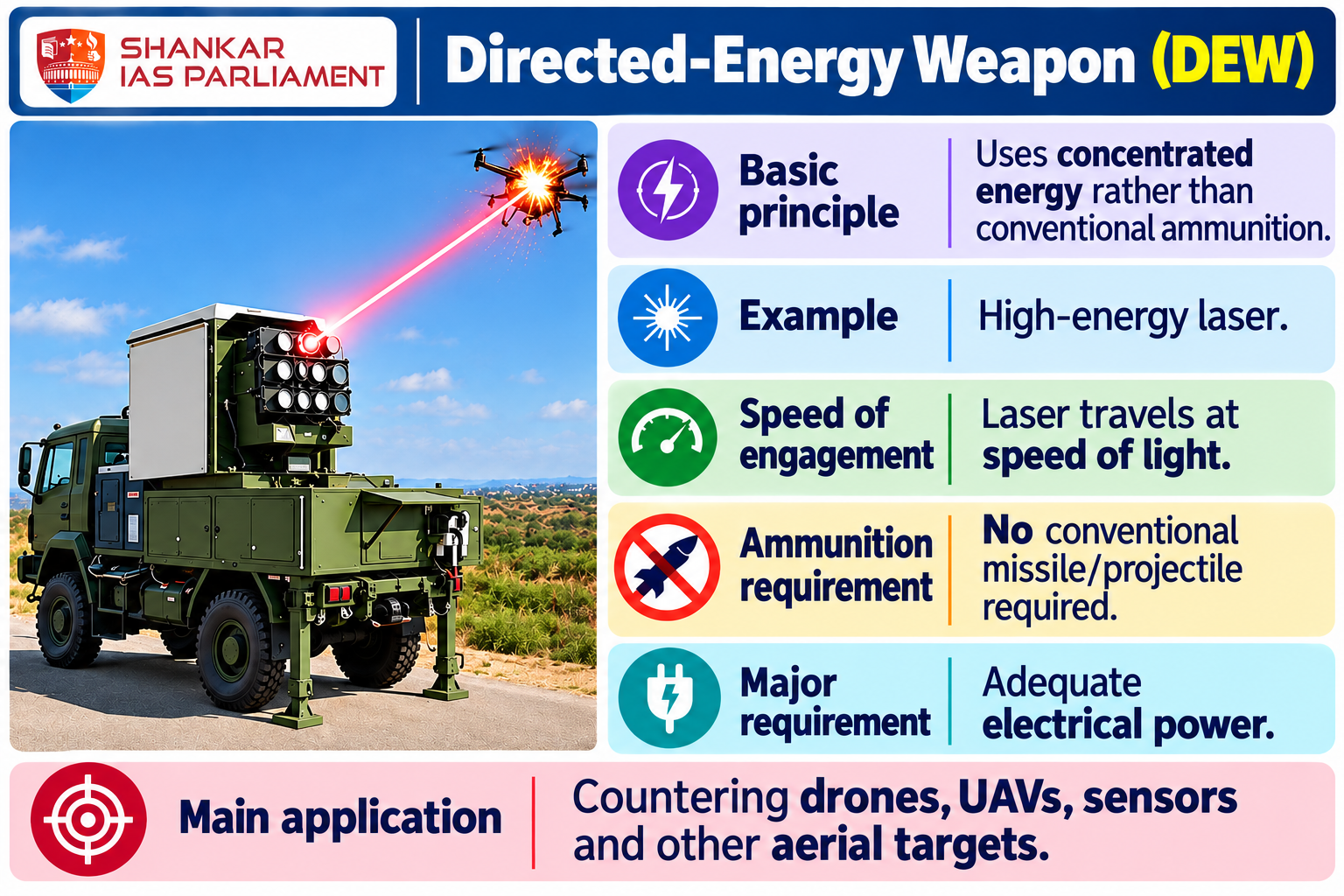
- Platform – Mounted on a truck chassis.
- Power Output – 30 kW class.
- Intended Targets
- Drone swarms
- Fixed-wing unmanned aerial vehicles (UAVs)
- Surveillance sensors
- Effective Range – Up to 5 kilometers.
- Status – Technology successfully demonstrated following final trials.
- Next Step – Transition to production in collaboration with an industry partner.
- Advantages
- Laser systems enable engagement of low-cost drones without incurring conventional interceptor expenditures.
- It provides near-instantaneous target engagement.
- After initial deployment, the cost per shot is potentially very low.
- There is no requirement for conventional ammunition storage.
- These are suitable for countering drone swarms.
- It can provide repeated engagements, provided that adequate power is available.
Conventional Challenge - High-cost interceptor missiles are often deployed against relatively inexpensive drones.
|
Mission Sudarshan Chakra
|
- The 30kW directed-energy weapon (DEW) is a component of India's comprehensive initiative to establish a layered air-defence architecture.
- Directed-energy weapons are designed to complement existing air-defence systems rather than serve as their replacements.
A layered air-defence system consists of multiple integrated components.
These components include missiles, guns, electronic warfare systems, and directed-energy weapons.
|
|
Distinction Between Directed-Energy Weapons and Electronic Warfare
|
- A directed-energy weapon (DEW) physically damages or disables a target by employing concentrated energy, such as a laser beam.
- Electronic warfare utilizes the electromagnetic spectrum to detect, disrupt, deceive, or deny the operation of an adversary's electronic systems.
|
Reference
TOI | Directed-Energy Weapons (DEWs)



