- Introduction – Deen Dayal Upadhyaya Grameen Kaushalya Yojana (DDU-GKY) 2.0 is an upgraded, outcome-oriented placement-linked skill training scheme under the National Rural Livelihoods Mission aimed at equipping rural youth with industry-aligned skills and sustainable employment opportunities.
- Role in Society – Serves as a central pillar for inclusive and sustainable rural transformation by unlocking India's demographic potential (projected youth population of nearly 345 million by 2036) and providing structured pathways from skilling to durable livelihoods.
- Modern Dynamics / Evolution – Originally launched on 25 September 2014, the scheme marked its 12th anniversary with the notification of the revised DDU-GKY 2.0 Guidelines in May 2025.
- The 2.0 iteration shifts focus towards end-to-end sustainable employment, digital governance, extended placement durations, and post-placement tracking.
Key Pillars and Framework of DDU-GKY 2.0
- Social Inclusion Mandate – Mandates affirmative coverage for poor rural youth aged 15–35 years, with mandatory quotas for Scheduled Castes/Scheduled Tribes (50%), women (33%), and persons with disabilities (5%).
- Standardised Training Structure –
- Duration and Components – Maintains a 576-hour minimum framework. A standard three-month course comprises 396 hours of domain technical training and 180 hours of mandatory non-domain training.
- Non-Domain Modules – Standardised across English Communication (60 hours), Employability and Life Skills (60 hours), Computer and Digital Literacy (30 hours), and Entrepreneurship (30 hours).
- Extended Placement Standards – Shifts the minimum required placement duration from three months to six months, covering continuous/non-continuous wage employment, self-employment, and gig employment.
- Sectors Covered – Multi-sectoral reach based on industry demand, including aerospace and aviation, agriculture, beauty and wellness, green jobs, healthcare, and textiles.
Retention Support, Migration, and Employer Connectivity
- Financial and Upskilling Support –
- Post-Placement Allowance – Placed candidates receive financial support totaling Rs.7,620 (paid at Rs.1,270 per month for six months).
- Retention Support – An additional retention incentive of Rs.5,000 is awarded to candidates who remain employed for 365 days (allowing a maximum break of 60 days).
- Career Progression – Provides upskilling and reskilling opportunities after 12 months of placement.
- Migration Support Centres (MSCs) – Established by State Rural Livelihoods Missions (SRLMs) in high-concentration candidate areas within home and destination states. Annual funding per MSC has been increased from Rs.10 lakh to Rs.30 lakh to deliver accommodation assistance, local administrative coordination, counselling, and alumni networking.
- Job Melas – Organized at Block and Gram Panchayat (GP) levels with funding up to Rs.1 lakh (block-level, target 200 placements) and Rs.50,000 (GP-level, target 100 placements).
- Uses the Kaushal Panjee platform to track placement outcomes for one year.
Targeted Interventions for Special Regions
- Roshni Initiative – Residential skill training dedicated to Left-Wing Extremism (LWE)-affected districts and Aspirational Districts, with a 40% mandatory coverage target for women candidates.
- Himayat Scheme – A 100% centrally funded special programme implemented in Jammu and Kashmir and Ladakh covering rural and urban youth across BPL/APL categories for wage, self, and gig employment.
- North Eastern Region (NER) – Earmarks 10% of the total DDU-GKY allocation specifically for North-Eastern States to address unique topographic and socio-cultural demands.
- Hard-to-Reach Areas – Grants a Special Area Allowance providing Project Implementing Agencies (PIAs) an additional 10% of the Base Training Cost per candidate.
Technology-Driven Lifecycle and Monitoring
- End-to-End Digital Ecosystem – Integrates a comprehensive platform covering PIA onboarding, project evaluation, candidate tracking, digital attendance, assessments, and financial management.
Key Technological Features –
- Biometric face authentication for candidate attendance and assessment verification.
- Integration with Skill India Digital Hub for automated course details validation.
- Real-time monitoring via advanced dashboards and automated workflows for Project Registration Numbers (PRNs) and grievance redressal.
- Public Candidate Portal to search training opportunities and review PIA performance ratings.
Complementary Rural Entrepreneurship – RSETIs
- Focus and Target – Rural Self-Employment Training Institutes (RSETIs) complement DDU-GKY’s wage-employment model by providing free residential training and handholding support to rural unemployed youth aged 18–50 years from BPL and DAY-NRLM households.
- Settlement Efficiency – Offers dedicated district-level infrastructure to promote self-employment. Out of all settled candidates, approximately 94% establish sustainable self-employment ventures, while 6% enter wage employment.
|
Key Achievements and Milestones
|
|
Metric / Parameter
|
DDU-GKY / DDU-GKY 2.0 Performance
|
RSETI Performance
|
|
Active Infrastructure
|
749 approved projects; 760 active training centres; 455+ PIAs
|
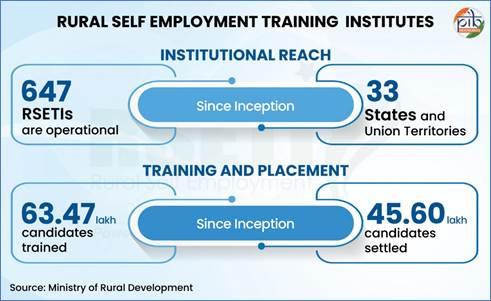
647 operational institutes across 634 districts (in 33 States/UTs)
|
|
Total Candidates Trained
|
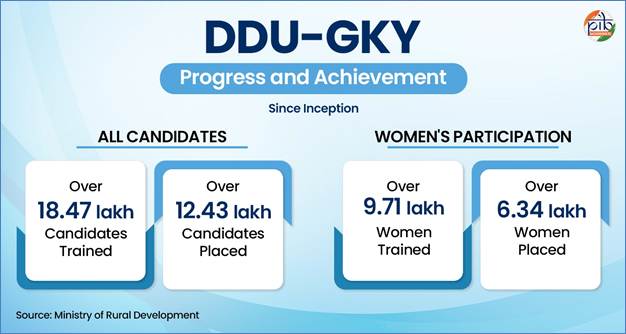
>18.47 lakh candidates (since 2014–15)
|
63.47 lakh candidates (since inception in 2009)
|
|
Total Placed / Settled
|
>12.43 lakh candidates placed
|
45.60 lakh candidates settled
|
|
Women Beneficiaries
|
>9.71 lakh trained; >6.34 lakh placed
|
Included across BPL/DAY-NRLM cohorts
|
|
Budgetary Allocation
|
Rs.750 crore allocated in Union Budget 2026–27
|
Central and State infrastructure funding frameworks
|
Early Rollout Champions (2025–26) –
- Goa – Pioneer state in creating initial training batches under DDU-GKY 2.0.
- Andhra Pradesh – Commenced training for over 12,000 candidates within three months.
- Jammu and Kashmir – Allocated 100% of targets and commenced training for 91% of its target allocation.
Contemporary Challenges
- Migration Pressures – Managing the transition, urban integration, and social security of rural youth migrating long distances for employment.
- Employment Retention – Preventing post-placement dropouts due to workplace adjustments, low initial wages, or geographic dislocation.
- Dynamic Industry Requirements – Ensuring curriculum and equipment in training centers continuously align with rapidly shifting technological and market demands.
Way Forward
- Strengthening Post-Placement Networks – Expanding the operational reach and funding of Migration Support Centres across major industrial corridors.
- Deepening Industry Collaboration – Encouraging direct partnerships between PIAs, corporate entities, and local employers to streamline job placement and career progression.
- Scaling Self-Employment Synergy – Harnessing RSETIs alongside DDU-GKY 2.0 to offer hybrid models of wage-employment and micro-entrepreneurship for rural youth.
Conclusion
- DDU-GKY 2.0 transitions rural skilling from basic training metrics to an integrated, sustainable, and technology-backed employment lifecycle.
- By prioritizing social inclusion, migration support, career progression, and self-reliance, the initiative serves as a cornerstone for building a skilled workforce that directly advances the national vision of Viksit Bharat @2047.
Reference
PIB



