Why in News?
The developing El Niño is forecast to become a very strong event by early 2027, potentially intensifying global heatwaves, rainfall extremes, droughts, agricultural losses and food insecurity.
What is El Nino?
-
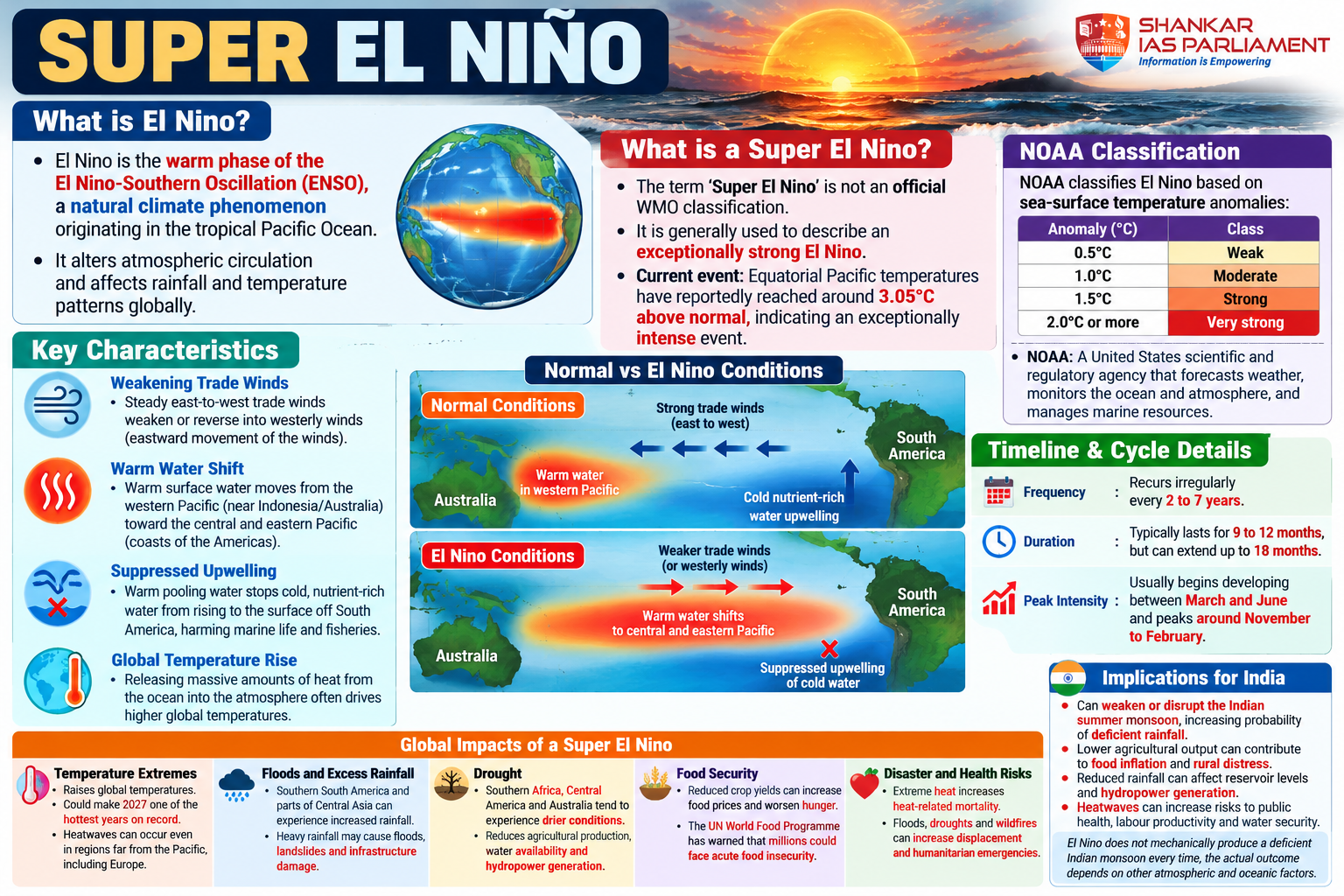
El Nino – It is the warm phase of the El Nino-Southern Oscillation (ENSO), a natural climate phenomenon originating in the tropical Pacific Ocean.
- This alters atmospheric circulation and affects rainfall and temperature patterns globally.
- Characteristics –
- Weakening Trade Winds – Steady east-to-west trade winds weaken or reverse into westerly winds (Eastward movement of the winds)
- Warm Water Shift – Warm surface water moves from the western Pacific (near Indonesia/Australia) toward the central and eastern Pacific (coasts of the Americas).
- Suppressed Upwelling – Warm pooling water stops cold, nutrient-rich water from rising to the surface off South America, harming marine life and fisheries.
- Global Temperature Rise – Releasing massive amounts of heat from the ocean into the atmosphere often drives higher global temperatures.
- Timeline & Cycle Details –
- Frequency – Irregularly every 2 to 7 years (in general).
- Duration – Typically lasts for 9 to 12 months, but can extend up to 18 months.
- Peak Intensity – Usually begins developing between March and June and peaks around November to February
La Nina (Cool Phase), Occurs less frequently than El Niño. However, individual La Niña events can last longer, often lasting 1 to 3 years
- ‘Super El Nino’ – The term ‘Super El Nino’ is not an official WMO classification.
- It is generally used to describe an exceptionally strong El Nino.
National Oceanic and Atmospheric Administration (NOAA) is a United States scientific and regulatory agency that forecasts weather, monitors the ocean and atmosphere, and manages marine resources.
- NOAA classifies El Nino based on sea-surface temperature anomalies:
- 0.5°C: Weak
- 1.0°C: Moderate
- 1.5°C: Strong
- 2.0°C or more: Very strong
- Current event – Equatorial Pacific temperatures have reportedly reached around 3.05°C above normal, indicating an exceptionally intense event.
What are the Global Impacts of a Super El Nino?
- Temperature Extremes – El Nino generally raises global temperatures.
- The combination with global warming could make 2027 one of the hottest years on record.
- Heatwaves can occur even in regions far from the Pacific, including Europe.
- Floods and Excess Rainfall – Southern South America and parts of Central Asia can experience increased rainfall.
- Heavy rainfall may cause floods, landslides and infrastructure damage.
- Drought – Southern Africa, Central America and Australia tend to experience drier conditions.
- Drought can reduce agricultural production, water availability and hydropower generation.
- Food Security – Reduced crop yields can increase food prices and worsen hunger.
- The UN World Food Programme has warned that millions could face acute food insecurity as the event develops.
- Disaster and Health Risks – Extreme heat increases heat-related mortality, particularly among vulnerable populations and outdoor workers.
- Floods, droughts and wildfires can increase displacement and humanitarian emergencies.
- Implications for India – India is particularly vulnerable because of its dependence on the South Asian monsoon and climate-sensitive agriculture.
- El Nino can weaken or disrupt the Indian summer monsoon, increasing the probability of deficient rainfall.
- Lower agricultural output can contribute to food inflation and rural distress.
- Reduced rainfall can affect reservoir levels and hydropower generation.
- Heatwaves can increase risks to public health, labour productivity and water security.
El Nino does not mechanically produce a deficient Indian monsoon every time, the actual outcome depends on other atmospheric and oceanic factors.
What is the Way Forward?
- Strengthening Climate Early Warnings – Improve forecasting systems for heatwaves, floods and droughts.
- Building Climate-Resilient Agriculture – Promote drought-resistant crops, efficient irrigation and crop diversification.
- Enhancing Water Security – Strengthen water-resource management and reservoir planning.
- Protecting Vulnerable Populations – Expand heat-action plans, cooling infrastructure and safeguards for outdoor workers.
- Deepening Global Climate Cooperation – Improve cooperation in climate forecasting, disaster preparedness and food security.
- Mainstreaming ENSO Forecasts – Integrate ENSO predictions into agricultural, energy and disaster-management planning.
What lies ahead?
- A very strong El Nino demonstrates how a natural climate variability event can interact with anthropogenic global warming to amplify weather extremes.
- For India, the challenge is not merely predicting El Nino but building resilience against its cascading impacts on monsoons, agriculture, water, food security, health and the economy.
- A combination of scientific forecasting, climate-resilient infrastructure and anticipatory disaster management is therefore essential.
Reference
DD News| Super El Nino



