Mains: GS III – Disaster management
Why in News?
Recently there has been a heavy landslide affecting significant parts of Keralam.
What is a Landslide?
- Definition – The National Disaster Management Authority (NDMA) defines a landslide as a wide variety of processes resulting in the downward and outward movement of slope-forming materials—including natural rock, soils, artificial fills, or combinations of these—under the direct influence of gravity.
- Main Types
- Falls – Rocks and debris break off a steep cliff or slope and drop straight down, bouncing or rolling as they hit the ground.
- Topples – Large blocks of rock or soil tilt forward over a pivot point near the bottom and fall away from the slope.
- Slides – A coherent mass of material moves down a slope along a clear breaking or slip surface.
- This includes rotational slides (moving along a curved surface) and translational slides (moving along a flat plane).
- Spreads – Fractured parts of a hard top layer stretch or move apart horizontally, usually because a weak layer underneath gives way.
- Flows – Mixed soil, rock, air, and water rush down like a liquid or thick fluid, often called mudflows or debris flows.
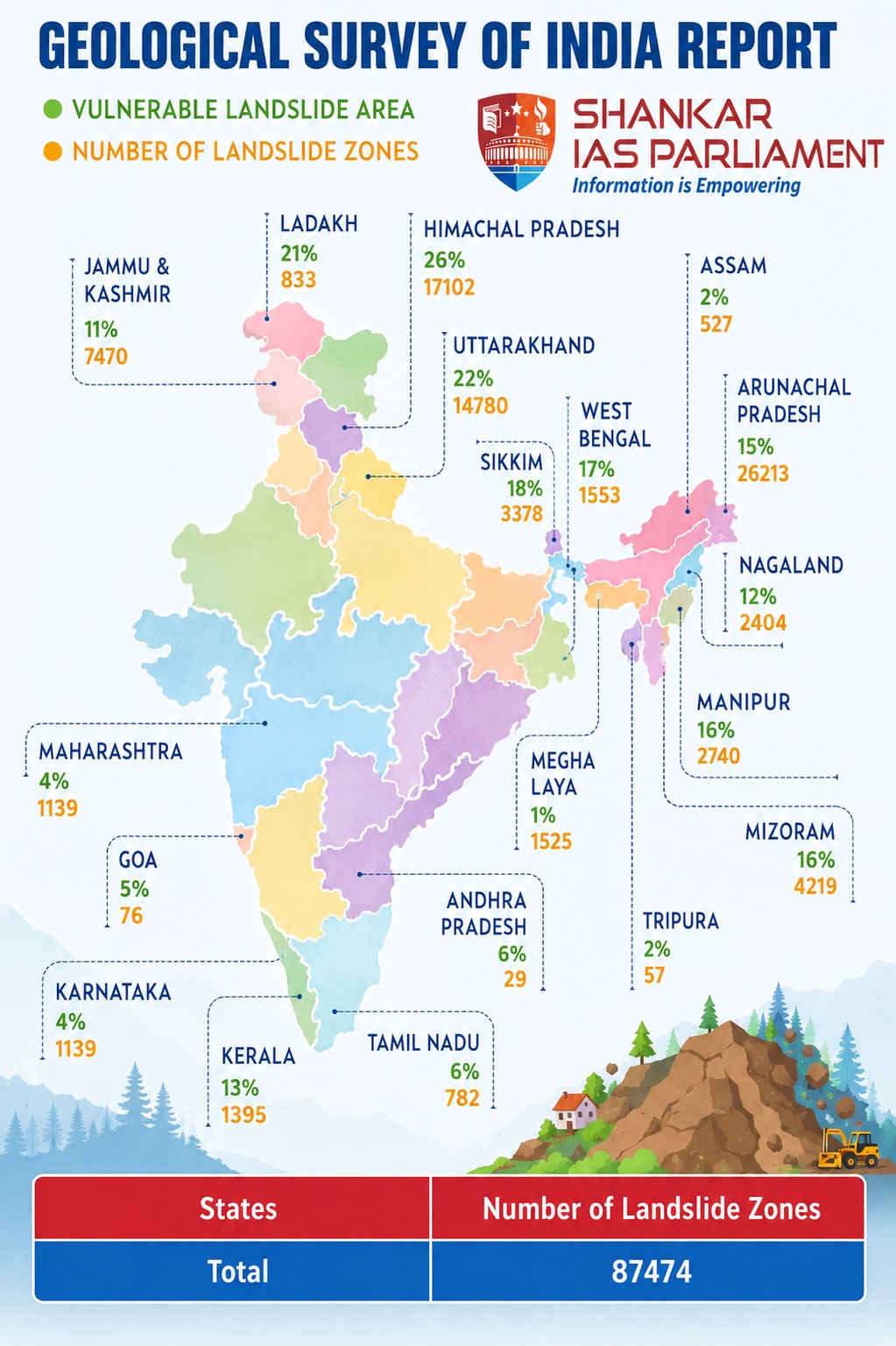
- Landslides Zones of India – India currently has 87,474 active landslide zones, spread across 179 districts in 19 states and union territories, a recent report released by the Geological Survey of India (GSI) has revealed.
- These danger-prone zones collectively cover about 4.2 lakh square kilometres, underscoring the scale of the challenge.
- Arunachal Pradesh ranks first with 26,213 landslide zones, followed by Himachal Pradesh with 17,102 zones across the nation.
- Uttarakhand stands third with 14,780 zones.
- Major Recent Landslides in India
- 2026(pathanamthitta, kerala)
- 2024 (Wayanad, Kerala)
- 2023 (Irshalwadi, Maharashtra)
- 2023 (Himachal Pradesh)
- 2022 (Noney, Manipur)
- 2021 (Kinnaur, Himachal Pradesh)
What are the causes of Landslides?
- Heavy Rain – Water makes soil heavy and slippery, which lowers the friction holding the dirt on the slope.
- Earthquakes – Shaking from the earth breaks rocks and shifts loose dirt on mountains.
- Volcanoes – Hot ash, melting snow, and lava flows from eruptions can start fast mudslides.
- Erosion – Rivers or ocean waves wash away the bottom part of a hill, leaving the top unsupported.
- Cutting Trees (Deforestation) – Tree roots hold the soil tightly together, removing trees makes the slope weak.
- Building and Mining – Digging into the sides of hills or using loud blasts shakes and weakens the ground structure
What are the impacts of Landslides?
- Human and Social Impacts
- Loss of life and injuries from falling rocks and moving mud.
- Displacement of local communities and families.
- Psychological trauma and stress for survivors.
- Disrupted access to schools, hospitals, and emergency services.
- Economic and Infrastructure Damage
- Blocked roads and railways that halt trade and travel.
- Destroyed utilities including power, gas, and water lines.
- Costly repairs for damaged buildings and public works.
- Loss of agricultural land and livestock for local farmers.
- Environmental Effects
- Soil erosion and permanent land degradation.
- Pollution of nearby streams and water bodies from heavy debris.
- Destruction of vegetation and local wildlife habitats
What could be done to reduce the impacts of Landslides?
- Land Use and Planning – Avoid constructing homes near steep hillsides, mountain ridges, or natural drainage channels.
- Review historical hazard information and local guidelines before purchasing land or starting new developments.
- Limit residential and commercial construction in areas identified as highly susceptible to landslides.
- Drainage and Water Management – Install effective surface and underground drainage systems, such as channels, pipes, and French drains, to reduce water accumulation in the soil.
- Ensure that roof gutters and runoff are directed away from unstable slopes.
- Regularly inspect and clear storm drains and weep holes to prevent water blockages.
- Vegetation and Bioengineering – Restore vegetation on bare or damaged slopes by planting native trees, shrubs, and deep-rooted grasses.
- Preserve existing tree roots, stumps, and ground cover, as they help stabilize the soil naturally.
- Use bioengineering methods, such as live crib walls and brush layering, to combine vegetation with structural support.
- Engineering and Structural Measures – Construct retaining or deflection walls to stabilize unstable slopes and prevent soil movement.
- Reshape steep slopes into stepped terraces to reduce their incline and improve stability.
- Strengthen loose soil and rock using geotechnical reinforcement techniques, including soil nails, rock bolts, geogrids, or grouting.
Reference
The Hindu| Landslides in Kerala



