Why in news?
Recently, the leaders of the world's Group of 20 (G20) wealthiest nations concluded a two-day summit on the Indonesian island of Bali.
What are the key takeaways from the G20 meeting in Bali?

- Xi Jinping’s emergence - The G20 meeting in Bali signalled Xi Jinping’s emergence from three years of self-imposed pandemic isolation.
- While the meeting Xi-Biden laid out major differences over Taiwan, trade restrictions and technology transfers, the two agreed to keep communications open and avoid confrontation.
- Russia's aggression – The leaders adopted a declaration deploring Russia's aggression in Ukraine in the strongest terms and demanding its unconditional withdrawal.
- Global economy - The emerging economies concern about the huge capital outflows if aggressive U.S. rate increases continue.
- The G20 economies agreed to pace interest rate rises carefully to avoid spillovers and warned of increased volatility in currency moves.
- Food security - The leaders promised to take coordinated action to address food security challenges and applauded the Black Sea grains initiative
- However, civil society groups criticised for the absence of concrete steps on hunger.
- Climate Change - G20 leaders agreed to pursue efforts to limit the global temperature increase to 1.5 degrees Celsius standing by the temperature goal from the 2015 Paris Agreement.
- Russia and the West - The divide between Russia and the West was evident again for a few hours after news of the Russian-built missile landing in Poland broke.
What is the significance for India?
- As India inherits the presidency of G20, with the US and European Union in one camp, Russia and China in another, it is faced with unique challenges and opportunities.
- Opportunities - India’s biggest advantage lies in the fact that it has a foot in both camps.
- India is about to take on the role of peace-maker on behalf of the South.
- India is also readying to push for global consensus on maintaining stable supply chains for food and fertilisers to build food security globally, and for stable supplies of energy.
- Another item on the agenda, might be to push the global North on its promise of climate finance and tech transfer to developing countries.
- The digital divide in the developing world indicates another likely big idea during India’s presidency.
- Challenges - The challenge lies in leveraging this middle ground over the next year.
- As G-20 president, India’s challenge would lie in taking all members along in follow-up meetings.
- India should build on its well-regarded position that ‘today’s era is not of war’ to nudge the world towards ending the war.
References
- The Indian Express│ Road to G20, Delhi 2023
- The Indian Express│ 5 takeaways from the summit in Bali
- The Hindu Businessline│ India needs to walk tightrope as G-20 helmsman
- Reuters│ Key takeaways from the G20 summit in Bali
Quick facts
G20
- The G20 is a strategic multilateral platform connecting the world’s major developed and emerging economies.
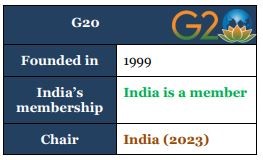
- Starting in 1999 as a meeting for the finance minister and central bank governors, the G20 has evolved into a yearly summit involving the Head of State and Government.
- The meetings are organised along two tracks, the “Finance Track” and the “Sherpa Track”.
- There are the Engagement Groups such as the Think 20 and the Business 20.
- Objective - To shore up the world’s economic and financial stability
- The G20 has no permanent secretariat.
- India is a member of the G20 and has assumed the current Presidency.
- India theme for its presidency is “One Earth, One Family, One Future” along with the official symbol of the lotus.
- Together, the G20 members represent more than 80% of world GDP, 75% of international trade and 60% of the world population.
- Troika, which comprises the past, present, and future presidents now includes Indonesia, India, and Brazil.