Why in news?
The trade data mismatch of India and China which is attributed to ‘under-invoicing’ by Indian importers for the imports originating from China, has attracted wide media coverage.
How about the picture of bilateral trade between India and China?
- Trade ties - Trade ties began to boom since the early 2000s driven largely by India’s imports of Chinese machinery and other equipment.
- In 2008, China became India’s largest trading partner.
- Total bilateral trade - The total bilateral trade registered a 14.6% increase compared to 2021, amidst the military standoff in eastern Ladakh.
- India and China bilateral trade continued to boom, crossing 100 billion dollars for the second year in 2022.
- Major imports - India’s biggest imports in 2021 were electrical and mechanical machinery, chemicals used in industrial production, active pharmaceutical ingredients and auto components.
- India also imported medical supplies during the pandemic.
- Trade deficit - China’s exports increased while India witnessed a decreased in exports leading to a trade deficit of over 75 billion dollars.
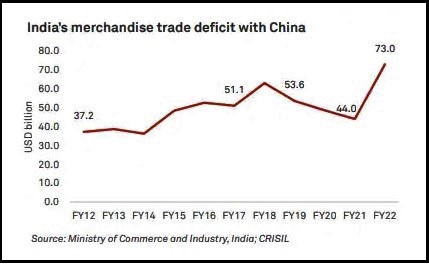
What about the trade data mismatch?
- China reported its exports to India over 103 billion dollars while India claims the Chinese imports at 92 billion dollars, hence a mismatch of 12 billion dollars.
- This reflects significant asymmetries in international trade statistics.
- Impact - The discrepancies in international trade statistics can result in ill-informed policy decisions.
- Under-invoicing is one of the reasons for trade data anomalies.
What reasons have been attributed for trade data mismatch?
- Diversion of goods - Re-routing or re-exporting of goods imported from China generally do not reflect in India but Chinese Trade Statistics record these as exports to India.
- This leads to trade data asymmetries.
- Some of the trading models that re-routes or re-exports goods to another country includes
- Merchanting trade transactions
- Bill to-ship to model
- Switch-bill of lading
- High Sea Sale (HSS) transactions
- Free Trade & Warehousing Zones - Some Indian trading firms buy bulk goods from China and maintain inventory at FTWZ locations and sell them in small quantities at higher profit margins.
- Chinese Statistics will record it as exports, but for India it is not imports as the goods are kept at a FTWZ, a foreign territory, as defined under the SEZ Act, 2005.
- Record maintenance - The mismatch in trade statistics also happens due to maintenance of records of export statistics and that of import statistics records.
- Inconsistent attribution of trade partners - A country may record statistics on goods destined to claimed territories as ‘others’ instead of reporting it as an exports to an actual country.
- National differences - There can be national differences on reporting of underlying records i.e. statistical norms and standards used to compile trade statistics.
References
- The Hindu Businessline│ Knots in India-China trade data
- The Economic Times│ India, China trade deficit climbs to $75 billion
- The Hindu│ China’s total trade surplus with India surpasses $1 trillion



