Prelims: Current events of national and international importance | Polity
Why in News?
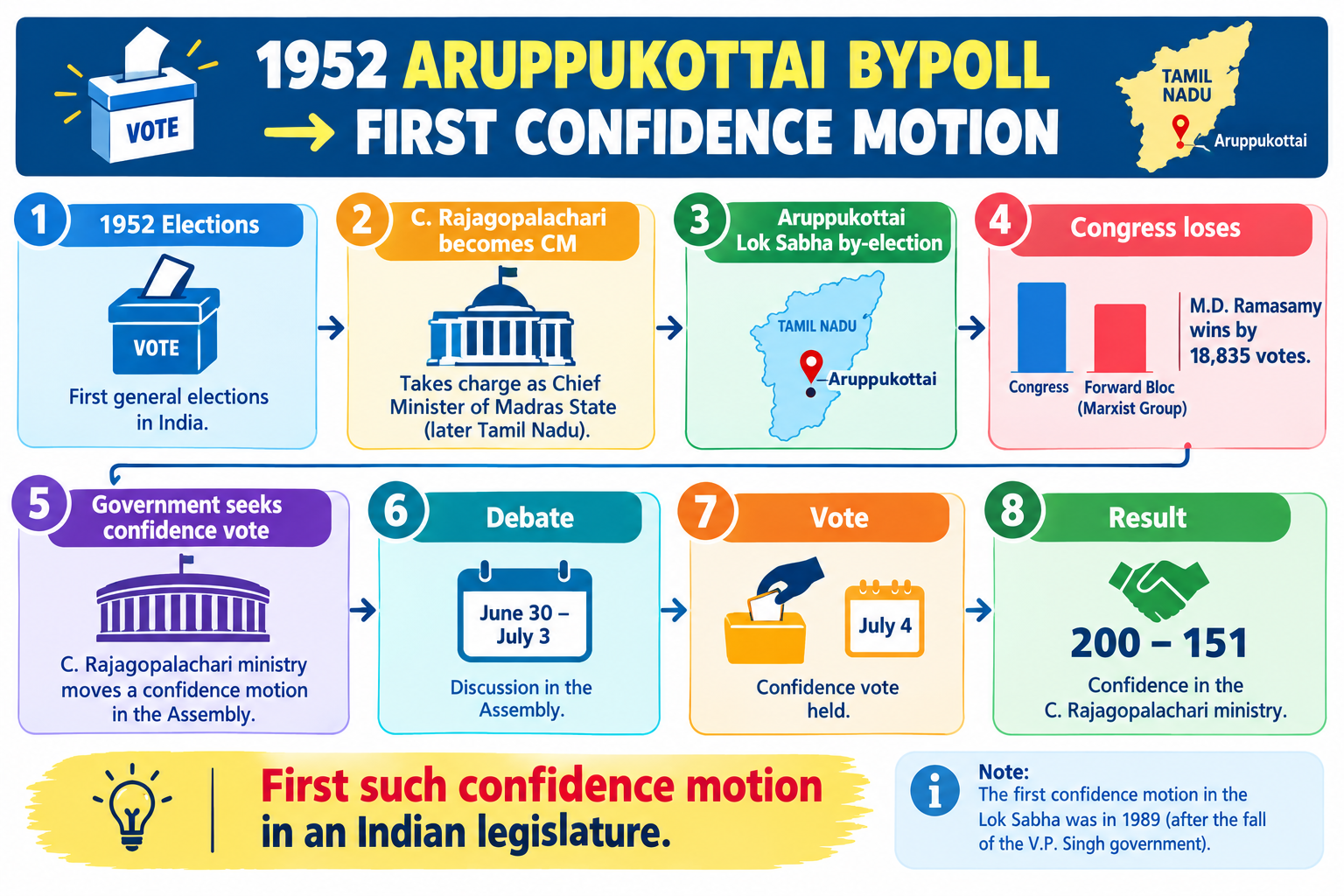
A 1952 Lok Sabha by-election in Aruppukottai, Tamil Nadu result prompted the then Madras Chief Minister C. Rajagopalachari (Rajaji) to seek a vote of confidence in the State Assembly.
Historical Context
- First General Elections - India held its first general elections in 1951–52. In Madras State, elections to the Lok Sabha and State Assembly were held simultaneously.
- Rajaji becomes Chief Minister- C. Rajagopalachari assumed office as Chief Minister on April 10, 1952.
- The Congress was the single largest party but did not have an outright majority in the Assembly, requiring support from other groups.
- Aruppukottai bypoll - The Lok Sabha seat became vacant following the resignation of U. Muthuramalinga Thevar, a prominent Forward Bloc leader.
- Rajaji's referendum approach- Rajaji publicly presented the by-election as a test of popular support for his newly formed government.
- The Congress candidate Rajathi Kunjithapatham contested against M.D. Ramasamy of the Forward Bloc (Marxist Group).
- Unexpected result - The Forward Bloc candidate won by 18,835 votes.
- Rajaji interpreted the defeat as an adverse indication regarding public confidence in his government.
The First Confidence Motion
- Following the Aruppukottai result, Rajaji's government decided to establish its support on the floor of the Assembly rather than relying merely on the by-election result.
- The confidence motion was moved by C. Subramaniam, the finance minister and Leader of the House.
- The debate began on June 30, 1952.
- The Speaker, J. Sivashanmugam Pillai, noted that this was the first motion of its kind in an Indian legislature.
- Since there were no specific Indian rules governing such a motion, parliamentary practice in Britain was followed.
- After a debate involving 71 members, the government won the confidence vote 200–151.
Constitutional Significance
- The episode is important because it illustrates the development of parliamentary conventions in post-Independence India.
- Core principle - Executive legitimacy → majority support in the legislature → collective responsibility.
- Today, this principle is constitutionally reflected in Article 164(2) for State governments, the Council of Ministers is collectively responsible to the Legislative Assembly.
- At the Union level, the corresponding provision is Article 75(3), under which the Council of Ministers is collectively responsible to the Lok Sabha.
Reference
The Hindu | First Motion of Confidence



