Prelims: Current events of national and international importance | Environment
Why in News?
Recently, the Ministry of Agriculture and Farmers Welfare prohibited the registration of Paraquat Dichloride, one of India's most widely used non-selective contact herbicides.
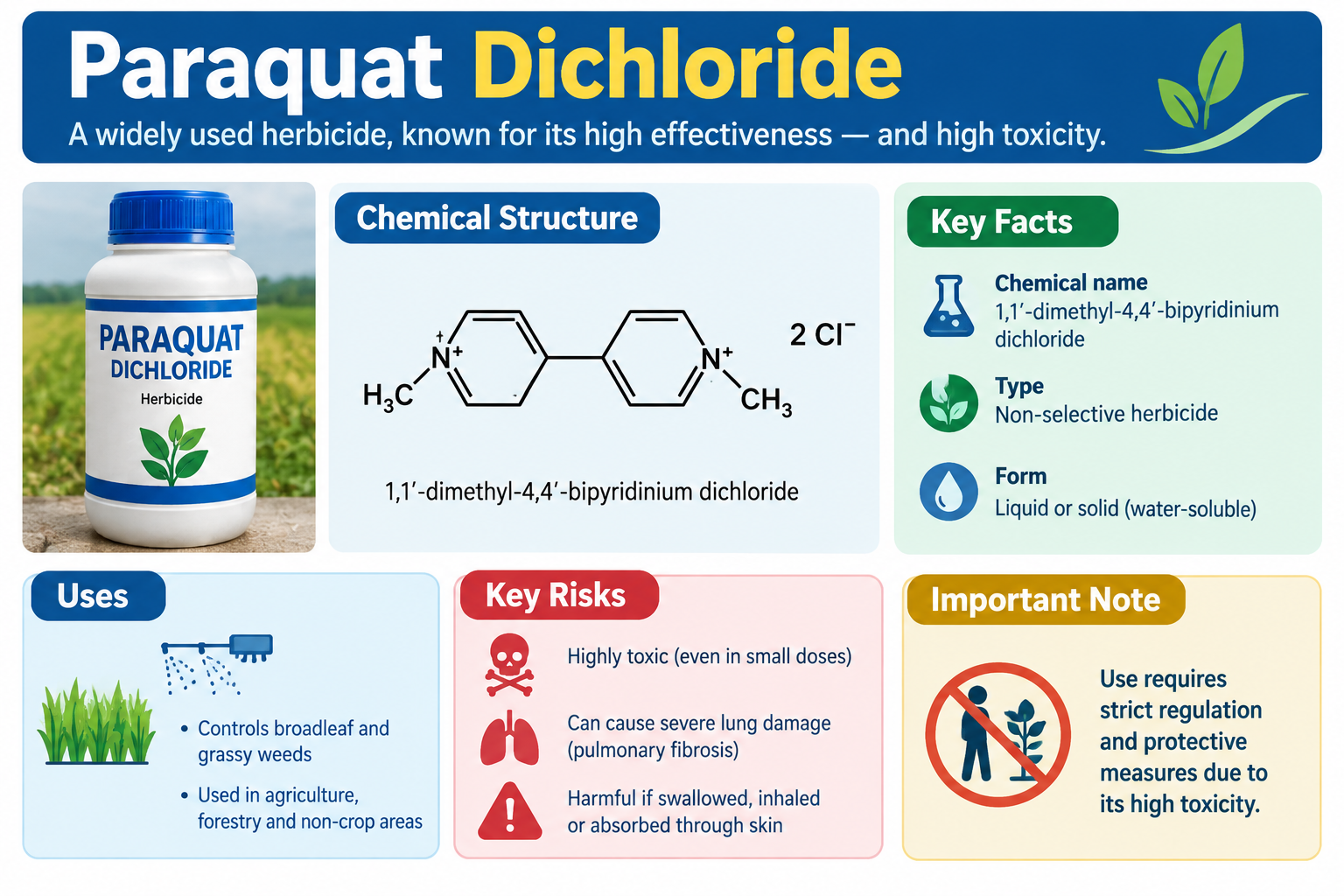
Paraquat Dichloride
- It is a fast-acting, non-selective ammonium herbicide that disrupts plant photosynthesis by generating reactive oxygen species (free radicals).
- It destroys plant cell membranes upon contact with sunlight.
- Agricultural Utility - Widely utilized for pre-emergence weed control, zero-tillage field preparation, and desiccation in crops such as cotton, paddy, tea, maize, and sugarcane.
Legal Provisions
- Statutory Power - Promulgated under Section 27(2) read with Section 28 of the Insecticides Act, 1968.
- It empowers the Central Government to ban or cancel registrations of toxic substances if their continued use poses unacceptable health risks.
- Immediate Certificate Recall - Directs the Registration Committee to recall all active Section 9 registration certificates from manufacturers and distributors, making failure to return certificates punishable under the Act.
- State-Level Enforcement - Mandates State Governments to take executive and administrative enforcement measures under the Act to halt the supply, trade, and application of the herbicide.
Toxicity
- Absence of a Specific Antidote - Ingestion of even a small quantity (10--15 ml) can be fatal, making medical intervention largely ineffective.
- Severe Multi-Organ Damage - Causes progressive pulmonary fibrosis (irreversible scarring of lung tissue), renal failure, and liver necrosis.
- High Hazard in Self-Harm - Accounted for a disproportionate share of accidental agricultural poisonings and intentional self-harm cases across rural India.
- Global Regulatory Status - Already banned or severely restricted in over 60 countries including the European Union, China, Brazil, and the UK, due to its acute lethal toxicity and absence of a specific antidote.
Significance
- Impulse for Bio-Herbicides - Accelerates the transition toward sustainable weed management under India's National Mission on Natural Farming (NMNF), bio-herbicides, and mechanical weeding techniques.
- Safer Alternatives - Directs agricultural extension services to promote less toxic alternatives such as Glufosinate-ammonium or targeted selective pre-emergence herbicides.
Reference
New Indian Express | India bans Paraquat Dichloride



