0.1036
7667766266
x

IN-SPACe Re-entry Guidelines

iasparliament Logo
August 01, 2026

Mains: GS III – Science and Technology

Why in News?

Recently, the Indian National Space Promotion and Authorisation Centre (IN-SPACe) released the 'Authorisation for Undertaking Planned Re-entry of Space Objects' guidelines.

What is the background?

  • Issue of debris Objects in orbit or the upper atmosphere, such as spent rocket stages, dead satellites, and orbital debris, naturally fall back to Earth due to gravity.
  • Most of these re-entries are uncontrolled, with smaller objects burning up in the atmosphere, while larger or heat-resistant components may survive and reach the Earth's surface.
  • Need for the guidelines – Rapid growth of India's commercial space ecosystem.
  • Increasing number of satellite launches.
  • Rising risks from uncontrolled space debris.
  • Need to safeguard public safety, aviation and maritime operations.
  • India's obligations under international space law.
  • Hence the guidelines specifically deal with planned re-entry.

What is Planned Re-entry?

  • Planned Re-entry – It refers to the controlled return of a space object into Earth's atmosphere by managing its landing location, trajectory, or timing using suitable technical measures.
  • The guidelines distinguish it from:
  • Unplanned Re-entry – Natural orbital decay without active control.
  • Post-Mission Disposal (PMD) End-of-life disposal measures to minimize space debris and ensure long-term sustainability of outer space.

IN-SPACe

  • IN-SPACE – The Indian National Space Promotion and Authorisation Centre.
  • It is a single-window, autonomous government agency under the Department of Space (DOS).
  • It promotes, permits, and oversees space activities by private companies and non-governmental entities in India.
  • Headquartered in Bopal, Ahmedabad, it acts as a bridge between ISRO and the private sector.
  • Core Functions:
    • Promote and Enable – Supports startups and private space firms in building rockets, satellites, and offering space services.
    • Authorise and supervise – Grants official clearance for private space launches, operations, and spacecraft re-entry guidelines.
    • Share Infrastructure – Allows private entities to use testing facilities, launch infrastructure, and premises belonging to DOS and ISRO


What are the major features of the guidelines?
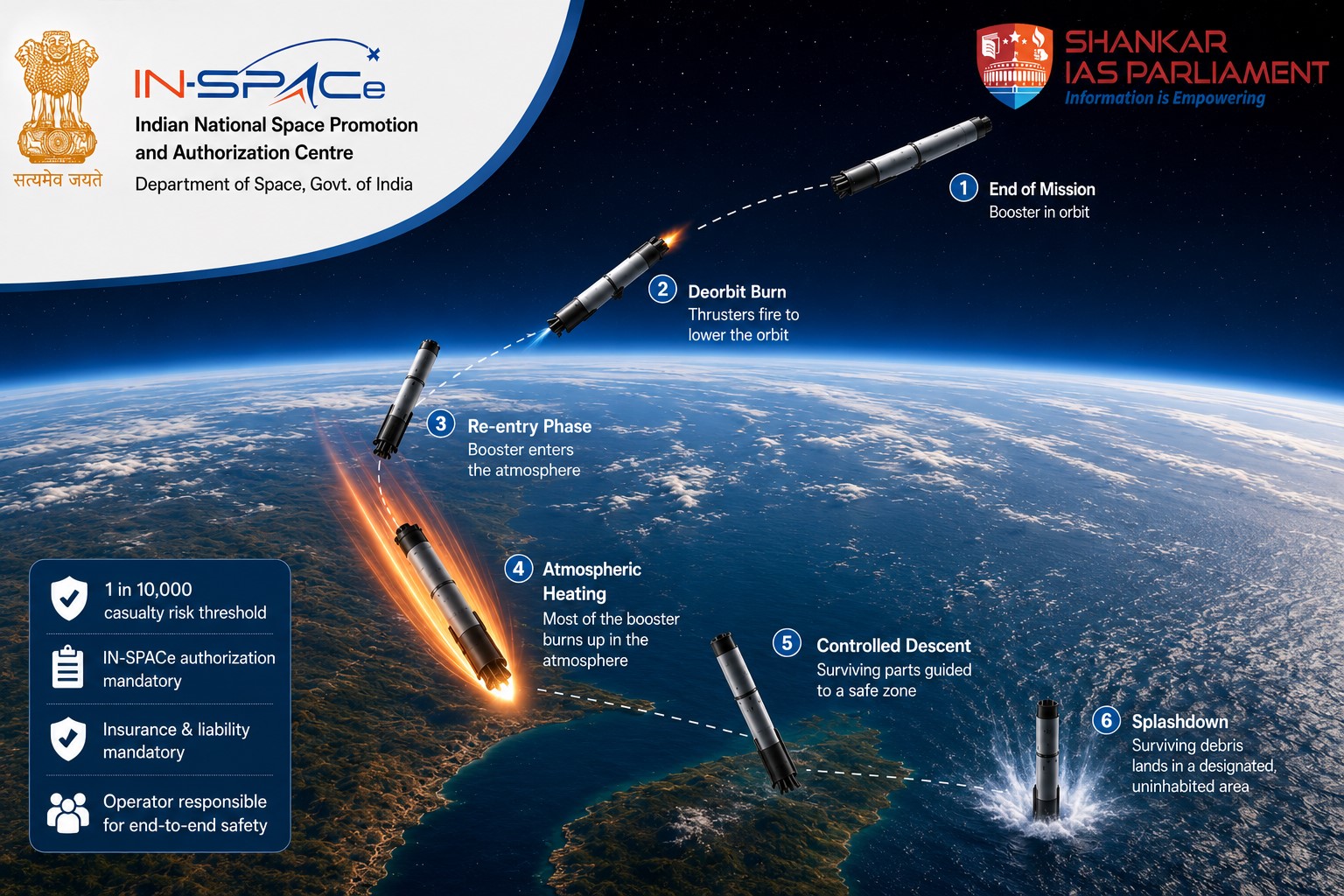
  • Mandatory IN-SPACe AuthorisationEvery planned re-entry undertaken by an Indian entity, whether inside or outside Indian territory, requires prior authorisation from IN-SPACe.
  • Foreign operators can undertake re-entry over Indian territory only through an incorporated Indian entity responsible for regulatory compliance.
  • Exception for Natural Burn-upSeparate re-entry authorisation is not required when:
    • The spacecraft naturally decays from orbit.
    • It completely burns up during atmospheric entry.
    • The post-mission disposal plan already addresses debris mitigation.
  • Such plans, however, must be disclosed in the Space Debris Mitigation Plan during authorisation.
  • Advance PlanningApplicants must, declare re-entry plans during satellite authorisation itself, submit detailed technical information, provide survivability studies, submit casualty risk assessments, furnish trajectory analysis.
  • Separate approval is revalidated approximately three months before the planned re-entry.
  • Where re-entry is planned after launch, applications must be submitted at least six months in advance.
  • Public Safety ThresholdThe guidelines prescribe a strict quantitative safety benchmark.
  • The Expected Casualty (Ec) due to re-entry must remain below 1 in 10,000
  • Applicants must demonstrate compliance through scientific risk assessments.
  • Comprehensive Risk AssessmentApplicants are required to submit mission objectives, re-entry trajectory, event timeline, failure scenarios, fragmentation pattern, ballistic coefficients, reliability analysis, de-orbit strategy, impact zones and danger zones.
  • IN-SPACe may require changes in mission planning if safety standards are not satisfied.

INSPACE Guidelines. UPSC

  • NOTAM and Danger Zone NotificationBefore every re-entry mission, Applicants must obtain an Advisory Note from IN-SPACe.
  • Relevant aviation and maritime authorities must issue NOTAM/NAVAREA warnings.
  • Notifications should generally begin around 45 days before the scheduled re-entry.
  • Revised notifications are mandatory if schedules or danger zones change.
  • Liability and InsuranceApplicants must bear full responsibility for third-party damages.
  • Protect the Government of India from liabilities arising under the Liability Convention (1972).
  • Obtain adequate insurance, including mandatory third-party liability insurance where prescribed.
  • Authorisation is contingent upon satisfying insurance and notification requirements.
  • International CoordinationWhere the planned re-entry affects another country's territory or Exclusive Economic Zone (EEZ), applicants must secure prior clearance from the concerned nation before authorisation.

What is the significance of the guidelines?

  • Strengthens India's Space GovernanceEstablishes a predictable regulatory framework, Enhances investor confidence and Supports private-sector participation.
  • Improves Public Safety – Minimises risks to life and property.
  • Protects aviation and maritime navigation and Enables scientifically managed re-entry operations.
  • Promotes Sustainable Space ActivitiesEncourages responsible end-of-life disposal.
  • Supports mitigation of space debris and Contributes to long-term sustainability of outer space.
  • Enhances International CredibilityAligns domestic practices with international obligations.
  • Demonstrates India's commitment to responsible space operations.
  • Supports Commercial Space EcosystemProvides procedural certainty for startups and private operators.
  • Facilitates growth under the Indian Space Policy and regulatory reforms.

What lies ahead?

  • The IN-SPACe 'Authorisation for Undertaking Planned Re-entry of Space Objects' guidelines establish a comprehensive framework governing the planned re-entry of space objects.
  • The guidelines strengthen India's regulatory framework for space activities while supporting emerging capabilities such as Gaganyaan, reusable launch vehicles, and commercial space missions.

Reference

The Hindu| IN-Space Re-Entry Guidelines

 

Login or Register to Post Comments
There are no reviews yet. Be the first one to review.

ARCHIVES

sidetext


