- Scientific name – Buceros bicornis, also known as Great Pied Hornbill.
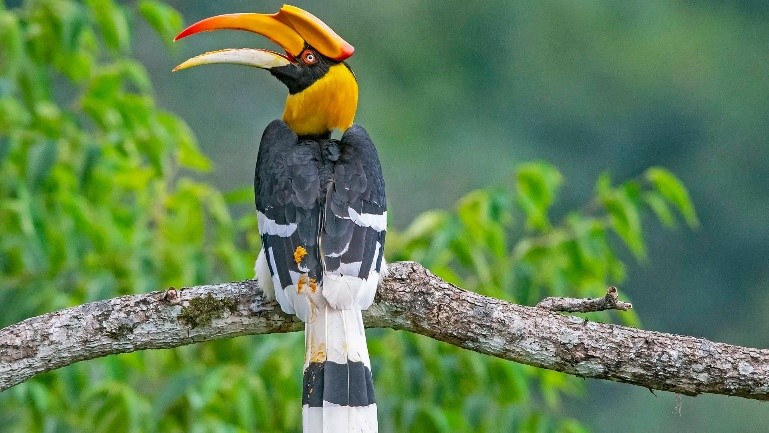
- Appearance - The great hornbill is a large, distinctive bird with a large yellow and black casque on its bill, contrasting black wings and tail with a white body, and bright yellow eyes.
- Size - It is a large bird, measuring approximately 95–130 cm in length and weighing 2–4 kg.
- Habitat - Hornbills prefer tall trees for their nests and has mutualism between them.
- Range - Found in the Himalayan foothills, the Northeast and the Western Ghats.
- Diet - It is predominantly a fruit-eater but also preys on small animals, has a heavy, loud flight.
- Nesting - It exhibits a unique nesting behavior where the female seals herself in a tree cavity during incubation.
- Ecological significance - They play a vital role in dispersing the seeds of about 80 rainforest trees.
- Threats - Illegal logging, hunting.
- Conservation Status
- IUCN – Vulnerable.
- CITES - Appendix I.
- Wildlife Protection Act, 1972 – Schedule I.
The Great Indian Hornbill is the State bird of both Kerala and Arunachal Pradesh.
|



