Prelims: Current events of national and international importance | Science & Technology
Why in News?
A recent study has confirmed that the HIV capsid remains an effective drug target even when resistance develops, reaffirming the potential of drug lenacapavir and opens door for a new generation of HIV drugs.
- HIV – HIV (Human Immunodeficiency Virus) is a type of RNA virus.
Viruses contain either DNA or RNA as genetic material, where DNA viruses are more stable and replicate in the nucleus, while RNA viruses mutate rapidly and evolve quickly.
- HIV attacks the body's immune system. Without treatment, it can lead to AIDS (acquired immunodeficiency syndrome).
- Once people get HIV, they have it for life. But proper medical care can control the virus.
A mutation is a permanent change in the genetic material of a cell or microorganism.
- HIV Mutation – HIV mutates rapidly while converting its RNA into DNA, creating many variants.
- Some viral parts are vital for survival and cannot change much, such as the HIV capsid protein.
- HIV Capsid – The capsid is a protective protein shell surrounding the viral RNA.
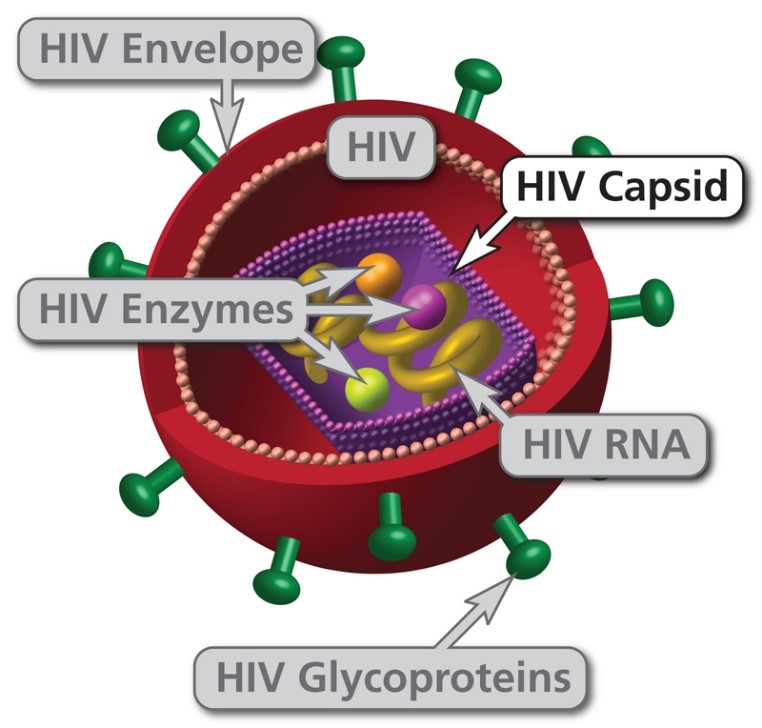
Key Findings
- First HIV Drug – In 1987, the first HIV drug, zidovudine, targeted the enzyme reverse transcriptase.
- Resistance – The drug slowed the virus, but the virus soon became resistant.
- Target "Must-Keep" Regions – Researchers focus on essential viral components that cannot mutate without stopping the virus from functioning, effectively closing the window for resistance.
- Combination Therapy – This led to the development of combination antiretroviral therapy targeting multiple viral proteins such as reverse transcriptase, protease, and integrase.
- 1999 study – Found that the capsid forms a unique 3D shape necessary for the virus to survive.
- Mutation Defect – Drug-resistant HIV viruses had mutations in specific capsid positions in order to escape the drug, which damaged their own capsid.
- Efficacy – Most changes in the capsid protein stop the virus from infecting cells.
- Lenacapavir – Initially faced poor water solubility, which is usually a problem for medicines to circulate effectively in the body.
- Advantage – This low solubility later became an advantage, allowing it to form a slow-release reservoir under the skin and work for six months with a single injection.
Lenacapavir is the world’s first capsid-based HIV inhibitor approved in 2025 by the U.S. Food and Drug Administration.
- Lenacapavir Effect – Patients treated with lenacapavir showed small mutations in the virus’s capsid protein that diminished the drug’s effect.
- Monotherapy Resistance – Resistance mainly developed when lenacapavir was used alone. When used with other active HIV drugs (combination therapy), the virus remained well controlled.
- High Efficacy – Showed 100% effectiveness in preventing HIV infection in high-risk individuals.
- Result – Lenacapavir in combination therapy made the virus weaker, and the resistant viruses multiplied at only 20–30% of their normal rate.
- But it is not a cure, and is considered close to an HIV vaccine in preventive potential.
Reference
TH | HIV capsid



