0.2695
7667766266
x

El Niño & Climate Dynamics

iasparliament Logo
February 28, 2026

Prelims: Current events of national and international importance | Geography

Why in News?

Recently, a study in Nature Geoscience linked recent global temperature spikes to Earth’s energy imbalance and ENSO shifts.

Key Findings

  • Temperature Spike – Earth’s temperature suddenly jumped higher in early 2023 and stayed high through 2025.
  • This rise was above the normal long-term warming trend.
  • Energy Imbalance – Scientists studied the gap between energy coming into Earth and energy going out to space.
  • In 2022, more heat was trapped than usual, making the planet warmer.
  • Main Causes – About 3-quarters of this extra trapped heat came from two things
    • Long-term human-caused climate change and
    • The shift from cooling la niña to warming el niño.
  • Triple La Nina – From 2020 to 2023, the world experienced a rare 3-year La Nina.

La Niña events typically prevail for 9 to 12 months during a standard cycle.

  • Around 23% of the recent heat increase was linked to this long La Niña.
  • Heat Trapping - During such prolonged phases the ocean continues to absorb and store excess heat.
  • Surface warming is somewhat suppressed temporarily.
  • However, the underlying long-term global warming trend continues due to greenhouse gases.
  • More heat is transferred from the atmosphere into the deeper Pacific Ocean.
  • This stored heat can later be released during a strong El Niño, often contributing to record-breaking global temperatures.
  • Fossil Fuels – Slightly more than half of the extra heat in the spike came from gases released by burning coal, oil and gas.
  • Label Change – Because oceans are getting hotter overall, scientists updated how they classify El Niño and La Niña.
  • The new method may label more events as La Niña and fewer as El Niño.

El Nino-Southern Oscillation (ENSO)

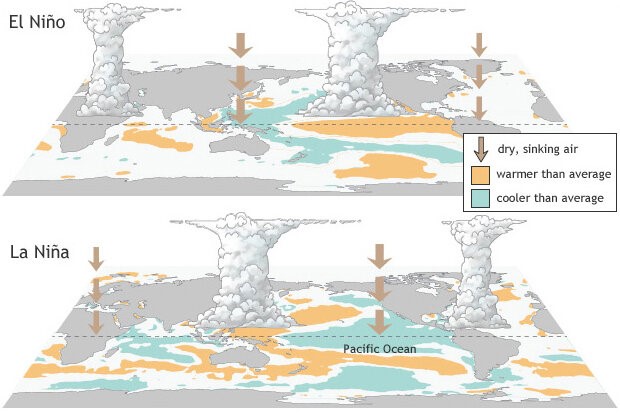
  • ENSO – It is a recurring natural climate pattern involving fluctuating ocean temperatures in the equatorial Pacific, alternating between warmer (El Niño) and colder (La Niña) phases, along with a neutral phase.

ENSO

Aspects

El Nino

La Niña

Meaning

It is a loose translation of “little boy” or “Christ child” in Spanish.

It is called “Little girl” in Spanish, which is the opposite of El Niño.

About

It is the warming of sea waters in the Central-east Equatorial Pacific that occurs every few years.

It sees cooler-than-average sea surface temperatures in the equatorial Pacific region.

Trade winds

It weakens in the western Pacific, which causes warmer waters in the East.

It becomes stronger than normal and causes warmer waters in the west.

Sea surface temperature

It increases across the Eastern Pacific by 6-8°C.

It reduces across the Eastern Pacific by 3-5°C.

Impact

It disrupts normal upwelling, reducing the rise of cold, nutrient-rich water from the ocean depths.

It enhances upwelling, bringing cold, nutrient-rich water to the surface near South America.

Impact on India

It has the impact of suppressing monsoon rainfall, which can cause droughts, adversely affecting agriculture and water supply.

It is associated with good rainfall during the monsoon season.

Frequency

It occurs every 3-7 years

It occurs half the amount of time El Niño events do.

References

  1. TH | El Niño Labelling & Global Temperature Spike
  2. NOAA | ENSO
Login or Register to Post Comments
There are no reviews yet. Be the first one to review.

ARCHIVES

MONTH/YEARWISE ARCHIVES

sidetext
Free UPSC Interview Guidance Programme
sidetext