Prelims: Current events of national and international importance | Polity
Why in News?
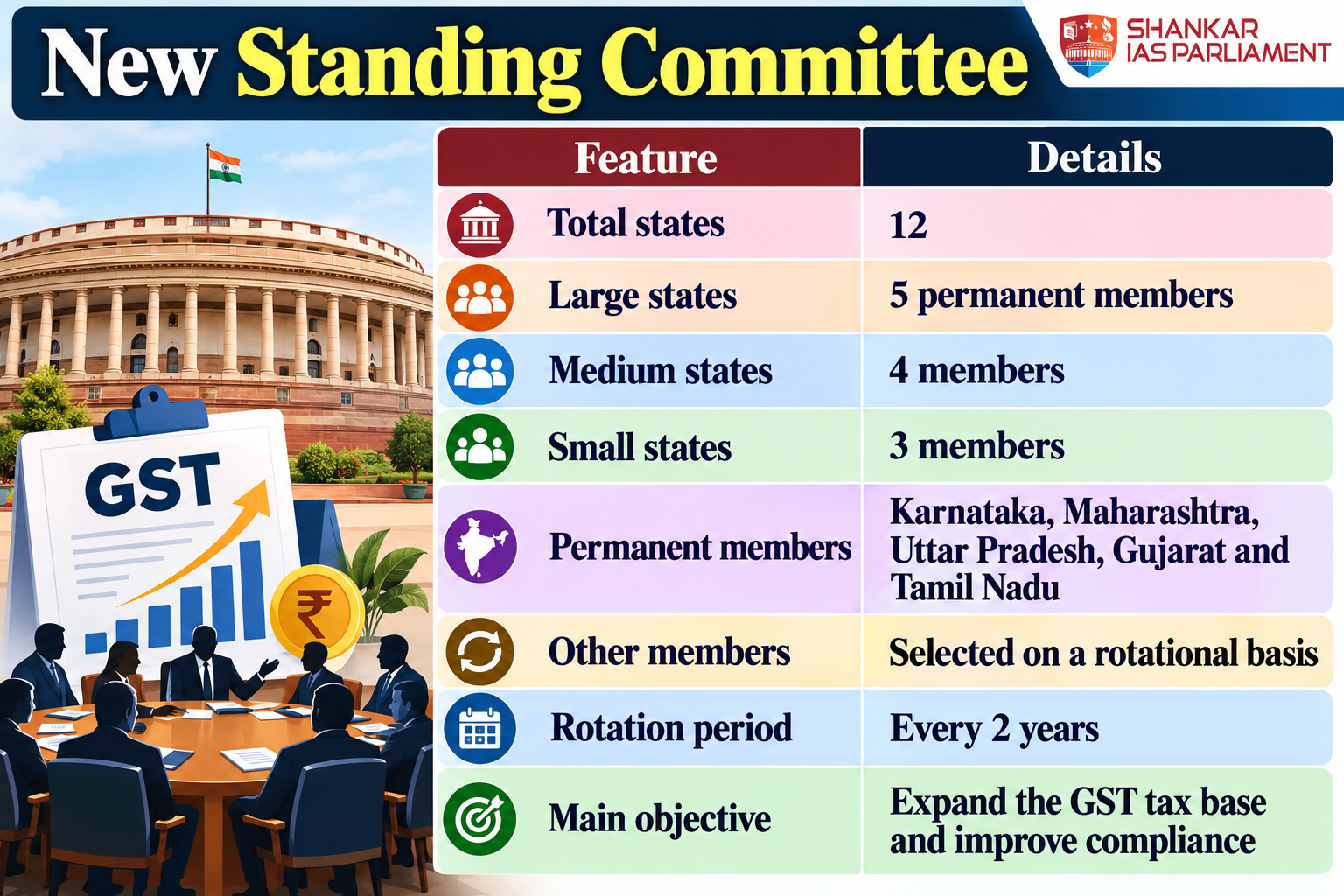
The central government has proposed the establishment of a new Standing Committee within the GST framework, consisting of representatives from 12 states.
GST Standing Committee
- Karnataka, Maharashtra, Uttar Pradesh, Gujarat, and Tamil Nadu are designated as the five permanent members of this committee.
- Aim – To expand the GST tax base, improve tax compliance and reduce tax leakages through technology and data analytics.
Key Measures for GST Compliance
- Expansion of the GST tax base – According to the report, India has approximately 17 million registered taxpayers.
- The central government will assist states by providing data analytics and technological support.
- Efforts will concentrate on identifying unregistered businesses and addressing gaps in tax compliance.
- The objective is to enhance the quality of tax disclosures while ensuring that compliance processes do not become unnecessarily intrusive.
- Business-to-Consumer (B2C) e-invoicing – States are expected to implement B2C e-invoicing beginning April 1, according to recent reports.
- The Goods and Services Tax Network (GSTN) intends to introduce a B2C application that will enable customers to generate invoices.
- Businesses are likely to be offered incentives to adopt the system, rather than being subject to an immediate mandatory requirement.
- Expected benefits:
- Enhanced tracking of transactions.
- Increased transparency throughout the supply chain.
- Reduction in tax evasion and revenue leakages.
- Improved reconciliation of invoices and tax returns.
Goods and Services Tax (GST)
|
Aspect
|
Key information
|
|
Constitutional Amendment
|
101st Constitutional Amendment Act, 2016
|
|
Constitutional provision
|
Article 246A – power to make GST laws
|
|
GST Council
|
Article 279A
|
|
GST dispute resolution
|
Article 279A provides for the GST Council to establish a mechanism to adjudicate disputes arising out of its recommendations or implementation
|
|
Nature
|
Destination-based, value-added indirect tax
|
|
Implemented in India
|
1 July 2017
|
|
GST Network (GSTN)
|
Provides the technological and IT infrastructure for GST administration
|
|
GST Council Chairperson
|
Union Finance Minister
|
|
GST Council members
|
Union Minister of State in charge of Revenue/Finance and the Finance/Taxation Minister or other nominated minister of each state
|
Types of GST
- Central Goods and Services Tax (CGST) is collected by the central government on intra-state supplies.
- State Goods and Services Tax (SGST) is collected by the respective state government on intra-state supplies.
- Union Territory Goods and Services Tax (UTGST) applies to intra-Union Territory supplies within the relevant Union Territories.
- Integrated Goods and Services Tax (IGST) is generally applicable to inter-state supplies and imports.
Constitutional Provisions Relating to the GST Council
- Article 246A confers special legislative powers upon Parliament and state legislatures to enact laws pertaining to the Goods and Services Tax (GST).
- Article 269A governs the levy and collection of GST on inter-state trade or commerce, specifying that imports are classified as inter-state supplies for this purpose.
- Article 279A provides for the establishment and composition of the GST Council.
- Article 366(12A) defines GST as a tax imposed on the supply of goods, services, or both, while explicitly excluding taxes on the supply of alcoholic liquor for human consumption.
- Article 270 addresses the distribution of certain taxes, including the framework for distributing GST revenues.
Reference
ET | New GST Standing Committee



