Mains: GS- III – Infrastructure
Why in News?
The Union Minister for Road Transport and Highways described the breakthrough as a landmark moment in India’s infrastructure journey and a historic milestone in national development.
What about the Zojila Tunnel?
- World’s Longest High-Altitude Tunnel – The Zojila Tunnel, spanning 13.14 km at 11,578 feet.
- Connectivity – The Zojila tunnel connects Sonamarg’s Baltal in central Kashmir’s Ganderbal district with Meenamarg in Ladakh’s Drass district.
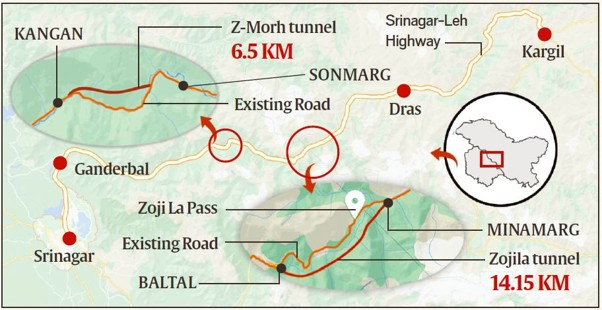
- Cost & Construction – Built at a cost of Rs.6,800 crore, it is India’s most ambitious high-altitude infrastructure project.
- Connectivity & Impact – The tunnel will provide all-weather access between the Kashmir Valley and Ladakh, overcoming the harsh Himalayan terrain that previously cut off Ladakh for months in winter.
What makes the Zojila tunnel an engineering marvel?
- Engineering Marvel – Zojila tunnel is India’s first longest single-tube bi-directional tunnel and an engineering marvel for several reasons.
- Technological Method – It is being excavated using the New Austrian Tunnelling Method (NATM).
- This modern technique treats the surrounding rock mass as an integral load-bearing component of the tunnel support structure rather than relying purely on heavy external scaffolding.
- Challenging Due to the Difficult Terrain – The western Himalayan range around the Zojila Pass has been daunting for engineers and planners, with the
- Fragile geology,
- Sensitive rock formations,
- Avalanche-prone terrain, and
- Harsh winter conditions all complicating the execution of the project.
- Supporting Infrastructure – To make the approach safe, engineers built 31 km of additional roadways, three bridges, and two smaller tunnels in Sonamarg.
- All Round Connectivity – It is a combined system of tunnels & roadways that forms a comprehensive corridor, designed to withstand the vagaries of winter, as avalanches and snow slides are often reported in the area.
- Safety Features – The tunnel is equipped with catch dams, protection walls, and deflector dams over a 6-km stretch for protection from snowstorms.
- It will have automatic and emergency lighting, emergency phone, message signalling, and radio to ensure travellers’ safety.
Why is this a memorable project for engineers?
- Extreme Weather Challenges – The tunnel was dug in extreme weather conditions, with temperatures dropping to minus 20 degrees Celsius on the Kashmir side and minus 30 degrees Celsius on the Drass side.
- Official estimates suggested that extreme weather conditions were prevalent for nearly 100 days a year.
- Avalanche Risks – Engineers faced five major avalanches during construction, which left two workers dead and over 172 workers stranded and later rescued.
- The constant snow accumulation was managed by a fleet of small and large snow blowers.
- Geological Complexity – The rock classification also changed 67 times across the 13-km stretch, “shifting constantly between good and poor formations.”
- This required constant adaptation of tunneling techniques.
Why is the tunnel significant for strategic connectivity?
- Historical Military Challenges – India has witnessed repeated military confrontations with China and Pakistan since 1947, particularly in the regions of Ladakh and Kashmir, most notably in 1962 and 1999.
- Connectivity Limitations – The restricted movement of military vehicles often caused delays in full-scale responses.
- The military response was hampered by lack of connectivity and poor mobility of men and material in the region, both along the Line of Control in the west and the Line of Actual Control in the east.
What does it mean for locals?
- Winter Isolation – Ladakh has always been cut off from the Kashmir Valley during winters.
- Heavy snow and landslides would often close the Zojila Pass for 4-6 months, leaving the region isolated.
- Safety Concerns – The pass was dangerous, with frequent commuter deaths caused by landslides during rains and avalanches even in sunny winters.
- Local Hardships – All this resulted in severe hardships for patients and students in the Kargil-Drass range.
- Stocks would be depleted, but the problem could not be attended to because of road closure.
- Locals relied on sun-dried vegetables and cereals during winters.
What is the significance of the tunnel?
- Strategic Advantage – The tunnel is now expected to provide year-long transportation access to the Indian forces stationed in Ladakh, significantly
- Improving mobility,
- Logistics reliability, and
- Strategic access in the border region.
- Civilian Benefits – It is expected to be movement of people and goods and no more weather-related isolation for the region.
- Additionally, the tunnel will put a spotlight on activities such as adventure tourism and skiing in Drass, which will contribute to the economy.
- Long-Term Impact – The project is moving closer to its long-envisioned goal of seamless all-weather connectivity that will spur long-term benefits in terms of mobility, economic integration, and strategic resilience.
When will the tunnel open for civilians?
- Work Still in Progress – Despite the breakthrough, the tunnel is likely to take two years to be fully functional.
- Issues like water seepage, benching, and electronic layouts are still being worked out.
- In case of emergencies, the tunnel could be opened for security forces even before completion.
- Pilgrimage Support – The tunnel will also help pilgrims on the Amarnath Yatra, whose base camp is in Baltal.
- Faster Travel – Vehicles can travel at a speed of 80 km per hour through the tunnel.
- Earlier, drivers could not drive more than 30-40 km per hour on the Zojila Pass, because of steep roads and hair-pin curves.
To know more about Zojila Tunnel, click here
Reference
The Hindu | Why is the Zojila tunnel a game changer?



