Mains: GS-III – Environment
Why in News?
Coral colonies and giant clams will be moved from Galathea Bay as part of environmental protection measures linked to the proposed transhipment port project at Great Nicobar Island, Zoological Survey of India (ZSI) has said.
What about coral reefs?
- Corals – They are tiny marine animals (polyps) from the phylum Cnidaria.
- They comprise hundreds to thousands of living organisms called polyps, each with only a few millimeters in diameter.
- Each polyp has stinging tentacles to capture food such as plankton and small fish.
- It lives in groups of hundreds to thousands of genetically identical polyps known as a ‘colony’, which is recognised as coral.
- Coral reefs – A coral reef is an underwater ecosystem formed of colonies of coral polyps.
- It covers 1% of the ocean floor yet supporting 25% of marine life by providing food, shelter, and breeding grounds.
- They are often called the “Rainforests of the Sea”, existing on the Earth for nearly 450 million years & they host 1/3rd of global marine species.
- Symbiotic Relationship – Corals depend on microscopic algae (zooxanthellae) living in their tissues, performing photosynthesis, supplying corals with food and giving them their bright colors.
- Global Distribution – Coral reefs exist in the Pacific, Atlantic, and Indian oceans.
- Australia’s Great Barrier Reef is the largest coral system in the world, stretching across 2,028 kilometres.
- Types of Corals
- Hard Corals – The architects of coral reefs are hard corals, which form complex three-dimensional structures over thousands of years.
- At the coral base is a hard, protective limestone skeleton called a calicle, which forms the structure of coral reefs.
- Soft Corals – It is flexible, plant-like, but does not form reefs.
- Reefs begin when a polyp attaches itself to a rock on the seafloor, then divides, or buds, into thousands of clones.
- The polyp calicles connect to one another, creating a colony that acts as a single organism.
In India, coral reefs are protected in the same way as the tiger or elephant, under Schedule I of the Wildlife Protection Act (WPA), 1972.
What are the key takeaways about the issue of ZSI?
- ZSI’s Announcement – The ZSI informed a biodiversity committee in November last year about plans to translocate coral colonies and giant clams from Galathea Bay.
- New Translocation Sites – ZSI has identified four new translocation sites on the west coast of the Great Nicobar Islands.
- It undertakes the translocation of coral colonies and Giant Clams from the project impact area as per EC (Environmental Clearance) and CRZ (Coastal Regulation Zone) clearance conditions prior to the commencement of project works.
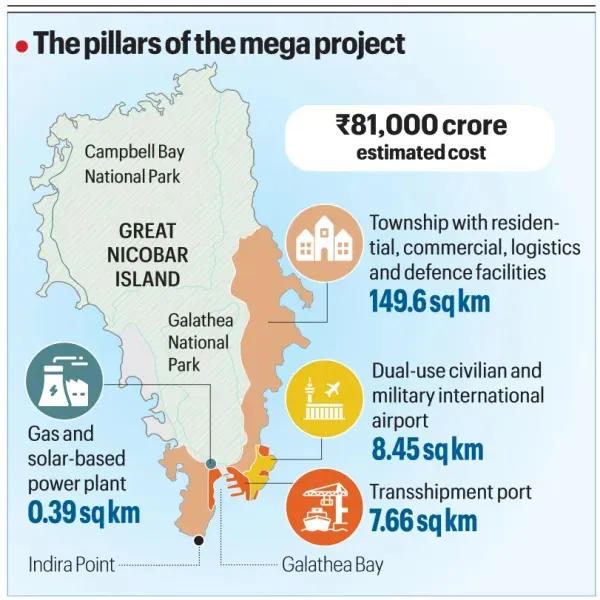
- Environmental Management Plan – In compliance with the condition for granting Environmental Clearance, an environmental management plan is implemented.
- In this regard, three independent Monitoring Committees are formed -
- Committee to oversee biodiversity-related matters.
- Committee to oversee pollution-related matters.
- Committee to oversee welfare and issues related to Shompen and Nicobarese.
- Biodiversity Oversight – The biodiversity-related committee is tasked with overseeing wildlife conservation plans and actions to mitigate the project’s impact on the
- Nicobar Megapode (endemic bird)
- Leatherback turtles
- Saltwater crocodiles
- Nicobar macaque
- Robber crab
- Coral colonies and other island-specific birds.
How are Coral Reefs translocated?
- Coral Reef Translocation – It is an environmental mitigation and restoration practice where living coral colonies are carefully detached, transported, and re-attached to a new, hospitable receptor site.
- This process is typically used to save corals from coastal development or polluted environments, though it remains a highly challenging procedure.
- Monitoring Coral Translocation – ZSI is dedicated to monitoring coral reef translocation.
- For restoration purposes, it successfully moved over 16,000 corals in the Gulf of Kachchh to new locations.
- Restoration Projects – In a project in the Andaman Islands since 2017, ReefWatch Marine Conservation has transplanted coral fragments on nine artificial structures totalling a 20 square metre area.
- In a three-year-long project in Sindhudurg, corals were cultivated by attaching fragments to concrete frames with nylon threads, then placed on ocean beds at suitable depths for growth.
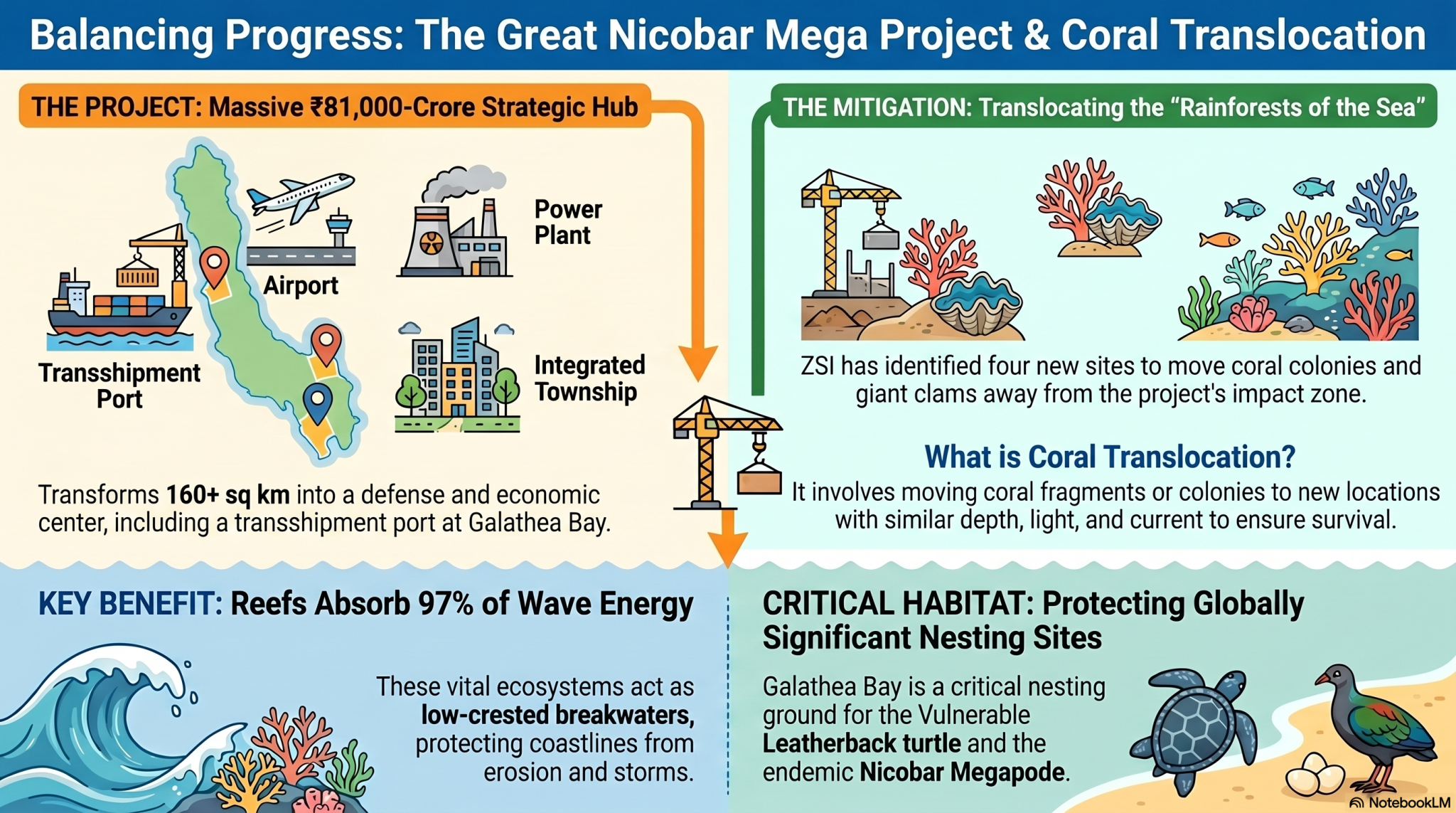
- Survival Factors – Some experts stress that corals must be moved to areas with similar environmental conditions — depth, water flow, light, and pressure — to ensure a high survival rate.
What is the significance of coral reefs?
- Protection from big storms & floods – Coral reefs act like low-crested breakwaters and absorb 97% of wave energy reduces the impact of big storms and floods on coastlines.
- Underwater Cities of Life – A single reef can support thousands of marine species, providing food, shelter, and breeding grounds.
- Barrier Against Sea Erosion – The reefs act as ‘wave breaks’ between the sea and the coastline and minimise the impact of sea erosion.
- Economic Value – Coral reefs generate goods and services worth around $375 billion annually, including fisheries, tourism, and coastal protection.
- Medical Potential – Scientists are exploring corals as a source of new medicines.
- For example, Eleutherobin, found in soft corals, shows promise in slowing cancer cell growth.
To know more about coral reefs, click here
To know about Great Nicobar Island (GNI) Mega Project, click here
To take mains test click here
Reference
Indian Express | 4 sites on Nicobar west coast identified for coral translocation



