Mains: GSI – Indian Society
Why in News?
The National Commission for Women (NCW) held a consultation on women’s property rights and access to social and economic justice, highlighting the need to shift from welfare-based empowerment to women-led development.
What is Women-Led Development?
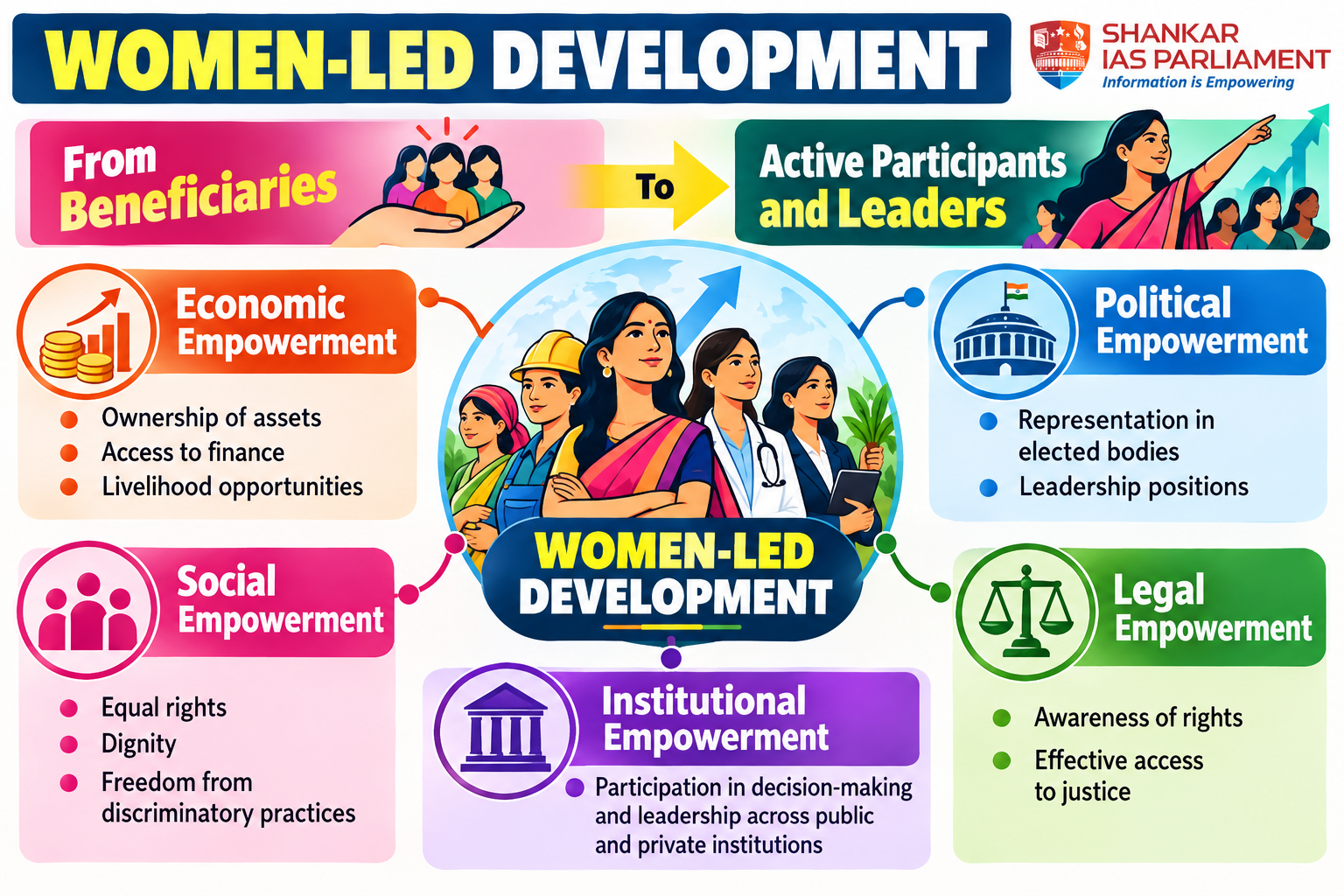
- Women-led development – It moves beyond treating women as beneficiaries of welfare schemes and recognises them as active participants and leaders in all aspects.
- It integrates –
- Economic empowerment – Ownership of assets, access to finance and livelihood opportunities.
- Political empowerment – Representation in elected bodies and leadership positions.
- Social empowerment – Equal rights, dignity and freedom from discriminatory practices.
- Institutional empowerment – Participation in decision-making and leadership across public and private institutions.
- Legal empowerment – Awareness of rights and effective access to justice.
What is the Difference Between Distributive and Compensatory Justice?
- Distributive Justice – Ensures equitable access to resources and opportunities according to people’s needs.
- Focuses on preventing inequality by addressing unequal resource distribution.
- Constitutional provisions – Articles 38, 39 and 46.
- In Air India Statutory Corporation v. United Labour Union (1996), the Supreme Court emphasised distributive justice as a means of establishing an egalitarian social order.
- Compensatory Justice – Provides remedies, protection and compensation to address discrimination, exploitation and existing inequalities.
- Includes legal safeguards, welfare schemes, reservations and victim compensation.
- Constitutional provisions – Articles 17 and 23, which prohibit untouchability, trafficking and forced labour.
- Section 396 of the Bharatiya Nagarik Suraksha Sanhita (BNSS), 2023, provides for victim compensation schemes.
- Key distinction – Distributive justice seeks to prevent inequality, while compensatory justice seeks to address its consequences.
Why Are Women's Property Rights Important?
- Economic independence – Property ownership improves women’s financial security and reduces dependence on family members.
- Social empowerment – Ownership strengthens bargaining power, social status and participation in household decisions.
- Gender equality – Equal inheritance rights recognise women as independent rights-holders rather than passive beneficiaries.
- Poverty reduction – Asset ownership can improve women’s access to credit, livelihood opportunities and economic security.
What are the Constitutional and Legal Provisions for Women's Property Rights?
- Article 14 – Guarantees equality before the law and equal protection of laws.
- Article 15 – Prohibits discrimination on grounds including sex; Article 15(3) permits special provisions for women and children.
- Article 21 – Protects life and personal liberty, interpreted by the Supreme Court to include human dignity.
- Article 300A – Protects every person against deprivation of property except by authority of law.
- Hindu Succession Act, 1956 – The 2005 amendment granted daughters equal coparcenary rights in Hindu joint family property.
- Vineeta Sharma v. Rakesh Sharma (2020) – The Supreme Court held that a daughter acquires coparcenary status by birth, irrespective of whether her father was alive on the date of the amendment.
- Other relevant laws include the Hindu Marriage Act, 1955, the Special Marriage Act, 1954, and applicable maintenance and inheritance laws.
What are the Major Challenges to Women's Empowerment?
- Patriarchal mindset – Social attitudes often discourage women from claiming inheritance and property rights.
- Poor legal awareness – Many women lack information about their legal entitlements and remedies.
- Limited access to justice – Legal costs, procedural delays and dependence on intermediaries restrict access to remedies.
- Implementation gaps – Existing laws and policies often fail to translate into effective ownership and control of assets.
- Weak institutional support – Complex land records and mutation procedures make it difficult to establish and enforce property claims.
- Limited decision-making power – Women may possess legal rights but lack meaningful control over assets and household decisions.
What Measures are Needed to Promote Women-Led Development?
- Gender-sensitive land records – Digitise property records, simplify mutation procedures and accurately record women's ownership shares.
- Improve legal literacy – Conduct awareness campaigns through Self-Help Groups (SHGs) and community institutions.
- Strengthen legal aid – Improve access to free legal assistance and grievance-redressal mechanisms.
- Enforce existing laws – Strengthen implementation and monitoring rather than relying solely on new legislation.
- Promote women's leadership – Provide women with leadership opportunities across governance, institutions and economic sectors.
- Ensure policy convergence – Coordinate constitutional safeguards, legal institutions, welfare programmes and economic policies.
- Change social attitudes – Promote equal inheritance, shared decision-making and recognition of women's independent rights.
What lies ahead?
- Achieving gender justice requires moving beyond welfare-oriented empowerment towards equal access to resources, enforceable property rights and meaningful participation in decision-making.
- Women-led development must recognise women not merely as beneficiaries of growth, but as equal partners and leaders in nation-building.
Reference
The Hindu| Women-Led Development Model



