Prelims: Current events of national and international importance | International relations
Why in News?
Recently, the United States officially concluded its 23-year military footprint in federal Iraq, completing the scheduled transition under Operation Inherent Resolve (OIR).
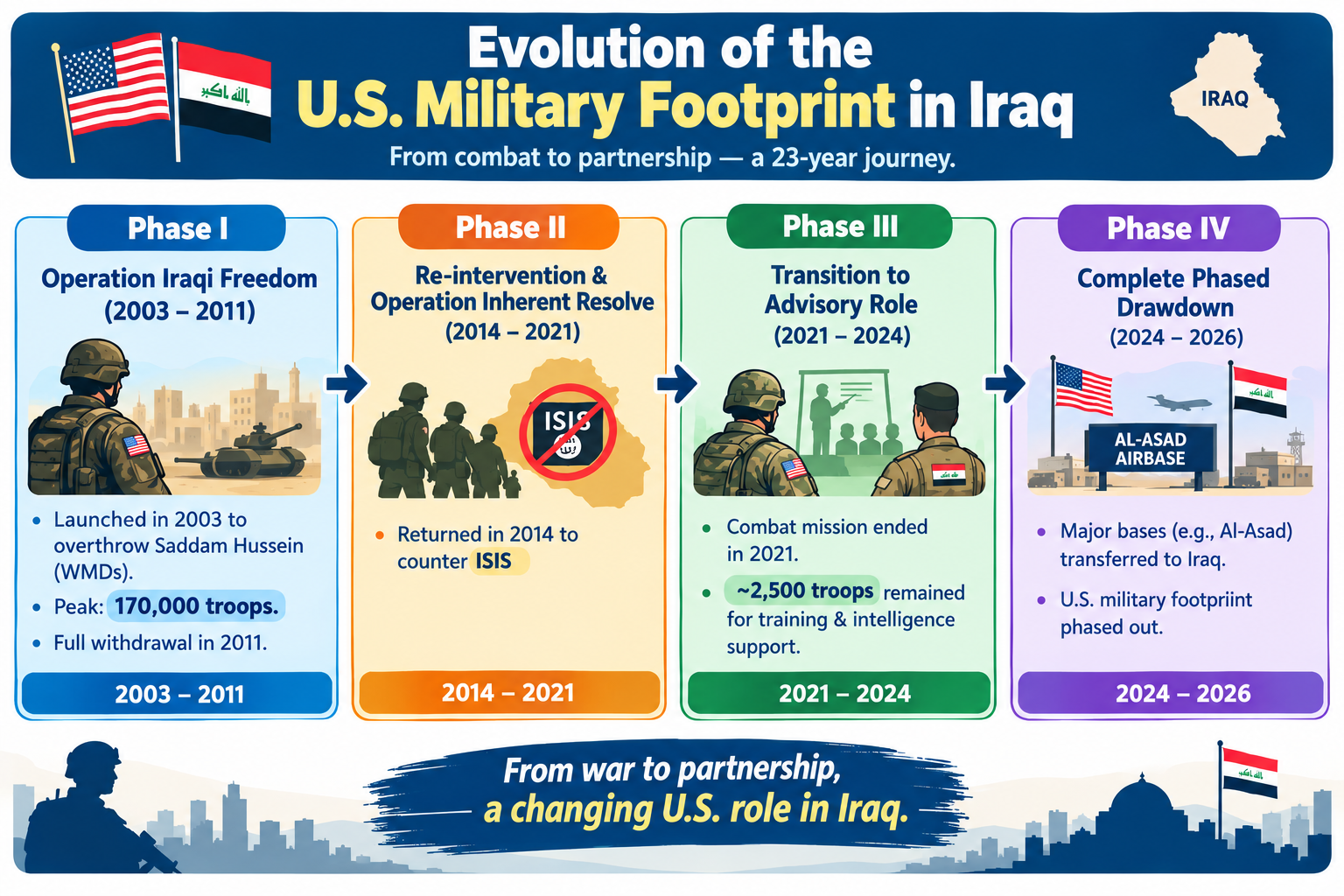
Evolution of the U.S. Military Footprint in Iraq
|
Phase I |
Operation Iraqi Freedom (2003–2011) |
Initiated in March 2003 to overthrow Saddam Hussein's regime based on allegations of weapons of mass destruction (WMDs). Reached a peak presence of over 170,000 troops before a full combat withdrawal were executed under the Obama administration in December 2011. |
|
Phase II |
Re-intervention & Operation Inherent Resolve (2014–2021) |
U.S. forces returned in 2014 at the invitation of the Iraqi government to lead an international coalition against the territorial expansion of the Islamic State of Iraq and Syria (ISIS/Daesh), which had seized nearly one-third of Iraqi territory. |
|
Phase III |
Transition to Advisory Role (2021–2024) |
In December 2021, the U.S. formally concluded its active combat mission, shifting remaining personnel (~2,500 troops) strictly to training, intelligence-sharing, and advisory functions. |
|
Phase IV |
Complete Phased Drawdown (2024–2026) |
Following bilateral security talks under the U.S.-Iraq Higher Military Commission, a phased timetable was established to dismantle coalition military structures, transferring major installations (such as Al-Asad Airbase) directly to Iraqi Joint Operations Command control. The Iraqi government declared the transition a major milestone for national sovereignty, establishing the day as a national celebration ("Day of Sovereignty"). |
Geopolitical Implications
Significance for Global Security
Reference



