Why in News?
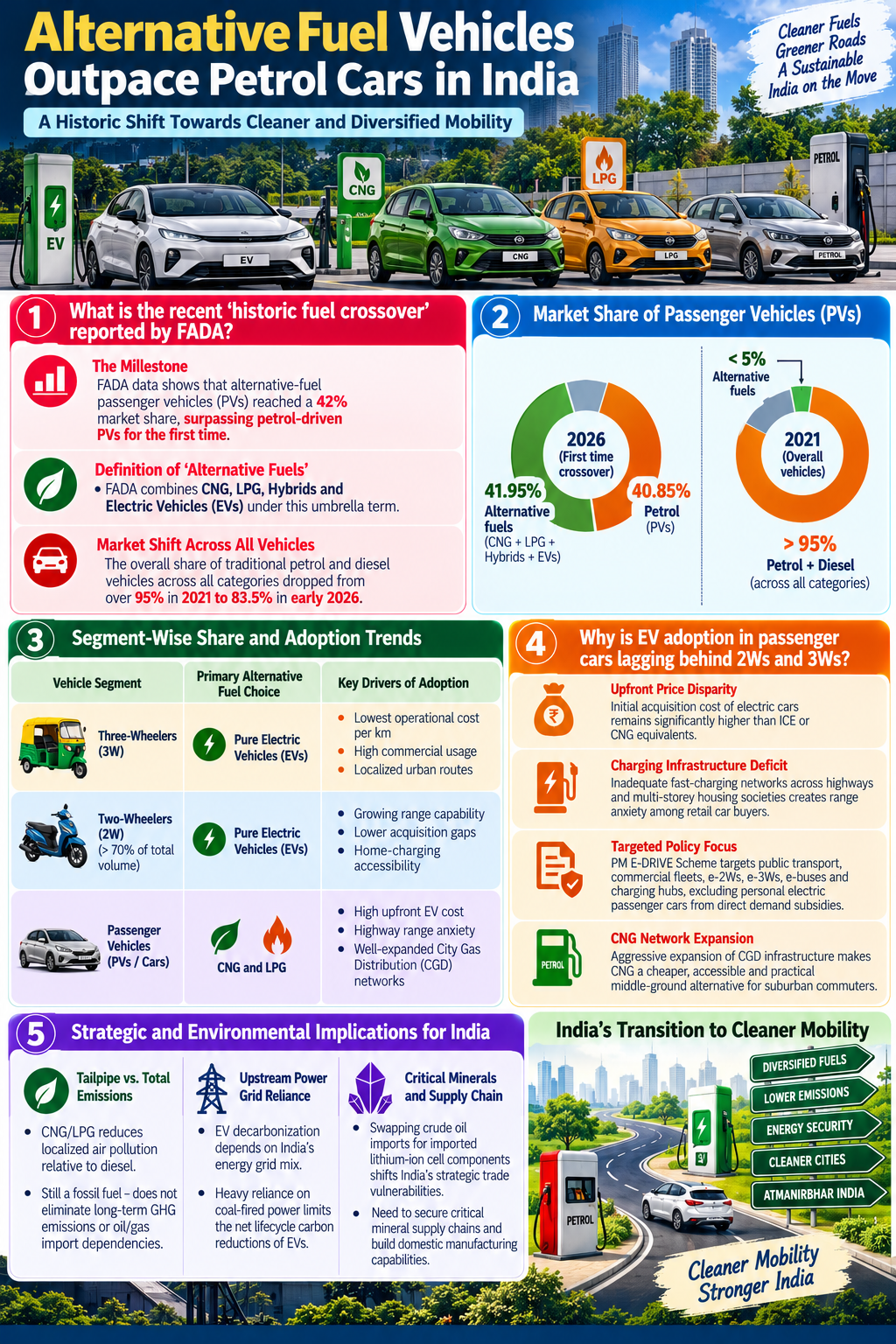
Recently, for the first time in the market share of passenger vehicles (cars) running on alternative fuels (41.95%) surpassed those running purely on petrol (40.85%).
What is the recent 'historic fuel crossover' reported by FADA?
- The Milestone – Federation of Automobile Dealers Associations (FADA) data revealed that alternative-fuel passenger vehicles (PVs) reached a 42% market share, surpassing petrol-driven PVs for the first time.
- Definition of 'Alternative Fuels' – FADA combines Compressed Natural Gas (CNG), Liquefied Petroleum Gas (LPG), Hybrids, and Electric Vehicles (EVs) under this umbrella term.
- Market Shift Across All Vehicles – The overall share of traditional petrol and diesel vehicles across all categories dropped from over 95% in 2021 to 83.5% in early 2026.
- Segment-Wise Share and Adoption Rates
|
Vehicle Segment
|
Primary Alternative Fuel Choice
|
Market Transition Drivers
|
|
Three-Wheelers (3W)
|
Pure Electric Vehicles (EVs)
|
Lowest operational cost per km, high commercial usage, localized urban routes.
|
|
Two-Wheelers (2W) (>70% of total volume)
|
Pure Electric Vehicles (EVs)
|
Growing range capability, lower acquisition gaps, home-charging accessibility.
|
|
Passenger Vehicles (PVs/Cars)
|
CNG and LPG
|
High upfront EV cost, highway range anxiety, well-expanded City Gas Distribution (CGD) networks.
|
Why is EV adoption in passenger cars lagging behind 2Ws and 3Ws?
- Upfront Price Disparity – The initial acquisition cost of electric cars remains significantly higher than Internal Combustion Engine (ICE) or CNG equivalents.
- Charging Infrastructure Deficit – Inadequate fast-charging networks across highways and multi-story housing societies creates severe range anxiety among retail car buyers.
- Targeted Policy Focus – Central government initiatives like the PM E-DRIVE Scheme explicitly target public transport, commercial fleets, e-2Ws, e-3Ws, e-buses, and charging hubs, while excluding personal electric passenger cars from direct demand subsidies.
- CNG Network Expansion – The aggressive expansion of City Gas Distribution (CGD) infrastructure makes CNG a cheaper, accessible, and practical middle-ground alternative for suburban commuters.
What are the strategic and environmental implications for India?
- Tailpipe vs. Total Emissions – While CNG/LPG reduces localized air pollution relative to diesel, it remains a fossil fuel that does not eliminate long-term greenhouse gas (GHG) emissions or oil/gas import dependencies.
- Upstream Power Grid Reliance – EV decarbonization depends on India's energy grid mix; relying heavily on coal-fired power limits the net lifecycle carbon reductions of electric vehicles.
- Critical Minerals and Supply Chain – Swapping crude oil imports for imported lithium-ion cell components shifts India's strategic trade vulnerabilities toward critical mineral supply chains.
Reference
The Hindu | Alternative Fuels



