|
One Liners 28-09-2026
|
|
History, Art and Culture
|
|
Etruscan Civilization
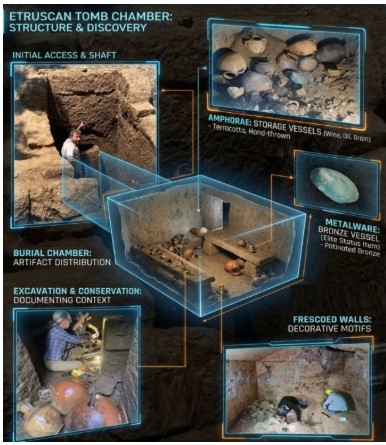
Archaeologists have uncovered a monumental Etruscan tomb at the Polledrara necropolis of ancient Vulci, central Italy.
- The tomb dates to the late 7th century BCE, making it around 2,700 years old.
- 1889 Connection – In 1889, French archaeologist Stéphane Gsell identified and mapped the circular burial mound, now known as the Gsell Tumulus.
- He could not locate the actual burial chamber because his excavation ended due to limitations of time and funding.
- The 2026 Return to Vulci project has now uncovered the chamber believed to be the tomb Gsell was searching for.
- Major Finds – The tomb, called the “Tomb of the Stone Chamber,” yielded:
- Weapons and chariot components
- Gold and bronze objects
- Jewellery and clothing-related artefacts
- Rare women’s shoes
- High-quality pottery
- An almost complete banquet service
- A bronze tripod made on Rhodes, indicating long-distance Mediterranean connections.
- Etruscan Civilization – The Etruscans developed a major civilization in central Italy before Roman dominance.
- Their society was strongly connected to Mediterranean trade and cultural exchange.
- Monumental tombs and rich grave goods provide important evidence about their social hierarchy, funerary practices, warfare, trade and elite culture.
- UNESCO recognises Etruscan necropolises such as Cerveteri and Tarquinia for their exceptional evidence of Etruscan civilization
|
|
Geography
|
|
India’s first world-class geological museum
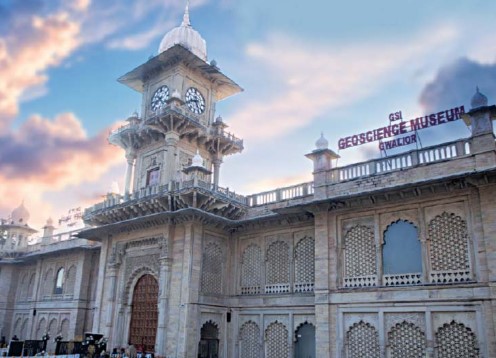
Country’s first world-class geological museum to be developed in Madhya Pradesh
- Location – It is proposed at the Bhedaghat–Lamhetaghat area in Jabalpur, Madhya Pradesh.
- Significance – The site is significant for understanding the geological history of the Narmada Valley.
- Major Attractions – Geological museum and interpretation centre with 6 galleries and 130+ exhibits.
- 3D models, interactive touch tables, digital panels and immersive theatre.
- Titanosaur Square, dinosaur park, fossil garden, geological maze and rock garden.
- Tree-top walkway, glass floor, nature trails and viewing decks.
- Environmental Focus – Emphasis on conserving the natural surroundings and existing trees.
- At least 90% of the area is targeted to remain green.
- Broader Facilities – Restaurants, food courts, local-product shops and an eco-resort will also be developed, combining geological education with sustainable tourism.
|
|
International Relations and Issues
|
|
International Day for Universal Access to Information
The International Day for Universal Access to Information is observed globally on September 28 to highlight the fundamental right to seek, receive, and impart information.
- 2026 Theme and Focus
- Themes – "Upholding Information Integrity in the Digital Age: The role of access to Information in addressing Information Disorder".
- Core Goal – Tackling misinformation and disinformation by promoting timely, reliable, and credible public data.
- Key Elements – Emphasizes proactive disclosure, media and information literacy, and digital technologies to build a healthy information ecosystem.
- Global Observance & Events
- Global Conference – Hosted by UNESCO and the Government of Sierra Leone from September 28–30, 2026, in Sierra Leone.
- Milestone – Marks the 10th anniversary of the international observance first held in 2016.
- Back-to-Back Events – Held alongside the 17th International Conference of the Information Commissioners (ICIC).

|
|
Sea-Level Rise Declaration 2026
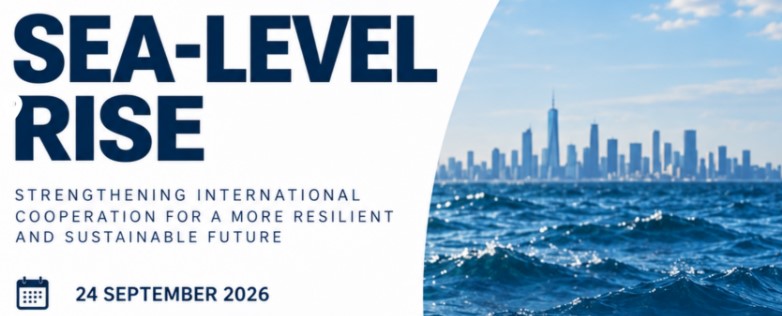
The UN General Assembly (UNGA) decided to convene a one-day high-level plenary meeting on sea-level rise.
- The decision was taken through UNGA Decision 78/558 on 1 August 2024.
- The meeting is to be held no later than the last day of the general debate of the 81st session.
- Main Objective
- Strengthen international cooperation and collective action on sea-level rise.
- Support developing countries, particularly those highly vulnerable to climate change.
- Assist coastal communities in Building resilience, Adapting to sea-level rise, Addressing its adverse impacts.
- Expected Outcome – The meeting will produce a concise, action-oriented declaration.
- The declaration will be Intergovernmentally negotiated and agreed by consensus
- The meeting is explicitly stated to not set a precedent for similar meetings.
|
|
Health
|
|
World Rabies Day 2026
World Rabies Day 2026 is observed on September 28 with the theme "Stronger Together" to highlight multi-sector cooperation for global rabies elimination.
Key Details of World Rabies Day 2026
- Theme – "Stronger Together" — emphasizing a unified One Health approach joining communities, governments, veterinarians, and healthcare workers.
- Significance – Commemorates the death anniversary of Louis Pasteur, who developed the first effective rabies vaccine.
- Global Goal – Reaching zero human dog-mediated rabies deaths by 2030.
- Prevention and Immediate First Aid
- Wound Care – Wash any animal bite or scratch immediately with soap and running water for at least 15 minutes.
- Medical Care – Seek emergency medical attention right away for post-exposure prophylaxis (PEP) before clinical symptoms appear.
- Animal Vaccination – Ensure domestic pets receive routine rabies vaccinations to interrupt transmission at the source.

|
|
Environment
|
|
Begonia rajvikramanii: New Species
Researchers from JNTBGRI, Thiruvananthapuram, have discovered a new Begonia species in the Western Ghats of Kollam, Kerala, during an exploration of wild ornamental plants.
- Habitat – The species, Begonia rajvikramanii, was found on wet rocky cliffs and road-cut walls at elevations of 200–350 metres in the evergreen forests of Rosemala.
- It flowers and fruits between August and April.
- Naming – The species is named after R. Raj Vikraman, former Head of Garden Management Division, JNTBGRI, recognising his contribution to ex-situ plant conservation.
- Conservation – Only about 200 mature individuals are known, occupying less than 5 km². It is currently classified as Data Deficient (DD) under IUCN criteria.
- Significance – The genus Begonia has about 2,200 accepted species globally, with 23 species in the Western Ghats, highlighting the region’s rich floral biodiversity.

|
|
Security
|
|
ICGS Shaunak
The Indian Coast Guard Ship Shaunak sailed from Chennai on September 25, 2026, to mark the start of the QUAD-at-Sea Ship Observer Mission.
- ICGS Shaunak – It is an indigenously built Samarth-class Offshore Patrol Vessel (OPV) designed and constructed by Goa Shipyard Limited. Commissioned on February 21, 2017, it provides the physical framework for the current observer mission.
- Technical Specifications & Capabilities
- Dimensions – 105 metres long, drawing a displacement of approximately 2,450 to 2,500 tons.
- Propulsion – Powered by twin 9,100 kW diesel engines, achieving a maximum speed of 26 knots.
- Endurance – Capable of sailing 6,500 nautical miles at economical speeds before needing replenishment.
- Armament – Equipped with a 30 mm CRN 91 Naval Gun and advanced Fire Fighting Systems.
- Aviation & Boarding – Designed to house one twin-engine Light Helicopter and five high-speed boats (including two Quick Reaction Inflatable Boats) for search-and-rescue or rapid law enforcement.

|
|
Science
|
|
AI Incident Communication Channel
The United States and China agreed to establish a bilateral communication channel for artificial intelligence.
- Bilateral Hotline – Designed to manage risks and address unexpected artificial intelligence (AI) or "super intelligence" incidents.
- Terminology Change – Both nations agreed during the talks to use the term super intelligence (SI) instead of AI in official contexts, following a push by the US administration.
- Super Intelligence Dialogue – The two countries set up the U.S.-China SI Dialogue to discuss the risks and benefits of the technology, with the next exchange scheduled by November 2026.
- Broader Context – The announcement came alongside agreements on reciprocal tariff reductions on roughly US$30 billion of goods and discussions regarding geopolitical challenges.

|
|
Index
|
|
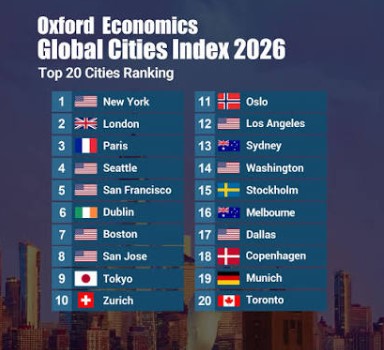
Oxford Economics Global Cities Index 2026
The Oxford Economics Global Cities Index 2026 ranks the world's 1,000 largest metropolitan areas across 163 countries based on present economic performance and future potential.
- Evaluation Categories
- The index evaluates cities across five core categories with varying weights:
- Economics (30%) – Assesses GDP size, income per person, and economic growth pace.
- Human Capital (25%) – Measures talent pool, educational attainment, and corporate presence.
- Quality of Life (25%) – Evaluates housing costs, life expectancy, crime rates, and cultural amenities.
- Environment (10%) – Examines air quality, carbon emissions, and climate risk exposure.
- Governance (10%) – Analyzes institutional quality and national-level governance frameworks.
|
|
Sports
|
|
India retained the Nona Gaprindashvili Trophy
India retained the Nona Gaprindashvili Trophy at the 46th Chess Olympiad in Samarkand, Uzbekistan.
- India emerged as the best overall nation by combining its performances in the Open and Women’s sections.
- This is India’s third consecutive Nona Gaprindashvili Trophy, following victories in 2022, 2024 and 2026.
Open Section
- Gold – Uzbekistan
- Silver – India
- Bronze – Germany
- India drew with Hungary in the final round and finished with 18 points.
- India secured silver ahead of Germany through a better tie-break score.
- Uzbekistan won gold with 20 points, defeating Ukraine 2.5–1.5.
Women’s Section
- Gold – China
- Silver – Kazakhstan
- Bronze – India
- India drew with Georgia in the final round.
- China finished with 20 points, defeating Vietnam 3–1.
Key Significance – The result highlights India’s consistent strength in both open and women’s chess, while the Nona Gaprindashvili Trophy recognises the best overall-performing nation across the two sections.

|



