|
One Liners 18-07-2026
|
|
Polity & Governance
|
|
Sabitri Dey @ Swasthi Dey vs Union of India
Recently, In Sabitri Dey @ Swasthi Dey v. Union of India (2026 INSC 694), the Supreme Court stressed fair and lawful citizenship determination.
- Background - The case arose from a 1997 Illegal Migrants (Determination) Tribunal (IMDT) declaring Sabitri Dey and her husband as illegal migrants after they failed to appear before the tribunal.
- Supreme Court's Order – It reaffirmed that citizenship and foreigner status must be determined through a fair, lawful and reasoned process, consistent with constitutional guarantees.
- SC set aside Gauhati High Court orders that upheld ex-parte (One-sided) foreigner declarations.
- Key ruling – Tribunals must give reasoned decisions and cannot rely only on police reports or ex-parte proceedings.
- Significance – The judgment protects Articles 14 and 21, ensuring no one is declared a foreigner without a fair process.
|
|
National Commission for Minorities
Harjit Singh Grewal appointed National Commission for Minorities chief.
- The National Commission for Minorities (NCM) is a statutory body in India established to protect and promote the interests of minority communities.
- It was created under the National Commission for Minorities Act, 1992.
- Notified Minority Communities
- Muslims
- Christians
- Sikhs
- Buddhists
- Zoroastrians (Parsis)
- Jains (notified in 2014)
|
|
Ban on Goods Made Using Forced Labour
India has officially banned the import of all goods produced or manufactured, wholly or in part, through the use of forced labour.
- This policy shift, introduced by the Directorate General of Foreign Trade (DGFT) via an amendment to the Foreign Trade Policy (FTP) 2023 in 2026, takes effect 30 days after publication.
- Definition of Forced Labour - The regulation adopts the ILO definition that any work or service extracted from someone under the threat of a penalty and for which they did not offer themselves voluntarily.
|
|
International Relations and Issues
|
|
12th BRICS Labour and Employment Ministers’ Meeting
The 12th BRICS Labour and Employment Ministers’ Meeting was held successfully in Hyderabad under India’s BRICS Chairship 2026.
- Theme – “Building for Resilience, Innovation, Cooperation and Sustainability (BRICS)”.
- India highlighted India's e-Shram and National Career Service (NCS) portals.
- The ministers also adopted Brics CONNECT.
- It is an India initiative to establish a platform for technical cooperation among member countries on labour and employment.
- The declaration also took note of an ongoing International Labour Organization (ILO) feasibility study on an International Reference Classification of Occupations (IRCO).
- It also recognises the growing importance of gig and platform work and calls for labour market transitions through knowledge sharing and South-South cooperation.
- India holds the BRICS chairship in 2026.
|
|
Assisted-dying Bill
France's National Assembly gave final legislative approval to a landmark assisted-dying bill.
- It aims to grant terminally ill, mentally competent adults the legal right to choose the timing and manner of their death, avoiding prolonged suffering.
- The law limited to persons who meets following conditions –
- Patients must be at least 18 years old.
- Applicants must be French citizens or legal residents.
- Must have a serious, incurable, and life-threatening illness in an advanced or terminal phase.
- Must experience constant physical or psychological suffering that cannot be relieved.
- Patients must be fully conscious and able to express free and uncoerced consent.
- Note – Psychological suffering alone does not qualify, and individuals with severe psychiatric conditions or neurodegenerative disorders like Alzheimer’s are excluded.
|
|
Economy
|
|
New solar and wind power capacity 2026
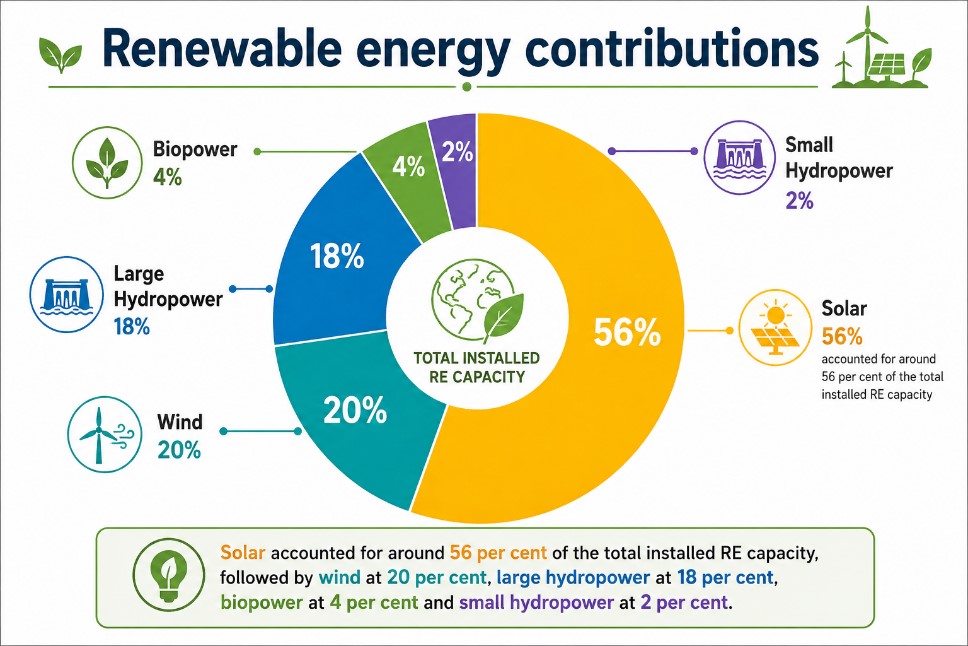
- India installed a record 29 gigawatts (GW) of new solar and wind power capacity during the first half of 2026.
- India was adding about 26 GW of solar and 2.9 GW of wind capacity.
- India's cumulative renewable energy (RE) installed capacity was about 288 GW.
- It was showed by the Union Ministry of New and Renewable Energy (MNRE).
- This growth was attributed primarily to the PM Surya Ghar: Muft Bijli Yojana.
- It accounted for a majority of rooftop solar installations during the period.
- Gujarat emerged as the largest contributor to solar installations followed by Rajasthan and Tamil Nadu.
- In the wind sector, Gujarat also led capacity additions, representing 43 % of the total, followed Maharashtra and Karnataka.
- Significance – These steps are supporting India's target of achieving 500 GW of non-fossil fuel-based electricity capacity by 2030.
PM Surya Ghar: Muft Bijli Yojana
- It is a Government of India initiative launched to provide up to 300 units of free electricity per month to 1 crore households.
- Eligible residential consumers receive a substantial government subsidy to install rooftop solar panels, reducing their overall electricity bills.
- Households generate their own electricity, significantly lowering monthly bills, and can even sell excess power generated back to the grid through net-metering.
|
|
Science
|
|
White Rabbit Technology
Minister for Consumer Affairs, Food and Public Distribution recently inaugurated the White Rabbit Technology.
- White Rabbit (WR) is an open-source, Ethernet-based network technology that provides ultra-accurate time synchronization and deterministic data transfer across large distributed networks.
- Under vision of – ‘One Nation, One Time,’ a uniform, highly precise and secure time standard across India.
- Led by – Legal Metrology Division of the Ministry of Consumer Affairs, in collaboration with ISRO, the National Physical Laboratory (NPL), BSNL, and SEBI.
- Objectives –
- To reduce dependence on foreign time sources like GPS,
- To strengthen India's digital sovereignty and protecting critical infrastructure.
- Advantages – Critical sectors will gain maximum protection against risks such as cyberattacks and data manipulation.
- It enhances stability of high-frequency financial markets, stock exchanges, digital banking payments, telecommunications networks, and national power grids.
|
|
Ultrafast Organic Anodes Designed for Next-Generation Rechargeable Batteries
- These represent a pioneering class of battery components designed to replace traditional inorganic graphite anodes.
- By using carbon-based molecular frameworks instead of heavy transition metals, these materials enable rapid charging, sustainability, and reduced costs.
- In recent breakthroughs, researchers have successfully engineered organic anodes that allow batteries to reach an 80% state of charge in just over 1 minute.
|
|
Index
|
|
Investment Friendliness Index (IFI)
Recently the Investment Friendliness Index (IFI) is released.
- It is a data-driven framework to assess how effectively states and Union Territories create an environment for investments.
- Launched by – NITI Aayog.
- Objective – To strengthen competitive and cooperative federalism by benchmarking state-level reforms and encouraging the adoption of best practices.
- The index grades states on a 100-point scale using 84 specific indicators.
- It combines official secondary data with direct feedback from investor perception surveys, evaluating regions across 8 core pillars –
- Infrastructure
- Business Climate
- Resources
- Government Policy
- Regulatory Ease
- Institutional Environment
- Financial Health
- Environmental Resilience
|
|
Space Exploration Gallery
Recently Space Exploration Gallery is inaugurated by CM of Madhya Prdaesh and union Union Minister of Culture and Tourism, Government of India.
- Located at – Bhopal, Madhya Pradesh.
- Key features –
- Interactive Simulators – Visitors can use flight simulators and enjoy an immersive virtual spacewalk experience.
- 3D Planetary Models – Walk through interactive, 3D surface views of the Moon and Mars.
- Space Missions – In-depth exhibits covering India's major achievements, including the Aryabhata, Chandrayaan, and Gaganyaan programs
- It aims to promote scientific thinking, first of its kind in the country.
|
|
Miscellaneous
|
|
World Youth Skills Day 2026
- Observed on – July 15.
- Established by – United Nations in 2014.
- Theme for 2026 – "Skills for a Shared Future".
- The day is celebrated to mark the strategic importance of equipping young people with skills for employment, decent work and entrepreneurship.
|
|
Nelson Mandela International Day 2026
- Observed annually on – July 18
- Established by – United Nations in 2009.
- Theme for 2026 – “It's still in our hands to combat poverty and inequity”
- In commemoration of – Marking the birth anniversary of the global icon and former South African President.
- The day celebrates Mandela's lifelong commitment to human rights, racial equality, and reconciliation.
- People around the world are encouraged to dedicate 67 minutes of their time to community service and acts of kindness.
|