|
One Liners 16-10-2026
|
|
History, Art and Culture
|
|
An Early Bronze Age shipwreck
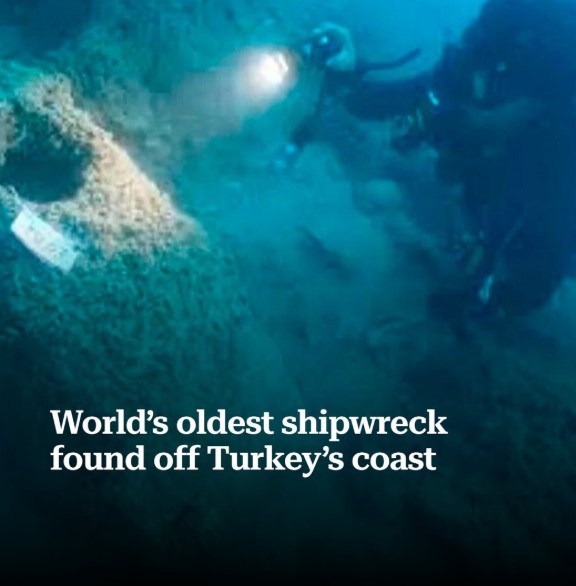
An Early Bronze Age shipwreck discovered off the coast of Kekova Island in Antalya, Turkey is believed to be the world's oldest known shipwreck.
Key Details of the Discovery
- Age & Period– Estimated to be 4,400 to 4,700 years old (dating roughly between 2700 and 2400 BCE), placing it in the Early Bronze Age around the time the Great Pyramid of Giza was built. It surpasses the previous record holder, a wreck near the Greek island of Dokos (dated to about 4,200 years ago).
- Location & Depth– Found in the Mediterranean Sea near Kekova Island in Antalya province, Turkey, at a depth of about 30 metres (approx. 100 feet) on an underwater slope.
- The Vessel– The wooden hull of the roughly 10-metre-long trading ship has completely decayed and disappeared over time.
- Cargo & Artifacts– Archaeologists recovered more than 30 ceramic storage jars (amphorae) with flat bases and side handles, along with three stone anchors. Some jars still contain preserved residues potentially consisting of olive oil, wine, or tree resins, and one unique amphora features markings that may relate to processing dairy products like butter or cheese.
- Trade Route– Researchers led by Professor Hakan Öniz of Akdeniz University and the Mediterranean Archaeology Association believe the merchant ship originated in the eastern Mediterranean and was likely bound for ancient Troy or Minoan Crete.
- Exhibition– The recovered artifacts are managed under the Turkish Ministry of Culture and Tourism and are slated for display at the new Mediterranean Underwater Archaeology Museum in Antalya.
|
|
International Relations and Issues
|
|
India’s Oil Imports
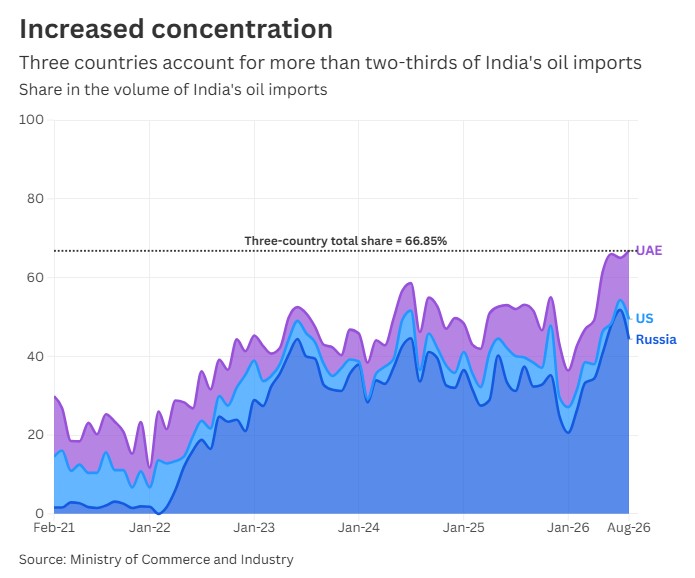
In August 2026, Russia, the United States and the UAE together accounted for 66.8% of India’s oil imports by volume.
- India’s Oil Import Scenario
- Total imports– 191.2 lakh tonnes in August 2026.
- Imports declined by 10.3% compared with July 2026, but increased by 3.4% year-on-year.
- Oil import bill– $12.2 billion, nearly 25% higher than in August 2025, mainly reflecting elevated oil prices.
- Their combined share of India’s oil import bill was even higher, at 67.8%.
- Russia’s Share Remains Significant
- Russia’s share declined from a record 51% in July to 44.3% in August 2026.
- Imports from Russia fell by 23% month-on-month but remained 22.5% higher than in August 2025.
- Russian oil accounted for 44.5% of India’s total oil import expenditure in August.
- Rising Imports from the U.S. and UAE
- United States
- Imports reached 9.7 lakh tonnes, accounting for 5.1% of the total.
- Import volume increased nearly 82% compared with July and over 130% year-on-year.
- India paid an average of $810.6 per tonne, compared with the overall average of $640 per tonne.
- United Arab Emirates (UAE)
- Imports rose to 33 lakh tonnes, accounting for 17.4% of the total.
- The UAE accounted for 16.9% of India’s oil import bill.
- Alternative supply routes through ports relatively unaffected by the West Asian conflict supported these imports.
|
|
Economy
|
|
India’s Largest Integrated Phenol–Acetone Plant
The Rs 6,000 crore integrated phenol and acetone plant inaugurated at Haldia
- Location– Haldia, West Bengal
- Inaugurated– 14 October 2026
- Developer– Adperma Private Limited, a wholly owned subsidiary of Haldia Petrochemicals Limited
- Investment– ₹6,000 crore
- It is India’s largest integrated phenol and acetone plant.
- It is the first phenol manufacturing facility on India’s eastern coast.
- Annual Production Capacity
- Phenol – 3.45 lakh tonnes
- Acetone – 2.15 lakh tonnes
- Phenol
- Chemical formula– C₆H₅OH
- An aromatic organic compound.
- Major uses–
- Phenolic resins
- Bisphenol A
- Pharmaceuticals
- Plastics and synthetic materials
- Acetone
- Chemical name– Propanone
- Formula– C₃H₆O
- A widely used industrial solvent and chemical feedstock.
- Used in the production of various industrial products, including plastics, coatings and synthetic materials.
- India’s First On-Purpose Propylene Unit
- The facility houses India’s first on-purpose propylene unit.
- Propylene is an important petrochemical feedstock used to produce–
- Polypropylene
- Propylene oxide
- Acrylonitrile
- On-purpose production means manufacturing a chemical specifically to meet market demand rather than obtaining it mainly as a by-product.
- The plant uses olefin conversion technology to produce propylene.
- Industrial Significance
- Strengthens India’s domestic petrochemical manufacturing capacity.
- Supports the downstream industries using phenol, acetone and propylene.
- Reduces dependence on imported petrochemical products.
- Enhances the industrial importance of Haldia as a petrochemical hub.
- Employment Generation
- Direct employment– Around 400 jobs
- Indirect employment– Around 1,000 jobs

|
|
India’s coir exports
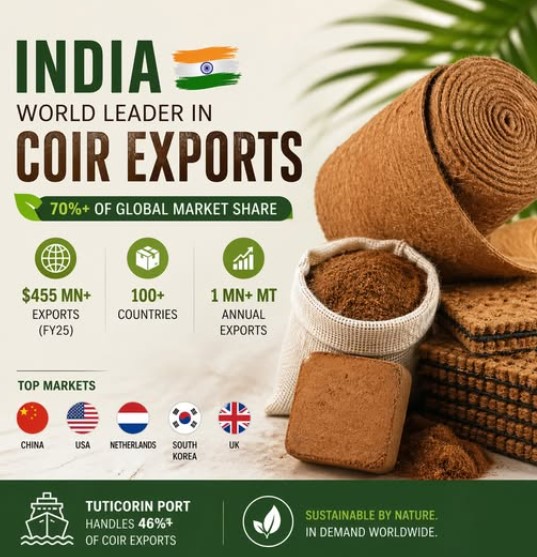
India's exports of coir and coir products reached ₹6,614.40 crore (approximately $694 million) in FY 2025–26, according to the Ministry of MSME Press Release.
- Export Growth– Rose by 305.70% (more than quadrupled) compared to ₹1,630.33 crore in FY 2014–15.
- Global Share– India is the world’s largest producer and exporter of coir, accounting for about two-thirds of total global production.
- Industry Scale– The Indian coir industry has an estimated turnover of ₹16,000 crore and contributes nearly 1% to India's GDP.
- Top Export Markets– China, the United States, the Netherlands, Spain, and the United Kingdom. China is the largest importer (accounting for ~26.79%), followed by the USA (~16.45%) and the Netherlands (~10.00%).
- Major Products Exported– Coir pith, coir fibre, coir yarn, and tufted mats (with coir pith making up the largest share of export value).
- Employment & Workforce– The sector supports over 7 lakh workers across more than 21,000 Udyam-registered units, with 80% of the workforce being women from rural households.
- Key Government Support– Driven by the Coir Vikas Yojana (CVY) scheme, which funds skill training (over 68,000 persons trained), technology development (150+ new machines/products), and the Export Market Promotion scheme.
|
|
India–China Trade Deficit Crosses $100 Billion in 2026
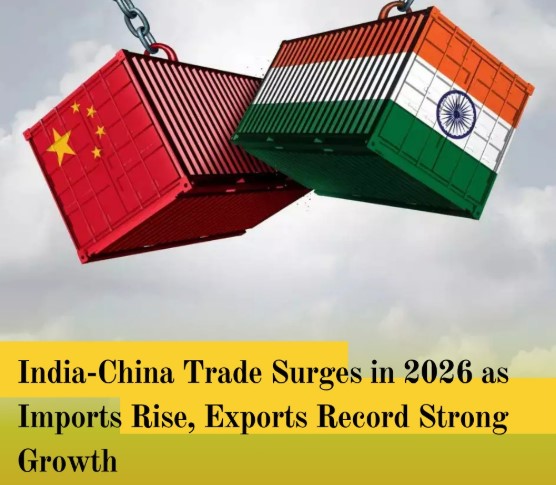
In January–September 2026, India–China bilateral trade increased by 25.4% to $144.45 billion.
- India’s imports from China– Rose 23.3% to $125.19 billion.
- India’s exports to China– Increased 40.7% to $19.26 billion.
- Despite strong export growth, the trade relationship remains heavily tilted in China’s favour.
- Widening Trade Deficit
- India’s trade deficit with China reached $105.93 billion during January–September 2026.
- The deficit is on track to exceed the 2025 record of $116.12 billion.
- The imbalance remains a major concern for India.
- India’s Major Exports to China
- India’s exports have shown significant growth and include Seafood products, Naphtha and Printed circuit boards (PCBs).
- India’s exports to China have already reached almost the level of the entire previous year.
- Why the Trade Imbalance is a Concern?
- Limited market access for Indian companies in China.
- Heavy dependence on China for industrial intermediates.
- Continued imports of finished goods, particularly Electronics, Machinery.
- This creates vulnerabilities in India’s manufacturing and supply chains.
- Chinese Export Controls
- India is increasingly concerned about Chinese export restrictions in critical sectors.
- These include fertilisers and rare earth elements.
- Such restrictions raise concerns regarding supply-chain security and strategic dependence.
- India–China Discussions
- The trade imbalance was discussed during the meeting between Prime Minister Narendra Modi and Chinese President Xi Jinping on the sidelines of the BRICS Summit.
- Both sides highlighted the need to address Structural trade imbalance, Supply-chain issues, Predictable and meaningful market access and Balanced economic and trade relations.
|
|
Sports
|
|
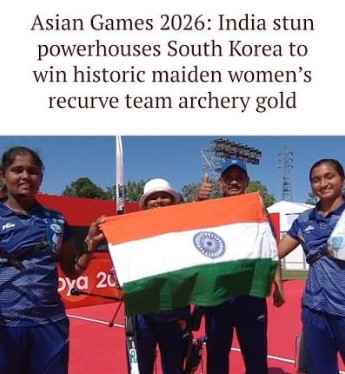
India’s Maiden Asian Games Gold in Women’s Recurve Archery
India won its first-ever Asian Games gold medal in the women’s recurve team event at the 2026 Asian Games in Aichi-Nagoya, Japan.
- India defeated South Korea 5–3 in the final.
- It was particularly significant because India had never previously reached the final of this event at the Asian Games.
- Indian Gold-Medal Team
- The Indian trio comprised–
- Ankita Bhakat
- Kirti Sharma
- Kumkum Anil Mohod
- They defeated the South Korean team of Kang Chaeyoung, Oh Yejin and Lee Yunji.
- Breaking South Korea’s Dominance
- South Korea had been the dominant force in women’s recurve archery at the Asian Games.
- India’s victory ended Korea’s seven consecutive women’s recurve team titles at the continental Games.
- The victory therefore marked a major milestone for Indian recurve archery.
- Kumkum Mohod – Star Performer
- 17-year-old Kumkum Anil Mohod played a crucial role in India’s historic victory.
- She later created another piece of history by becoming the first Indian woman to win Asian Games gold in the individual recurve event.
- In the individual final, she defeated South Korea’s Oh Yejin in a shoot-off after the match was tied 5–5.
- Significance for India
- First Asian Games gold– Women’s recurve team event.
- First individual women’s recurve gold– Kumkum Mohod.
- Demonstrates India’s growing strength in international archery.
- Kumkum’s individual victory also secured an LA 2028 Olympic quota place for India.
|
|
First Recipients of New IOA Awards 2026
Archer Kumkum Mohod and wrestler Sujeet Kalkal are the first-ever recipients of the new Indian Olympic Association (IOA) awards following the 2026 Aichi-Nagoya Asian Games.
- Kumkum Mohod
- Award– Jaspal Rana Award (Best Female Sportsperson)
- Sport– Recurve Archery
- Age– 17 years old
- Achievements– Won three medals (two gold and one silver), including the women's individual recurve gold and the women's recurve team gold (which broke South Korea's long-standing Asian Games win streak). Her individual gold also earned an Olympic quota for the 2028 Los Angeles Games.
- Sujeet Kalkal
- Award– Raja Randhir Singh Award (Best Male Sportsperson)
- Sport– Freestyle Wrestling (65 kg category)
- Age– 23 years old
- Achievements– Won the gold medal in the men's 65 kg freestyle event, defeating Japan's Olympic champion Kotaro Kiyooka in the semifinals and staging a comeback win in the final. About the Awards
- Purpose– Honoring the top-performing female and male athletes of the Asian Games.
- Tribute– Named in memory of Indian sports icons Jaspal Rana and Raja Randhir Singh, who passed away earlier in 2026.

|
|
Miscellaneous
|
|
World Food Day 2026
World Food Day 2026 is observed on Friday, October 16, 2026, marking the founding anniversary of the Food and Agriculture Organization (FAO) of the United Nations in 1945.
- Theme– "Innovate today. Nourish tomorrow."
- Core Message – Emphasizes scaling up science, data, technology, and artificial intelligence to build climate-resilient, sustainable, and inclusive food systems.
- Global Context– Highlights that approximately 645 million people face chronic hunger, while billions cannot afford a healthy diet due to climate shocks, inflation, and conflicts.
- Key Events & Initiatives
- World Food Forum (WFF) – Held from October 8–16, 2026, at the FAO Headquarters in Rome, Italy, uniting youth, scientists, and policymakers.
- Global Awareness – Activities span nearly 150 countries, featuring high-profile displays (such as LG video promos in Times Square and Piccadilly Circus) and regional agricultural forums.
- Youth Engagement – An international poster contest is open for children and youth aged 5–19 with a deadline of November 6, 2026.

|
|
Global Handwashing Day
Global Handwashing Day is observed annually on October 15, with the 2026 campaign centered on the theme “Be a Handwashing Hero!”
- Established – 2008 by the Global Handwashing Partnership (GHP)
- Core Purpose – To promote handwashing with soap and clean water as a simple, affordable, and lifesaving habit to prevent respiratory and diarrheal infections. Why Handwashing Matters
- Disease Prevention – Proper hand hygiene reduces the risk of diarrheal diseases by roughly 40% to 50% and acute respiratory infections by 20% to 25%.
- Recommended Technique – Wet hands with clean running water, apply soap, scrub thoroughly for 20 seconds, rinse well, and dry with a clean towel or air dry.
- Key Times to Wash– Before eating or preparing food, after using the restroom, after handling waste, after caring for someone who is sick, and after returning from crowded public space.

|
|
International Day of Rural Women
The International Day of Rural Women on October 15, 2026, is observed under the theme “Rural Women Farmers Caring for Mother Nature.”
Key Details for 2026
- Official Theme – “Rural Women Farmers Caring for Mother Nature” focuses on seed conservation, biodiversity protection, water management, and land restoration by rural women.
- Broader Context – 2026 is also designated by the United Nations as the International Year of the Woman Farmer, highlighting women's contributions to sustainable agrifood systems.
- Core Purpose – The day honors rural and indigenous women for driving agricultural development, enhancing food security, and reducing rural poverty.
- Key Challenges – Rural women frequently face unequal land and water rights, limited access to finance and markets, lower pay, and heavy unpaid care work.

|



