Prelims: Current events of national and international importance | Science & Technology
Why in News?
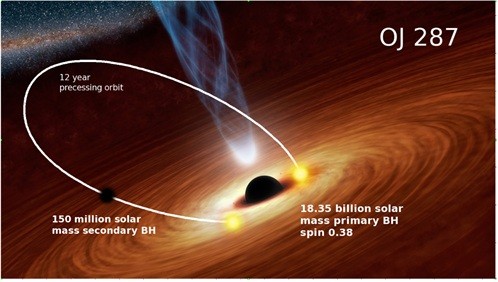
Recently, the study of the famous blazar OJ 287, led by scientists from the Aryabhatta Research Institute of Observational Sciences (ARIES) in Nainital, provided crucial new insights into its rare supermassive binary black hole (SMBH) system.
Key Observations
- System Architecture - Located approximately 4 billion light-years away in the constellation Cancer.
- OJ 287 is an active galactic nucleus (AGN) belonging to the BL Lacertae (BL Lac) blazar class.
- It features a secondary supermassive black hole orbiting a primary black hole in a tight, precessing 12-year orbit.
- Mass Refinement of Central Black Hole - By analyzing 8 optical spectra recorded during low-brightness states using the Steward Observatory (USA), researchers evaluated the spectral broadening of the [O III] emission line.
- This spectral analysis established that the central primary black hole's mass is at least 3.89 billion solar masses.
- Multi-Wavelength Flickering- The 10-year monitoring program recorded complex optical and X-ray variability.
- It helps untangle the complex interplay between thermal accretion disc emission, non-thermal jet radiation, and periodic impact flares produced when the smaller companion pierces the primary's accretion disc twice per orbit.
Significance
- Testing General Relativity in Extreme Gravity Regimes
- OJ 287 serves as a natural cosmic laboratory to test Einstein's theory of General Relativity in strong gravitational fields.
- The companion's extreme orbital precession rate (~39° per orbit), driven by energy loss from gravitational wave radiation, provides direct observational validation of general relativistic orbital mechanics.
- Multi-Messenger Astronomy Target
- Supermassive binary black hole systems like OJ 287 are prime candidate sources for low-frequency gravitational waves detectable by Pulsar Timing Arrays (PTAs) and future space-based detectors like LISA.
- Linking electromagnetic variations (light, X-rays) with gravitational wave predictions bridges key gaps in multi-messenger astrophysics.
- Understanding Relativistic Jet Formation - Insights into how dual black hole dynamics affect jet precession, particle acceleration, and energy output help explain how relativistic jets in active galaxies are powered and sustained.
Reference
PIB | Rare giant binary black hole system



