Prelims: Current events of national and international importance | Science & Technology
Why in news?
A breakthrough metal-free catalyst developed by scientists could significantly reduce the cost of next-generation clean-energy technologies.
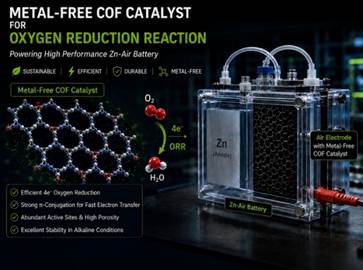
- New Material (TTT-DHTD) – It is a metal-free porous organic framework designed for energy applications.
- The material contains numerous microscopic pores, providing a large surface area for chemical reactions and functioning as an efficient electrocatalyst in water-splitting reactions used to produce hydrogen.
- Name – The material, named TTT-DHTD, was prepared using 2,4,6-tris(4-aminophenyl)-1,3,5-triazine (TTT) and 4,8-dioxo-4,8-dihydrobenzo[1,2-b:4,5-b’]dithiophene-2,6-dicarbaldehyde (DHTD) linkers.
- Developed by – Researchers from the S.N. Bose National Centre for Basic Sciences (SNBNCBS), Kolkata, the Institute of Nano Science and Technology (INST), Mohali and SRM University, Amaravati.
- Nodal Department – Under the Department of Science and Technology (DST).
- Made from – Made entirely from abundant elements such as carbon, sulfur, nitrogen and hydrogen, the material forms an ultra-porous, honeycomb-like network that facilitates the conversion of oxygen into electricity.
- Zinc-air (Zn-air) batteries – They generate electricity through the oxygen reduction reaction (ORR), in which oxygen from the air reacts at the electrode.
- The efficiency of this reaction plays a critical role in determining battery performance.
- Zn-air batteries are considered a promising option for next-generation energy storage because they use zinc, an abundant, relatively inexpensive and safe material, while drawing oxygen directly from the air instead of storing an active cathode material.
- Comparison with Li-ion and Hydrogen fuel cells
- Lithium-ion batteries – Zn-air systems have the potential to offer higher theoretical energy density, lower material costs, improved safety and greater sustainability.
- Hydrogen fuel cells – Zn–air batteries can provide a simpler, more compact energy storage solution that does not require high-pressure hydrogen storage or extensive hydrogen infrastructure.
- Need for new catalyst – Many such clean-energy technologies currently rely on platinum as an ORR catalyst because of its high catalytic efficiency. However, platinum’s high cost, scarcity and limited availability remain significant barriers to large-scale deployment.
- Achieved Result – Laboratory tests showed that the catalyst achieved about 96% of the performance of commercial platinum catalysts while demonstrating high stability.
- It maintained its performance after 120 hours of continuous operation without the degradation or contamination that can affect conventional metal-based catalysts.
- Significance – Replacing platinum with inexpensive organic materials could reduce the cost of Zn-air cells and potentially support wider adoption in clean transportation, portable power systems and renewable-energy storage.
- The development could contribute to efforts to create more affordable, durable and sustainable energy-storage and fuel-cell technologies.
Reference
DD News | New metal-free porous material could help make clean energy more affordable



