- Swachh Bharat Mission Focus – Scientific management of municipal solid waste has been a core goal since its launch in October 2014.
- Waste as a Resource – Organic waste is now recognized as a valuable resource to generate clean energy, electricity, fuel, and organic fertilizer.
- Benefits of Biogas –
- Produced via anaerobic decomposition of organic waste.
- Offers a viable, economical, and eco-friendly cooking fuel.
- Leaves a nitrogen-rich slurry by-product that acts as an effective organic fertilizer, reducing chemical dependencies and maintaining soil fertility.
- Diverse Applications (SBM-Urban 2.0) – Waste-to-energy adapts across India based on community needs –
- Hyderabad – Vegetable markets power streetlights using rotten produce.
- Prayagraj – Multi-feedstock bio-CNG plant transforms organic waste into clean fuel and compost.
- Gandhinagar – An educational institution cooks for 500+ people daily without LPG.
- Gwalior – A gaushala turns cow dung into compressed biogas.
Key Case Studies
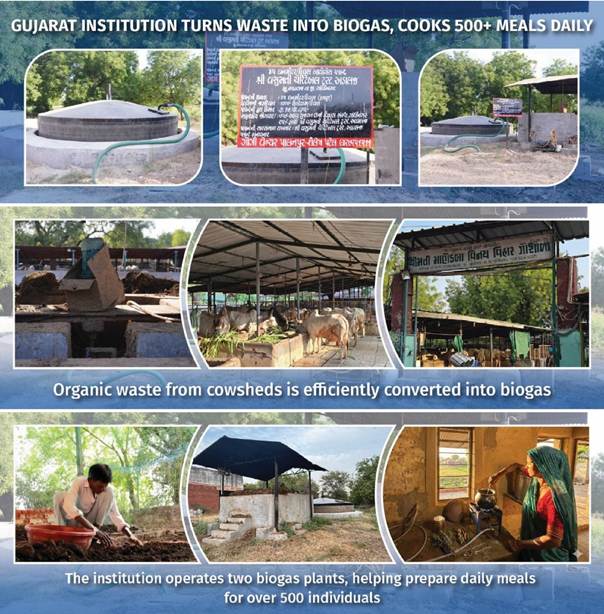
Gandhinagar – Educational Campus Eliminating LPG Dependence
- Location – Shrimati Manekba Vinay Vihar Educational Complex, near Adalaj, Gujarat (managed by Vasumati Charitable Trust).
- Scale of Impact – Cooks daily for 500+ people (250 hostel students getting 2 meals/day, plus 15 staff families).
- Infrastructure and Capacity –
- Operates two biogas plants with a combined capacity of 90 cubic metres per day.
- Eliminates the need for 30 LPG cylinders per month.
- Feedstock Used – Dung from 222 campus cows, supplemented by kitchen waste and local agricultural residue.
- Institutional Support – Supported by the Gujarat government’s Institutional Biogas Plant Scheme and the Gujarat Energy Development Agency (GEDA).
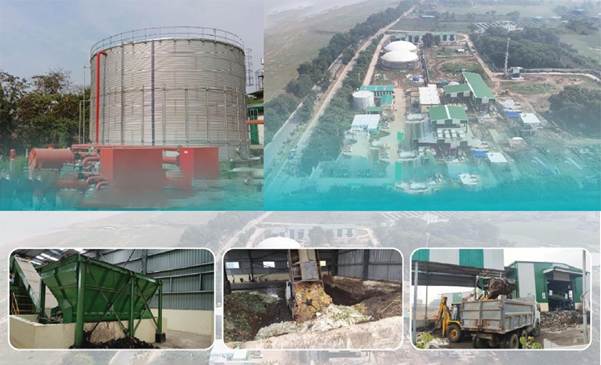
Prayagraj – One Plant, Four Feedstocks
- Capacity and Production –
- Processes 343 tonnes of organic waste daily.
- Produces 21 tonnes of bio-CNG and 28 tonnes of high-quality compost per day for local farmers.
- Multi-Feedstock Model – Uses wet waste, paddy straw, cattle dung, and poultry litter—helping mitigate regional stubble burning.
- Operational Highlights –
- Built on a Public-Private Partnership (PPP) model.
- Absorbs bulk organic waste from local hotels, restaurants, and apartments.
- Daily wet-waste processing grew from an initial 7–8 tonnes to 125 tonnes.
- Distribution and Future Scope –
- Bio-CNG is sold via the CBG-CGD Synchronisation Scheme to power city transport.
- Projected to extend piped clean gas access to ~45,000 households and offset 57,000 tonnes of carbon emissions annually.
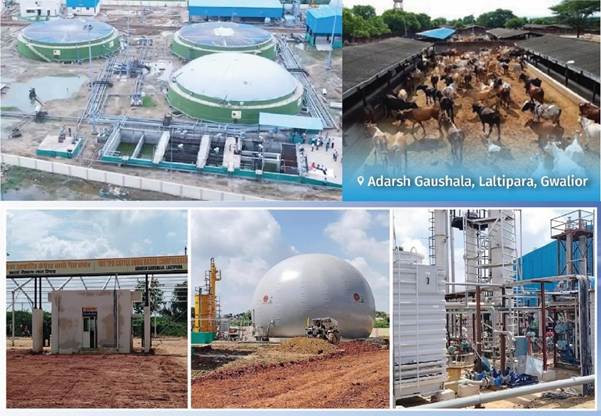
Gwalior – A Gaushala Turned Power Plant
- Location – Adarsh Gaushala in Laltipara (Gwalior’s largest cowshed, home to over 10,000 cattle).
- Facility Details –
- In August/October 2024, inaugurated a 100 tonnes-per-day (TPD) Compressed Bio-Gas (CBG) plant.
- Built over 5 acres with a Rs.31-crore investment in collaboration with Indian Oil Corporation.
- Dual Processing and Output –
- Processes cattle dung alongside vegetable/fruit waste from markets and homes (Madhya Pradesh’s first plant to do so).
- Converts 100 tonnes of dung into 2 tonnes of compressed biogas and 10–15 tonnes of dry bio-manure daily.
- Community Impact – Reduces carbon emissions, promotes organic farming, and creates local green energy employment opportunities.
Bowenpally – Powering a Vegetable Market
- Waste Processing – Collects ~10 tons of fruit and vegetable waste daily that previously went to landfills.
- Energy Output – Generates 400–500 units of electricity and 30 kg of biofuel per day.
- Application of Generated Energy –
- Electricity runs market streetlights, stalls, administration buildings, water pumps, and cold storage rooms.
- Biofuel feeds the market's commercial kitchen via pipelines.
- Economic Impact –
- Cut the market’s monthly electricity bill by roughly half (from an average of Rs.3 lakh/month).
- Led to funding for 5 additional plants across other market yards (Gudimalkapur, Gaddiannaram, Erragadda, Alwal, and Saroornagar).
- Operational Process – Vegetables are shredded and ground into a slurry, processed in anaerobic digesters, stored in gas balloons, and fed to a 100% biogas generator.
- Social Impact and Women Empowerment –
- Creates steady jobs for local women in waste sorting, machine operation, and administration.
- Provides competitive wages and essential safety gear (masks, gumboots, gloves).
What Ties These Stories Together
- Circular Resource Recovery – Shifts the perspective on organic waste from a disposal issue to an energy and agricultural asset.
- Broader Expansion – Transforms urban waste management under the Swachh Bharat Mission into a continuous model of processing and energy generation.
- Path to Sustainability – Combines scientific waste management, community participation, and supportive policy to establish scalable, cleaner, and self-reliant cities.
Reference
PIB



