Mains: GS II – Polity and Governance
Why in News?
Recent protests and subsequent government actions in India have raised significant concerns regarding the diminishing space for democratic dissent in the country.
What is dissent in Constitutional Democracy?
- Dissent – In every constitutional democracy, the right to disagree with the government is not a privilege granted by those in power; rather, it is a fundamental right guaranteed by the Constitution.
“Dissent is the safety valve of democracy. If dissent is not allowed, the pressure cooker may burst.”
- The freedom to question, criticise, protest, and seek accountability forms the very foundation of democratic governance.
- When these freedoms are curtailed through the use of criminal law, prolonged incarceration or arbitrary restrictions on speech and assembly, democracy itself begins to weaken.
- It ensures that state power remains accountable, transparent, and responsive to the citizenry.
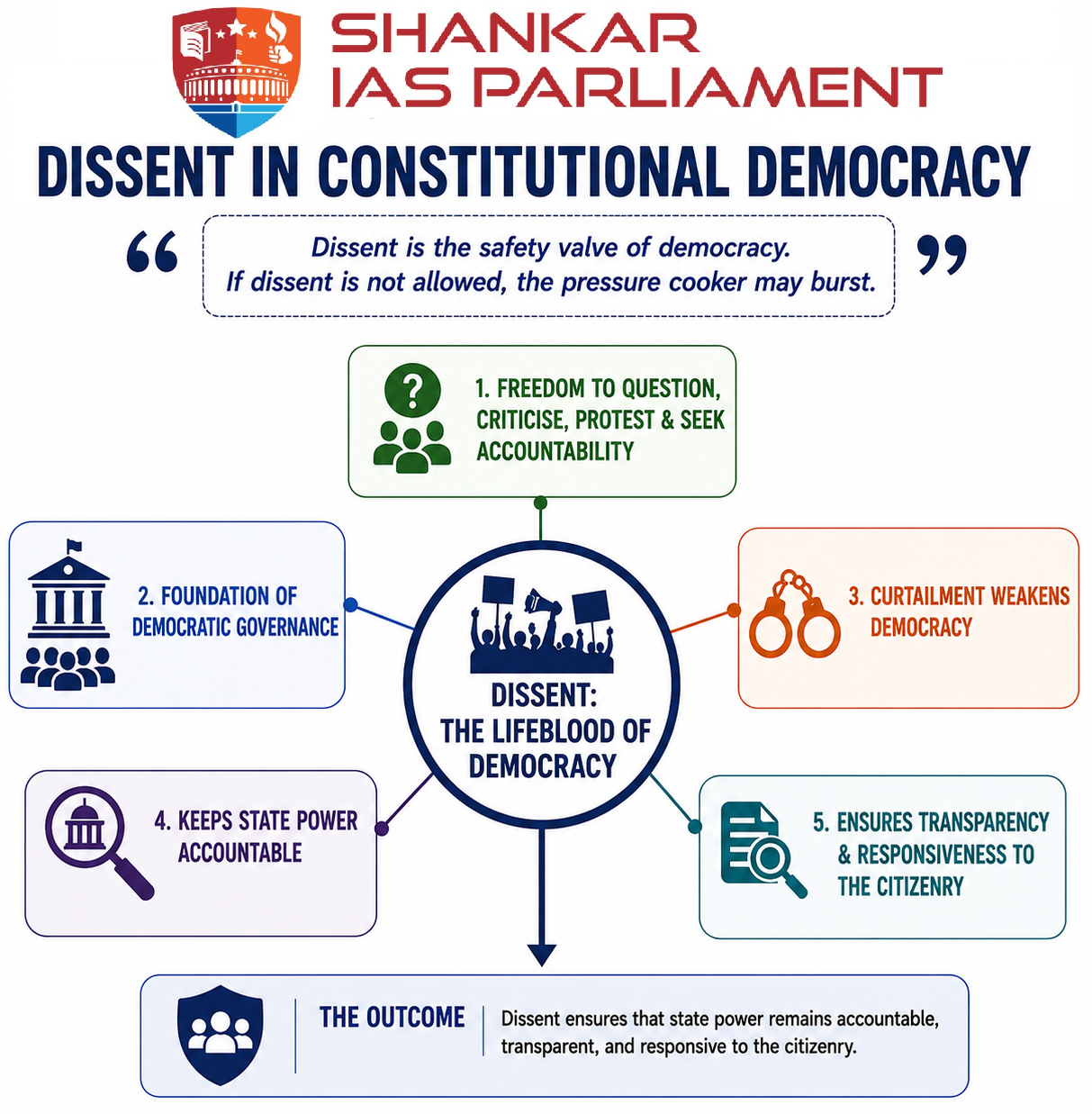
A constitutional democracy is a system of governance where the authority of the majority is limited by legal and institutional frameworks specified in a constitution.
What are the provisions behind the right to dissent?
- Constitutional provision – While the term "dissent" is not explicitly written in the text of the Constitution of India, it is implicitly guaranteed under fundamental rights:
- Article 19(1)(a) – It guarantees the Freedom of Speech and Expression, which includes the right to express opinion, critique, and disagree with state action.
- Article 19(1)(b) – It protects the Right to Assemble Peacefully and Without Arms, providing the legal basis for peaceful protests, rallies, and demonstrations.
- The right to dissent is inseparable from the freedoms guaranteed under Part III of the Constitution.
- Article 21 – The Right to Life and Personal Liberty, which courts have interpreted broadly to include political liberty and protection against arbitrary state detention or harassment.
- Fearless dissent – The Constitution envisions a Republic where citizens are free to question authority without fear.
- Judicial Precedents – The Supreme Court of India has repeatedly held that dissent is a "safety valve of democracy".
- Ramleela Maidan (2012) – Affirmed citizens’ fundamental right to peaceful protest, condemning state force against Baba Ramdev’s rally.
- Shreya Singhal (2015) – Struck down Section 66A of IT Act, safeguarding online free speech and protecting digital dissent.
What are the significances of right to dissent?
- Serves as a watchdog – By enabling citizens to monitor government actions and identify systemic flaws.
- Prevents authoritarian tendencies – Through continuous public scrutiny, which discourages leaders from adopting dictatorial practices.
- Requires justification – As public dissent compels authorities to defend and articulate the rationale behind their decisions.
- Amplifies marginalized voices – By enabling underrepresented groups to advocate for fairness and equal rights.
- Catalyst for change – As demonstrated by historic movements such as civil rights campaigns that utilized dissent to overturn unjust laws.
- Improves governance – By encouraging constructive criticism, which generates alternative solutions to complex social challenges.
- Guarantees free expression – It ensures the rights of freedom of speech and peaceful assembly.
- Preserves pluralism – By preventing enforced conformity and maintaining societal openness to diverse perspectives.
What are the challenges to ensure the right to dissent?
- Criminalization of Disagreement – Increasing misuse of stringent laws (such as sedition, UAPA, or national security statutes) against activists, journalists, and students.
The criminal justice system’s role is to punish genuine crimes, not suppress political disagreement or peaceful civic participation.
- Abuse of Pretrial Detention – Extended incarceration without trial, making the judicial process itself act as a form of punishment.
- Online Blocking – Governments restrict internet access or instruct social media platforms to remove posts critical of state actions.
- Online Harassment – Coordinated groups and automated accounts target dissenting individuals online to intimidate and suppress their expression.
- Media Pressure – News organizations encounter financial and legal threats when reporting critically on government activities.
- Chilling Effect – Arbitrary arrests and state intimidation deter citizens from exercising their legitimate fundamental rights out of fear.
- Criminal Charges – Authorities often respond rapidly to protests, imposing severe charges on participants under expansive public safety regulations.
- Investigative Reach – State agencies are frequently employed to audit, interrogate, and suppress active civil society organizations.
- Executive Overreach – Treating administrative inconvenience or political criticism as a threat to public order or national security.
What steps should be taken?
- Judicial Vigilance – Courts must proactively safeguard personal liberties, grant bail as a rule rather than an exception, and strictly scrutinize state actions that curb peaceful protests.
- Legal Reforms – Review or repeal vaguely worded laws that enable the executive branch to arbitrarily detain peaceful dissenters.
- Police & Institutional Sensitization – Train law enforcement to view peaceful assemblies as constitutional exercises rather than security threats.
- Proportionality Principle – Ensure that restrictions imposed on free speech and assembly adhere strictly to the "reasonable restrictions" test under Article 19(2).
- Preserving Trust in Institutions – Sustaining public faith in democratic institutions requires that peaceful protest be seen as a strength of the Republic, not a threat to governance.
- Balancing Security and Liberty – The state must strike a fair balance between maintaining public order and upholding individual liberties, ensuring that security measures do not erode fundamental constitutional rights.
- Strengthening Civil Space – A thriving democratic society depends on maintaining open channels for public dialogue, constructive criticism, and peaceful civic engagement.
What lies ahead?
India’s survival as the world’s largest democracy in size and spirit depends on safeguarding dissent. True democracy thrives when freedom of conscience and institutional respect coexist, ensuring that criminal justice remains a tool for justice, not political control.
Reference
The Hindu | Peaceful Dissent in Constitutional Democracy



