Prelims: Current events of national and international importance | Reports
Why in News?
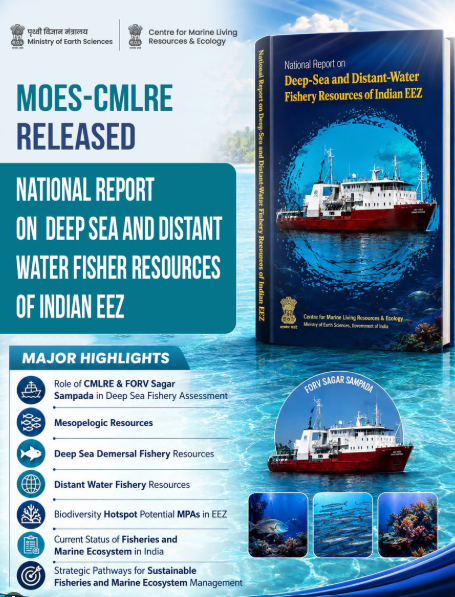
The Ministry of Earth Sciences (MoES) released the "National Report on Deep-Sea and Distant-Water Fishery Resources of the Indian EEZ,".
- Data Synthesis- Consolidates nearly 4 decades of oceanographic research and over 400 scientific cruises conducted across India’s 2.37 million square kilometer Exclusive Economic Zone (EEZ).
- Data collected under the Marine Living Resources Programme (MLRP).
- Surveying Vehicle - Utilized the research vessel FORV Sagar Sampada to map species distributions and assess stock potential from the Arabian Sea and Bay of Bengal to the Andaman Sea and Southern Ocean.
Key Assessments
- Mesopelagic Resources - Highlights the vast biomass of lanternfishes (Myctophids).
- Their nightly vertical migrations drive the ocean's "biological carbon pump," transferring carbon from surface waters to the deep ocean to help regulate global climate.
- Deep-Sea Demersal Stocks - Identifies underexploited stocks along continental slopes beyond 200 meters depth, including deep-sea shrimps, perches, scombroids, flatfishes, and eels.
- Protected Hotspots - Maps vulnerable marine ecosystems requiring conservation, specifically highlighting Kollam Bank, Angria Bank, the off-Mangalore deep-sea slope, the terrace off Trivandrum, Lakshadweep, and the Andaman-Nicobar Islands.
Technological Framework
- Advanced Methodology - Integrates fisheries acoustics, environmental DNA (eDNA), autonomous observation platforms, satellite sensing, AI, and ecosystem modeling to support marine spatial planning.
- National & Global Goals - Serves as a foundational scientific roadmap for India’s Vision 2047 Blue Economy pillar, while reinforcing commitments to UN SDG 14 (Life Below Water) and the UN Decade of Ocean Science.
Reference
PIB | National Report on Deep-Sea and Distant-Water Fishery Resources



