Mains: GS III – Space Technology
Recently, NASA formally invited ISRO to join its ambitious Moon Base programme under the Artemis Accords.
NASA's Moon Base programme – It is an ambitious plan to establish a long-term human presence on the Moon, especially near the south pole, which has a volatile environment with temperatures ranging from -203°C to 54 °C.
The programme envisages:
Ongoing crewed and uncrewed lunar missions
Building infrastructure on the Moon
Conducting scientific research and experiments
Supporting long-duration astronaut activities
Developing technologies for lunar surface living and work
Using the Moon as a gateway for deep-space exploration, including missions to Mars.
Water potential – These shadowed regions may contain ice, which could be used for drinking water, oxygen, and hydrogen fuel.
Scientific exploration – Studying these challenging areas may provide insights into the Moon’s origins, the evolution of the solar system, and support future missions to Mars and Venus.
|
Artemis Accords |
|
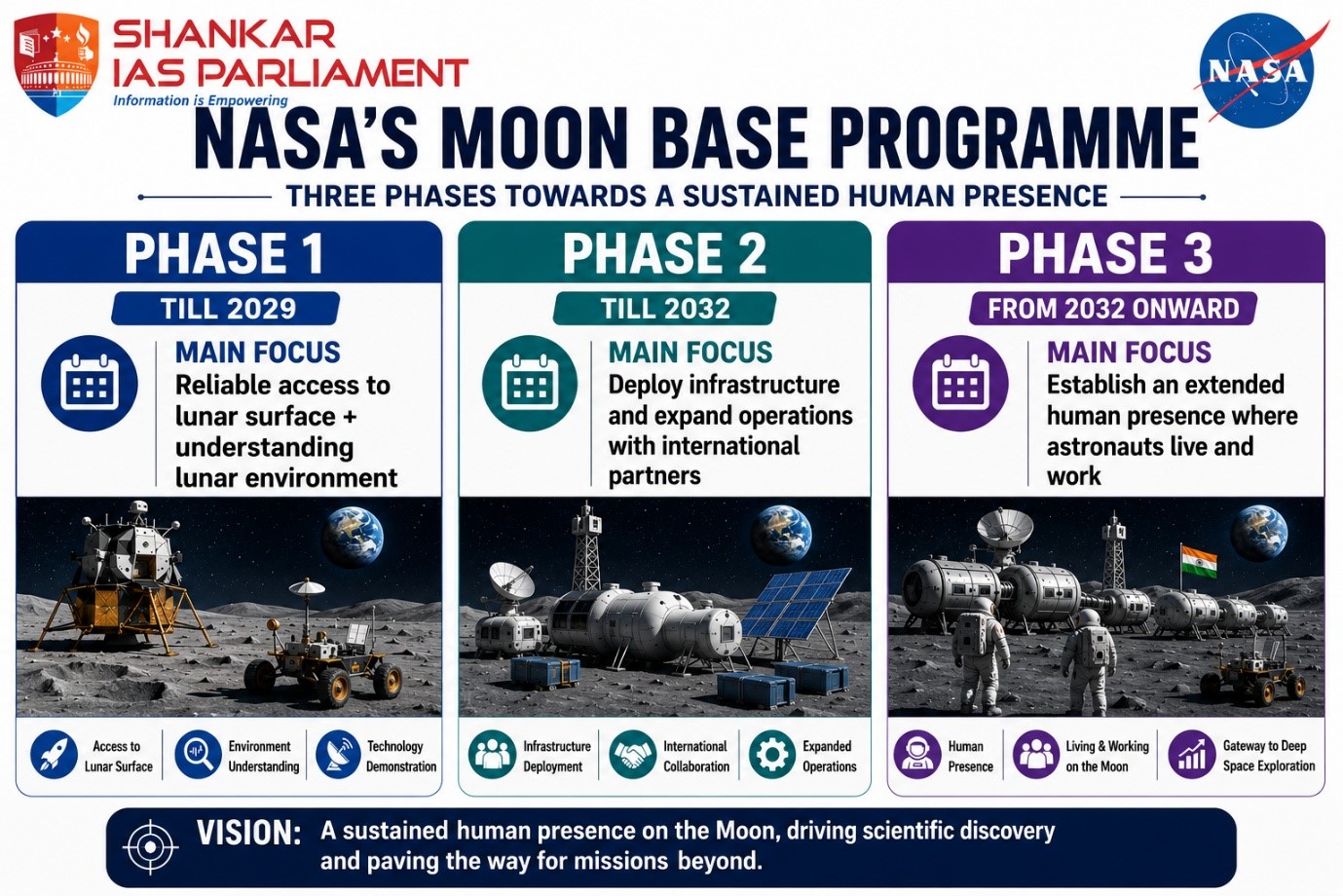
Phase 1 – Access and Exploration
Establish reliable and consistent access to the lunar surface.
Conduct comprehensive scientific investigations.
Characterise and analyse the lunar environment and its challenges.
Develop the technological foundation necessary for subsequent phases.
Phase 2 – Infrastructure Development
Construct and deploy essential lunar infrastructure.
Expand operational capabilities on the lunar surface.
Apply knowledge and data acquired during Phase 1.
Enhance cooperation with international partners.
Phase 3 – Permanent Human Presence
This phase represents the most ambitious stage of the program.
Establish a sustained human presence on the lunar surface.
Enable astronauts to live and work on the lunar surface for extended durations.
Moon becomes a platform for further deep-space exploration.
Technological Advancement and Expertise – India may acquire experience in advanced lunar technologies, including habitat construction, robotics, life-support systems, deep-space communication, and long-duration human missions.
Such expertise is particularly valuable as India transitions from robotic exploration to human spaceflight and crewed lunar missions.
Scientific Collaboration – India would be able to participate in international lunar research and both access and share scientific data.
NASA and India have already agreed to advance discussions regarding open scientific data sharing within the Artemis framework.
Support for India's Indigenous Lunar Ambitions – India is planning more advanced Chandrayaan missions and maintains a long-term objective of sending Indian astronauts to the Moon.
Experience gained through participation in an international lunar programme could assist the Indian Space Research Organisation (ISRO) in developing the capabilities required for these future missions.
International Standing and Strategic Influence – Participation in a major multinational lunar programme would enhance India's status as a leading space power.
It would also provide India with the opportunity to contribute to discussions regarding future rules, norms, and the responsible utilization of lunar resources.
Space Economy and Private Sector Development – Participation could generate opportunities for Indian space startups and industries in the following areas.
Robotics
Sensors
Communication
Propulsion
Electronics
Lunar Infrastructure
Data and Artificial Intelligence (AI)
The Moon is emerging as the primary frontier for international space exploration.
India's participation in NASA's Moon Base program may facilitate the advancement from its current lunar exploration capabilities toward its long-term objective of becoming a leading human spaceflight and deep-space power.
The Hindu | NASA’s Moon Base Programme



