Mains: GS III – Economy
Recently, The Mines and Minerals (Development and Regulation) Amendment Bill, 2026 passed in both the Houses of the Parliament.
Amendment to – Mines and Minerals (Development and Regulation) Act, 1957.
Objective – To establish a uniform and balanced fiscal framework for the sector.
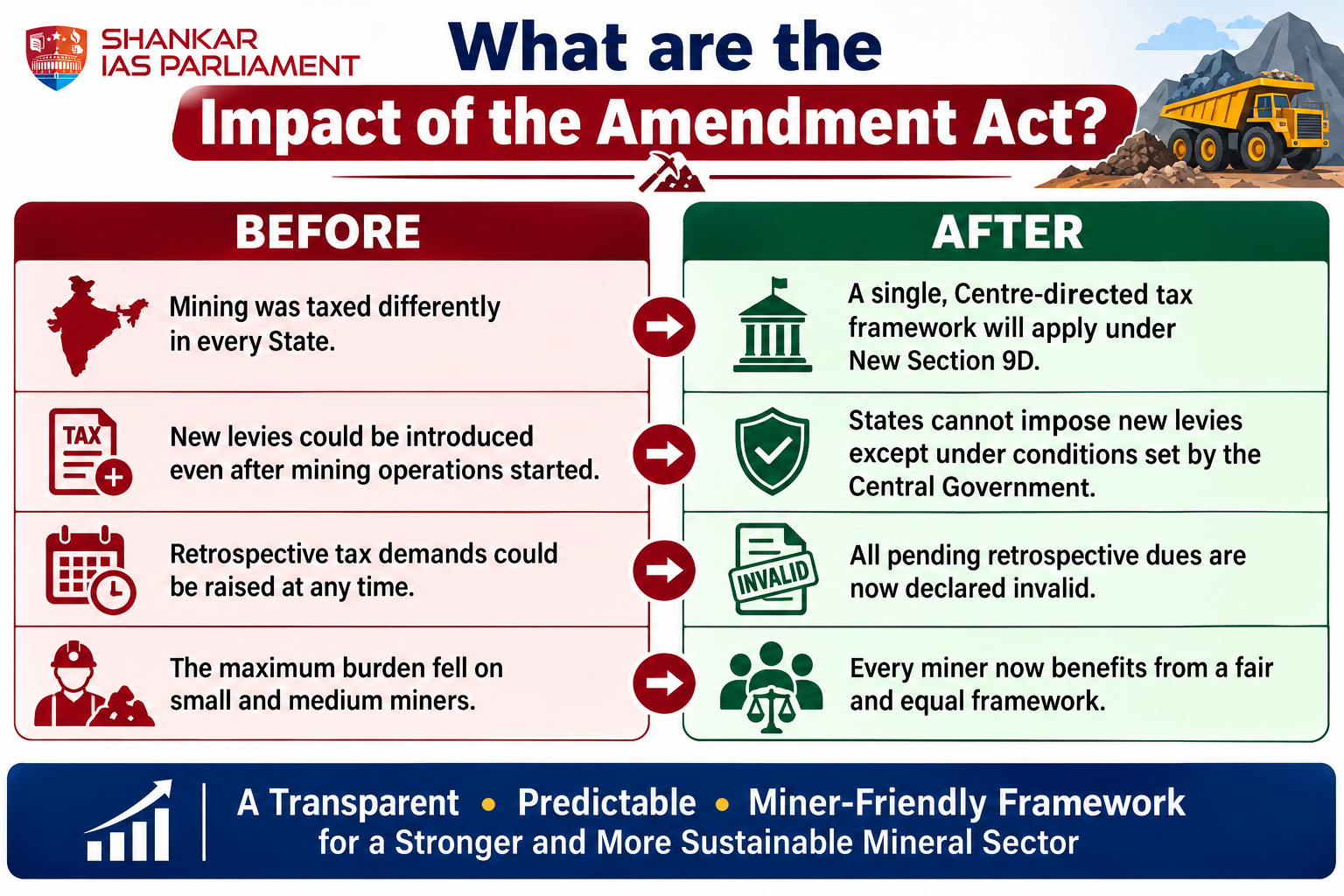
As per the Amendment Act, State Governments cannot levy fresh taxes on mineral rights and mineral-bearing lands, except within conditions prescribed by the Central Government.
Mining in India is regulated under the Mines and Minerals (Development and Regulation) Act, 1957.
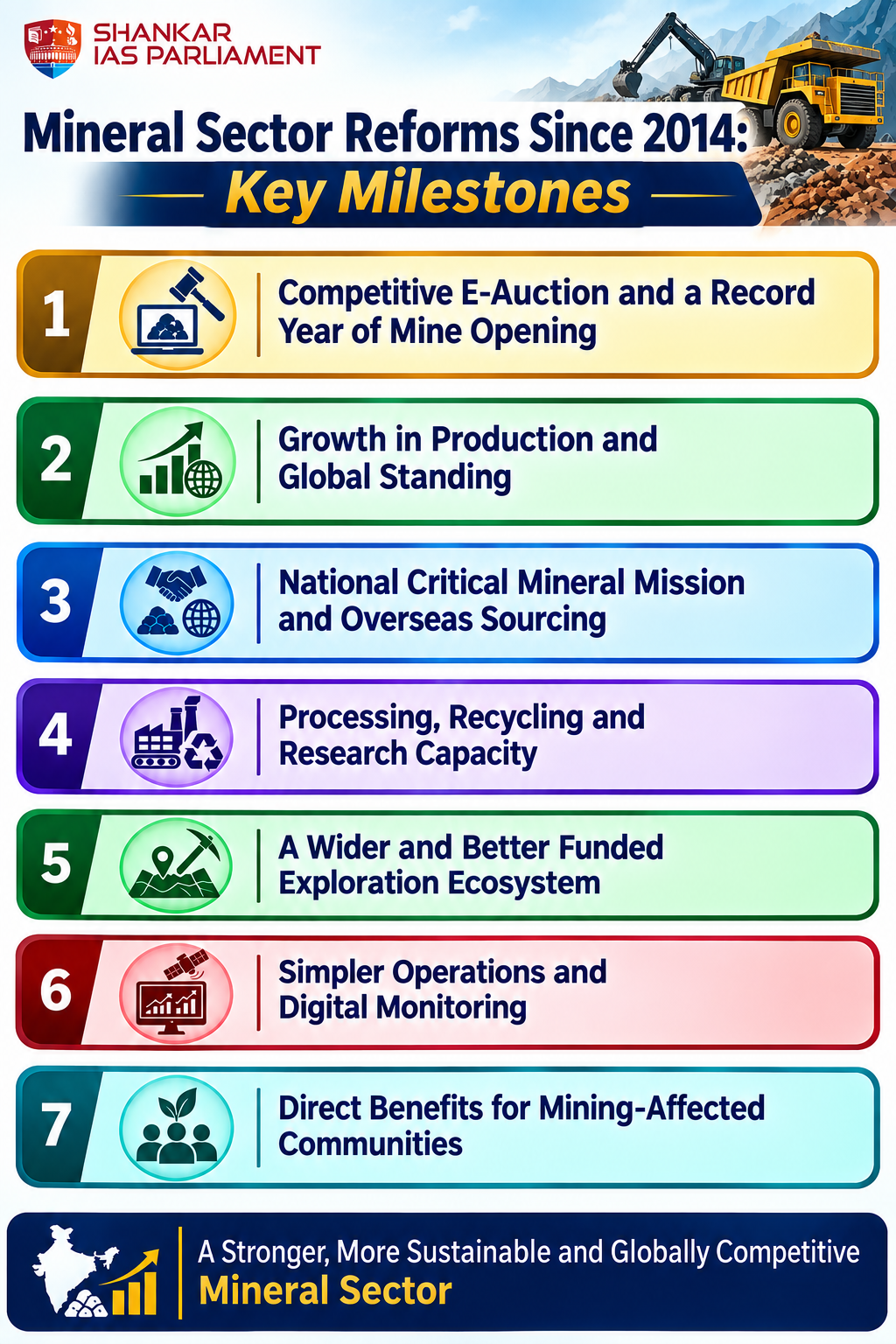
Energy Security – A resilient domestic mining sector, supported by critical minerals and competitive coal, requires a stable and predictable tax regime to ensure energy security and reduce import dependence.
Multiplicity of Levies – States impose approximately 14 levies, including royalty, DMF, GST, and land tax of up to 20 %, resulting in a significant cumulative burden that the Act aims to address.
Levies on Strategically Important Minerals – High levies on critical minerals such as graphite and uranium make projects uneconomical.
Inconsistent State rates further create disparities, highlighting the need for rationalisation to ensure viability.
Dual Burden on Foreign Exchange – High domestic mineral costs increase imports (₹10.12 lakh crore, FY 2025‑26) and reduce exports (iron ore ₹15,136 crore).
Effective cost control is essential for Atmanirbhar mineral security.
Fragmentation of the National Mineral Market – Variations in State levies fragment the mineral market and increase supply chain and logistics costs. The Act aims to establish uniform national rates to enhance efficiency.
Cost Ultimately Reaches the Household – Mining levies increase mineral prices, which subsequently raise the costs of steel, cement, power, and housing. Therefore, rational taxation is essential to maintain household affordability.
Threat to Employment – High mining levies have led to closures and stalled projects, with small and medium enterprises most affected.
This threatens jobs for over 1.5 crore workers, including many in tribal areas.
Deterrence to Long-Term Investment – Mining investment relies on a stable and predictable tax regime.
Sudden changes discourage capital, slow expansion, and negatively affect manufacturing, defence, shipping, construction, and renewables.
New Section 9D — limits on State levies – No tax, cess or other levy, by whatever name called, shall be imposed by a State Government on mineral rights or mineral-bearing lands.
This covers levies based on mineral quantity, mineral value, royalty or any other basis.
Such levies may be imposed only as per conditions or restrictions prescribed by the Central Government.
Treatment of past levies – Any levy not paid or collected by the State before the amendment applies will be treated as invalid.
However, amounts already deposited or recovered before such commencement shall not be liable to be refunded.
Rule-making power – Section 13 of the MMDR Act is amended to empower the Central Government to make rules.
These rules will prescribe the conditions or restrictions for imposition of such levies by State Governments.
|
Minor Minerals Under State Control |
|
Benefits the Common Man – Competitive coal prices help reduce electricity costs and benefit households in their daily lives.
Lower mineral costs strengthen industries, infrastructure, economic growth and employment.
Strengthens Manufacturing, Infrastructure and the Economy – Coal provides energy, while iron ore, limestone and bauxite support steel, cement and aluminium production.
Copper also supports modern industry, electricity and defence.
The Act therefore benefits power, manufacturing, railways, roads, housing, transport and development programmes.
Viksit Bharat – It creates a more competitive, transparent, predictable and investor-friendly mining sector.
It strengthens investment, production, employment, energy security, national security and self-reliance.
The Mines and Minerals (Development and Regulation) Amendment Act, 2026 marks an important step in modernising India's mineral governance.
By ensuring a stable and uniform fiscal regime, it aims to strengthen mineral exploration, critical mineral security and sustainable resource development.
These efforts will help advance India's journey towards Viksit Bharat.
PIB | MMDR Amendment Act, 2026



