0.1035
7667766266
x

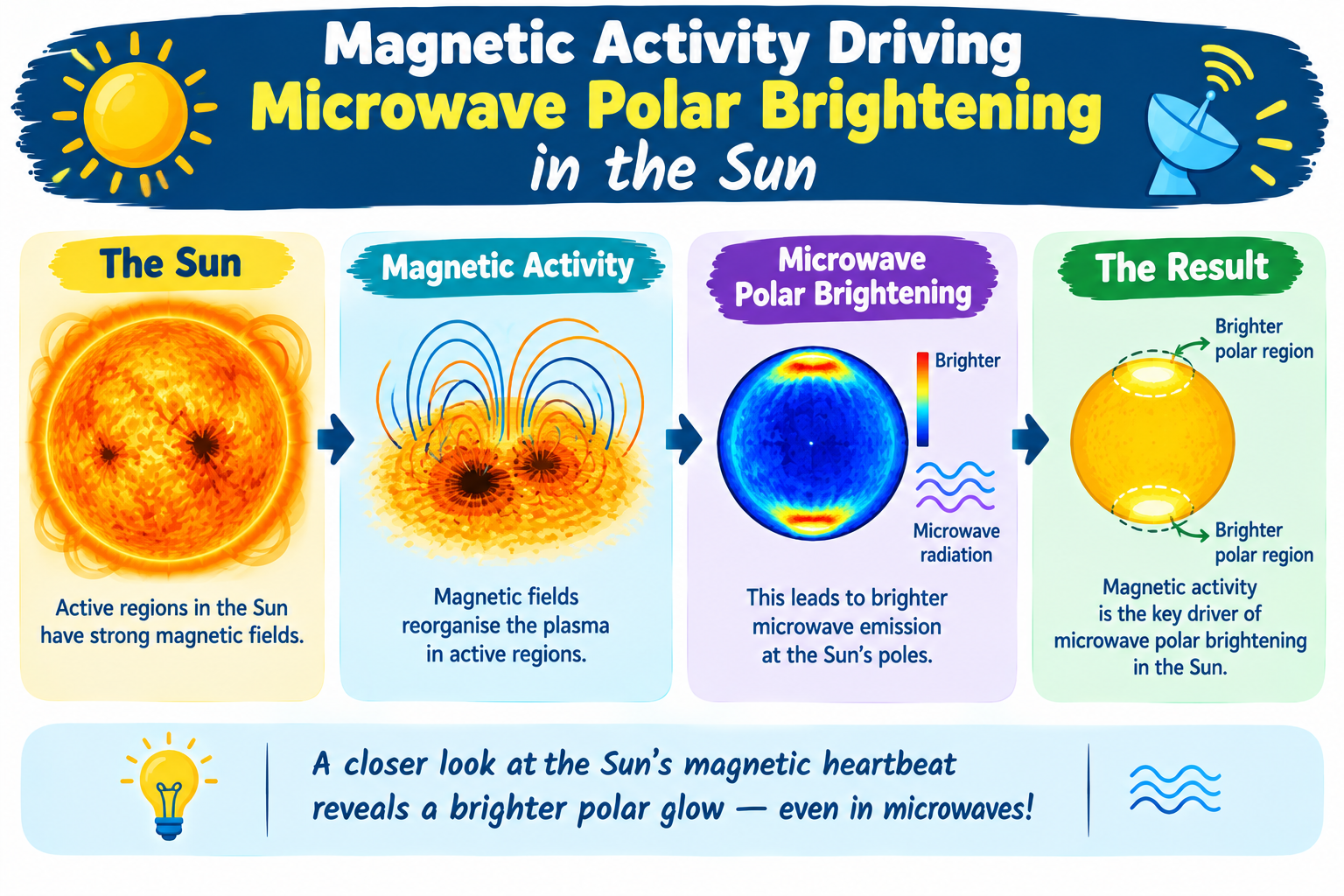
Magnetic Activity Driving Microwave Polar Brightening in the Sun

iasparliament Logo
October 14, 2026

Prelims: Current events of national and international importance | Science & Technology

Why in News?

Recently, research was conducted by scientists at the Indian Institute of Astrophysics (IIA) investigating the mechanisms behind solar microwave polar brightening.

  • Led by - Aryabhatta Research Institute of Observational Sciences (ARIES), Nainital in collaboration with the Udaipur Solar Observatory (USO) / Physical Research Laboratory (PRL) and IIT Roorkee.
  • The team uncovered the magnetic mechanism driving "Microwave Polar Brightening" (also called microwave aurorae) in the Sun.

Key Scientific Findings

  • The Phenomenon of Polar Brightening:
    • When observed at high radio frequencies (particularly in the microwave spectrum, around 17–37 GHz), the solar poles appear noticeably brighter than the quiet central disk of the Sun.
    • This microwave enhancement originates in the upper chromosphere and low transition region of the solar atmosphere.
  • Dual Magnetic Drivers (Large-Scale vs. Small-Scale):
    • Large-Scale Poloidal Fields - Microwave polar brightening reaches its maximum intensity during solar activity minima (when global activity like sunspots is low) because the global polar magnetic fields are strongest at this stage of the 11-year solar cycle.
    • Small-Scale Unipolar Magnetic Elements - High-resolution magnetic maps showed that the brightening is not uniform.
    • It is concentrated in concentrated patches driven by small, intense, unipolar magnetic structures (unipolar network elements) embedded near the poles.
  • Thermal Structure & Plasma Physics
    • The presence of these small-scale magnetic elements causes localized heating in the solar plasma.
    • This elevated electron temperature and density increase free-free thermal bremsstrahlung radiation at microwave frequencies.

Solar Dynamics Across the 11-Year Solar Cycle

Solar Cycle Phase

Global Magnetic State

Polar Microwave Brightening Behavior

Solar Minimum

Strong, well-defined global polar magnetic fields; low active-region sunspot count.

Maximum Brightening -  Enhanced concentration of unipolar magnetic network elements at the poles.

Solar Maximum

Global polar fields weaken, decay, and undergo field reversal; high active-region sunspot count.

Minimum Brightening -  Disruption and dispersal of polar magnetic structures cause a sharp decline in polar microwave emission.

Significance

  • It provides a reliable proxy for measuring the strength of the Sun's poloidal magnetic field, which is critical for predicting the strength and timing of future solar cycles.
  • Offers fresh insights into coronal heating mechanisms, regarding why the outer solar atmosphere (corona) is millions of degrees hotter than the underlying solar surface (photosphere).
  • Complements measurements from space missions like
    • Aditya-L1 (India’s flagship solar observatory) and
    • NASA/ESA's Solar Orbiter, enhancing forecasting models for solar wind acceleration, coronal mass ejections (CMEs), and geomagnetic disturbance risks to satellite operations.

Magnetic Activity Driving Microwave Polar Brightening in the Sun

Reference

PIB | Large- and small-scale magnetic activity

There are no reviews yet. Be the first one to review.

ARCHIVES

sidetext