From Tradition to Enterprise
- Khadi and Village Industries (KVI) are promoting rural entrepreneurship by connecting traditional skills and local resources with finance, technology, training and markets.
- The sector supports the vision of Vocal for Local and Atmanirbhar Bharat by generating employment and encouraging self-reliance.
- The annual Khadi Mahotsav (2–31 October) promotes Khadi and local products, particularly among youth.
Khadi and Village Industries Commission (KVIC)
- KVIC is a statutory body established under the Khadi and Village Industries Commission Act, 1956.
- It plans, promotes, facilitates, organises and assists village industries through training, raw materials, marketing, research, quality improvement and technical support.
Performance of Khadi and Village Industries
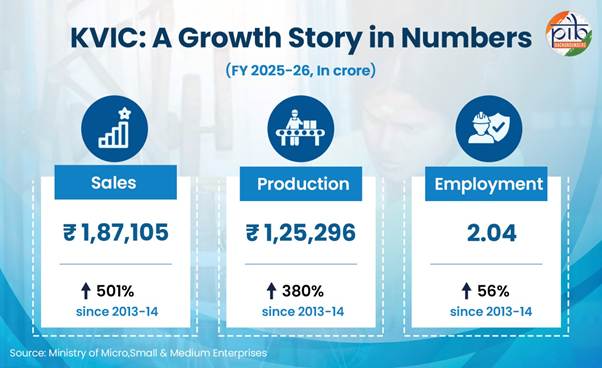
- Sales: Reached a historic ₹1.87 lakh crore in 2025–26, an increase of 501% over 2013–14.
- Production: Increased by 380% to ₹1,25,296 crore.
- Employment: Increased by 56% to 2.04 crore.
- Artisan remuneration: Increased from ₹4 to ₹15 per hank, a rise of approximately 275%.
- Women’s participation: Women constitute over 80% of approximately five lakh artisans in the Khadi sector.
- One hank equals 840 yards of yarn and weighs one pound.
Major Initiatives for Artisans and Rural Enterprises
- Skill Development: KVIC operates 35 departmental and non-departmental training centres offering training in beekeeping, bakery, agarbatti, candles, motor repairing and other activities.
- In 2025–26, 79,682 trainees received training, including 47,382 women.
- Prime Minister’s Employment Generation Programme (PMEGP): Since March 2008, it has provided employment opportunities to nearly 97.95 lakh people through KVIC.
- Gramodyog Vikas Yojana: Provides modern machinery, toolkits and equipment. Over 3.23 lakh machines, toolkits and equipment had been distributed by May 2026.
- Khadi Vikas Yojana: Supports product improvement, value addition and market-oriented pricing.
- Under Modified Market Development Assistance, ₹245 crore was disbursed to 1,097 Khadi institutions in 2024–25, benefiting 1,45,484 artisans.
- Interest Subsidy Eligibility Certificate Scheme: Enables eligible Khadi institutions to access credit at a concessional interest rate of 4% per annum.
- Workshed Scheme: Improves production facilities and working conditions for artisans. Up to December 2025, 1,309 artisans benefited during 2025–26.
Rural Entrepreneurship and Success Stories
- Punjab: An enterprise supported under PMEGP produces honey and cookies, employs around 200 workers and exports to 36 countries, with KVIC facilitating international market access.
- Tamil Nadu: An agarbatti unit supported under Gramodyog Vikas Yojana uses vetiver to produce agarbatti, herbal products and other value-added goods.
- Himachal Pradesh: A mono-carton manufacturing unit established under PMEGP with a project cost of ₹25 lakh records an annual turnover of around ₹45 lakh and employs 23 people.
Market Expansion and Global Reach
- The online Khadi India store sells clothing, fabrics, groceries, beauty products, essential oils, perfumes and incense sticks.
- KVIC operates eight departmental Khadi India outlets and 15 branches, while Khadi institutions run 8,035 sales outlets nationwide.
- National, zonal, state and district exhibitions and domestic and international trade fairs expand market access.
- Khadi has gained international visibility through platforms such as New Zealand Fashion Week 2026 and Lakmé Fashion Week 2025.
Conclusion
- Khadi and Village Industries are evolving from traditional occupations into competitive rural enterprises.
- Strengthening skills, affordable finance, modern technology, product quality and market linkages can further enhance artisan incomes, women’s empowerment, rural employment and India’s self-reliance.
Reference
PIB



