0.1147
7667766266
x

Ken – Betwa Link Project (KBLP)

iasparliament Logo
July 21, 2026

Mains: GS III – Environment

Why in News?

Recently, protest erupted against the  ken – betwa river link project.

What is the Ken-Betwa Link Project?

  • It is India's first major inter-state river interlinking initiative.
  • Rivers involved – It transfers surplus water from the Ken River in Madhya Pradesh to the water-deficit Betwa River in Uttar Pradesh.
  • Primary objective – It specifically targets the drought-prone Bundelkhand region to provide widespread irrigation, drinking water, and hydropower.

Bundelkhand is a historic and cultural region in central India, spanning an area of roughly 69,000 sq km across Uttar Pradesh and Madhya Pradesh.

Home to about 14.5 million people, it is bounded by the Yamuna River to the north and the Vindhya Range to the south. Jhansi is the largest city in the region.
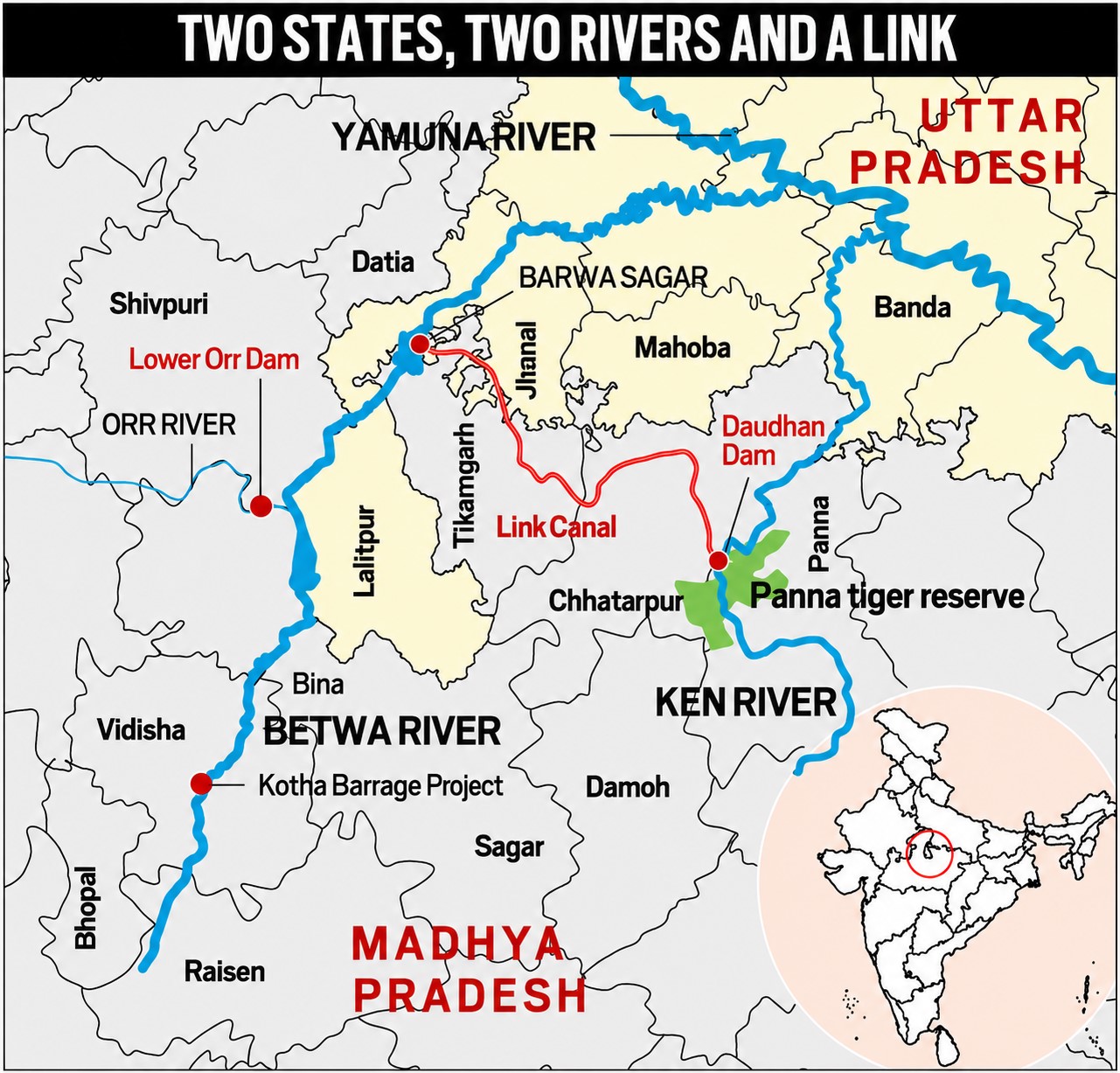

KEN 1

What are the benefits of the project?

  • Enhanced Irrigation It provides annual irrigation to 1.06 million hectares of agricultural land, which will boost food security and increase agricultural income for rural families in both states.
  • Drinking Water SupplyReliable, clean drinking water will be supplied to approximately 6.2 million people across the drought-prone districts of the region.
  • Renewable Energy GenerationThe project is designed to generate 103 MW of hydropower and 27 MW of solar energy, supporting India’s green energy goals.
  • Drought MitigationBy utilizing surface water instead of over-exploiting aquifers, it alleviates groundwater depletion and drought vulnerability in central India.

What are the concerns with the project?

  • Panna Tiger Reserve SubmergenceThe construction of the proposed Daudhan dam threatens to submerge over 10% of the core area of the Panna Tiger Reserve in Madhya Pradesh.
  • Biodiversity LossScientists and conservationists highlight major habitat fragmentation for tigers, vultures, and gharials.
  • DeforestationThe project requires the felling of millions of trees, causing significant disruption to the local ecology.
  • As per the Jal Shakti Ministry, approximately 17,101 trees had been identified for felling to facilitate the execution of the Daudhan Dam and allied infrastructure until July, 2025.
  • Of these, 12,404 trees have been felled within the Panna Tiger Reserve Forest.
  • Hydrological DisruptionsStudies (such as those by IIT Bombay) point to potential local rainfall deficits and micro-climate changes due to large-scale deforestation and water transfer.
  • Mass DisplacementThe project is expected to displace over 6,600 families, many of whom are indigenous tribal communities reliant on the local forests.
  • Inadequate CompensationAffected tribal families have held sustained, severe protests demanding fair, timely compensation and better rehabilitation and resettlement packages.
  • Tribal RightsThere are ongoing concerns regarding the questionable implementation of the Forest Rights Act and fears that local communities will lose their community forest rights without fair exchange.
  • High Financial CostThe massive implementation costs—exceeding Rs.44,000 crore—along with significant ongoing maintenance expenses have raised questions about the project's long-term economic viability.

What are the key demands of tribal communities?

  • Rehabilitation Package – Tribal communities demand that each adult be counted as a separate unit for compensation of Rs.12.5 lakh, rather than compensation being allocated per family.
  • Eligibility Cut-off – The cut-off date for compensation eligibility should be updated from February 16, 2024, to the current date.
  • Survey Irregularities There are allegations that the survey process included ineligible beneficiaries while excluding genuine residents.
  • Other Projects – Tribal communities are also demanding similar compensation packages for the Majhgaon and Runjh irrigation projects.
  • Accusations – Reports include illegal evictions, disconnection of electricity, and the filing of false police cases against 250 villagers.

What could be done?

  • Transparent Rehabilitation – Adults should be counted individually for compensation, cut-off dates should be updated, and only genuine beneficiaries should be included.
  • Independent Oversight – An impartial body should be established to monitor compensation distribution and environmental clearances.
  • Updated Hydrological Data – The latest hydrological data should be released to enable accurate assessment of 'surplus water' claims.
  • Ecological Safeguards – Measures should be implemented to minimize tree felling and to protect the tiger reserve and gharial sanctuary.
  • Inclusive Dialogue – Tribal communities should be actively engaged in decision-making processes to restore trust.

What lies ahead?

  • The Ken–Betwa project exemplifies the challenge India faces in balancing developmental objectives with ecological sustainability and the protection of tribal rights.
  • Without equitable rehabilitation and credible environmental safeguards, the project risks becoming a symbol of dispossession rather than progress.

Reference

The Hindu| KBLP

NWDA| Ken – Betwa


Login or Register to Post Comments
There are no reviews yet. Be the first one to review.

ARCHIVES

sidetext
Free UPSC Interview Guidance Programme
sidetext

