Mains: GS III – Economy & Social Issues
Why in News?
Despite having the world’s largest youth population, Gen Z faces delayed labour market entry, high unemployment, and insecure jobs — raising concerns of a looming employment crisis.
What is meant by Generation Z and Millennials (Gen Y)?
- Gen Z – Born between 1997 and 2012 and currently aged 15 to 26, represents the youngest working-age cohort.
- Millennials (Gen Y) – Born between 1981–1996, currently aged 27–42 years.
- United Nations data, 2025 – India has 371 million youth, this demographic dividend can only be realised if education leads to productive employment.
What are the employment patterns of Gen Z in India?
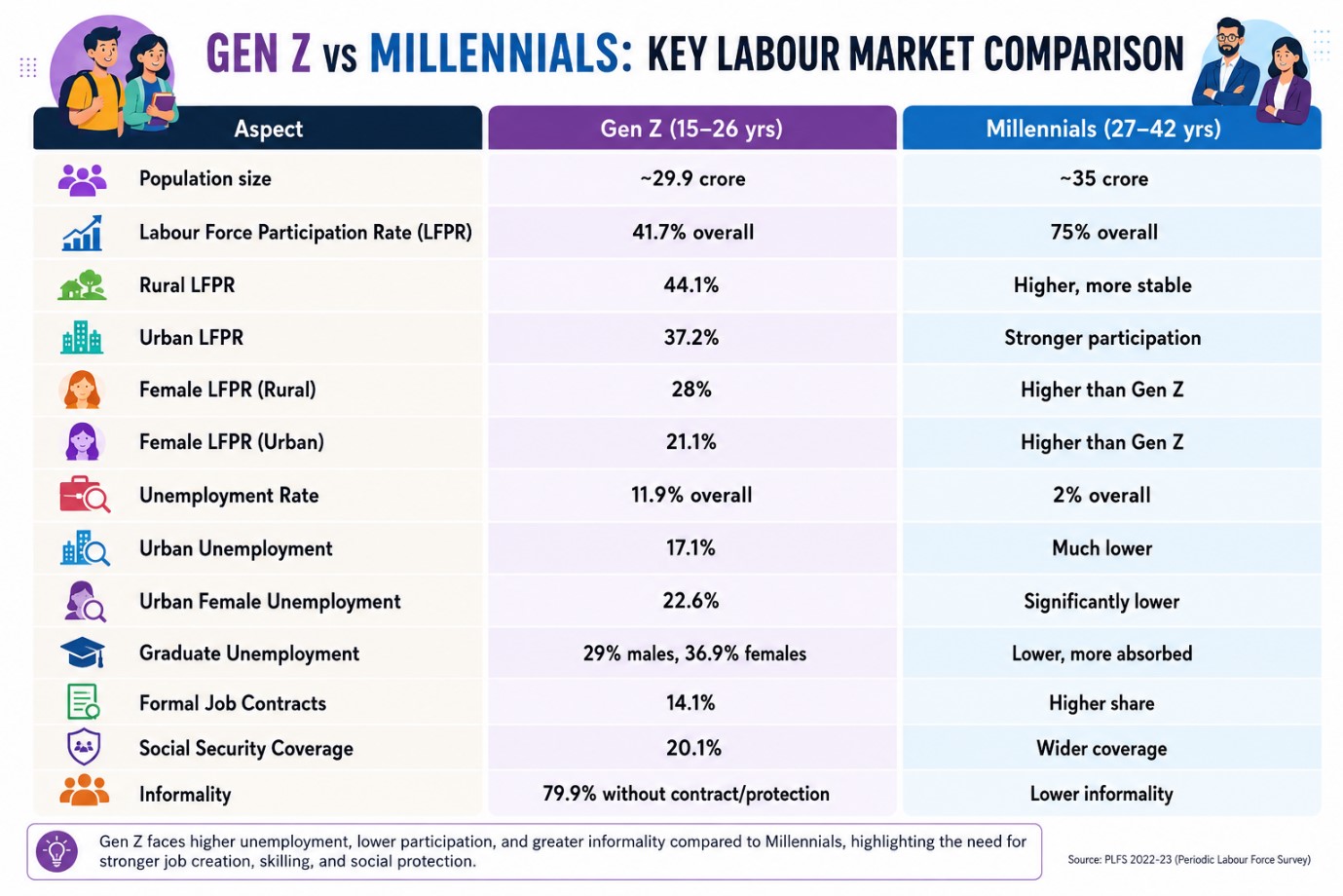
- Generational Comparison – According to the 2023-24 Periodic Labour Force Survey (PLFS), India has an estimated 29.94 crore working-age Gen Z individuals, compared with 35 crore Millennials.
- Delayed Entry – 41.7% of Gen Z males and 38.4% of females are still pursuing their studies.
- Gender Divide – 27.1% of females are engaged in domestic duties compared to only 0.32% of males.
- Employment Patterns – Among males, 15.8% work as unpaid family members, 12.3% hold casual jobs, and 14.8% receive regular wages.
- Among females, 35% perform domestic duties, 10.7% are unpaid family workers, and 4.7% earn regular wages.
What are the comparisons between Generation Z and Millennials (Gen Y)?
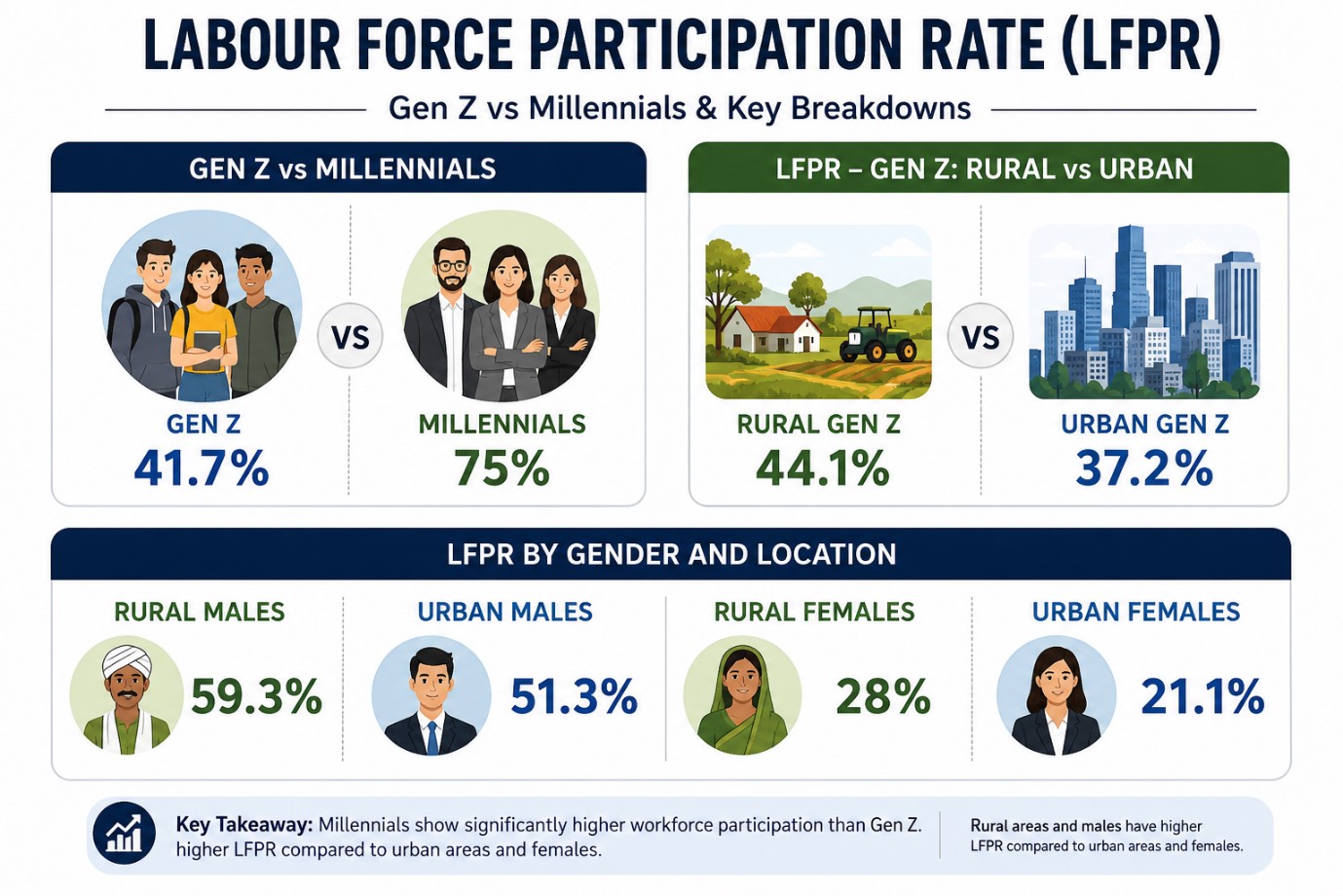
- Labour Force Participation Rate (LFPR) – Gen Z: 41.7% vs Millennials: 75%.
- Rural Gen Z – 44.1% vs Urban – 37.2%.
- Rural males – 59.3%, Urban males – 51.3%;
- Rural females – 28%, Urban females – 21.1%.
- Unemployment
- Gen Z – 11.9% vs Millennials – 2%.
-
- Urban Gen Z – 17.1% young men, urban young women – 22.6%.
- Graduate Trap – Gen Z graduates: Males 29% unemployed, Females 36.9%.
- Millennial graduates – Males 5.2%, Females 13.8%.
- Education does not guarantee employment, highlighting a mismatch between educational attainment and labour market requirements.
What are the structural factors contributing to the Gen Z employment crisis?
- Skill and Sectoral Alignment – Employment prospects improve when training is directly aligned with employer needs.
- Technology Factor – Automation and artificial intelligence are reshaping workforce demand and reducing traditional job opportunities.
- Weak School-to-Work Transition – Educational programs are not aligned with job market requirements.
- Barriers for Women – Domestic responsibilities, insufficient childcare, and unsafe transportation limit women’s participation in the workforce.
- Informalisation – The increase in insecure jobs and weak employment protections is a growing concern.
- The social consequences include heightened frustration among youth, increased protests such as the Noida unrest, erosion of public trust, and a greater risk of societal instability.
What are the impacts of the Gen Z employment crisis?
- Economical – The crisis results in a wasted demographic dividend and a deceleration of national growth.
- Social – The crisis leads to youth disillusionment, increased unrest, and diminished confidence within families.
- Gender outlook – Women are disproportionately excluded from formal employment opportunities.
- Structural outlook – The increasing informalisation of employment undermines both job quality and security.
What are the ethical dimensions?
- Equity and justice – It require equal opportunities for youth, regardless of gender or geographic location.
- Integrity of education – It mandates that higher education should result in employability; failure to do so undermines the investments made by families.
- Social responsibility – It requires the state to establish pathways that prevent youth frustration and societal instability.
What could be done?
- Expand Labour‑Intensive Sectors – Manufacturing, services, green jobs.
- Strengthen School‑to‑Work Pathways – Vocational training, apprenticeships.
- Support Women – Childcare, safe transport, flexible work.
- Formalisation Incentives – Encourage contracts, social security coverage.
- Timely reforms are essential to align educational outcomes with employer demand, thereby preventing a potential demographic disaster.
What lies ahead?
- India’s primary challenge lies not in the readiness of Gen Z, but in the preparedness of the economy.
- In the absence of structural reforms, the demographic dividend may transform into a demographic disaster.
Reference
The Hindu | Missing Jobs for India’s Gen Z



