0.1015
7667766266
x

India’s First National-Level Study on All Four Bear Species

iasparliament Logo
October 21, 2026

Prelims: Current events of national and international importance | Environment

Why in News?

Recently, the Wildlife Institute of India (WII), Dehradun, announced the initiation of the country's first nationwide scientific assessment covering all four bear species native to India.
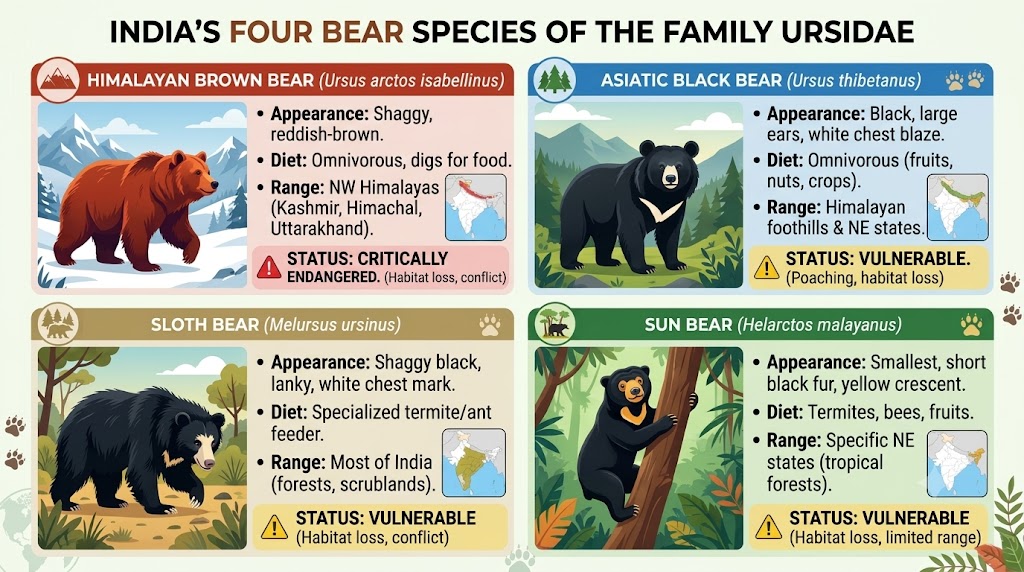
  • Aim - To generate fresh baseline data regarding population estimates, geographic distribution range, shifting habitat dynamics, and drivers of human-bear conflicts.

India’s First National-Level Study on All Four Bear Species

Parameter

Himalayan Brown Bear (Ursus arctos isabellinus)

Asiatic Black Bear (Ursus thibetanus)

Sloth Bear (Melursus ursinus)

Sun Bear (Helarctos malayanus)

Geographic Range

High-altitude alpine meadows of Upper Himalayas (J&K, Ladakh, HP, Uttarakhand).

Himalayan forest belt and hilly regions of Northeast India.

Central India, Western Ghats, Vindhyas, Satpuras, & Himalayan foothills.

Highly restricted presence in dense tropical forests of Northeast India.

Key Characteristics

Large size; herbivorous/omnivorous; adapted to cold alpine ecosystems.

Arboreal tendencies; V-shaped white patch on chest; fruit & nut eater.

Myrmecophagous (termite/ant feeder); shaggy coat; prominent V or Y chest mark.

Smallest bear species; short sleek coat; horseshoe-shaped chest mark.

IUCN Status

Critically Endangered (Subspecies level) / Least Concern (Global species level).

Vulnerable.

Vulnerable.

Vulnerable.

WPA 1972 Schedule

Schedule I.

Schedule I.

Schedule I.

Schedule I.

Strategic Importance

  • Scientific Validation of Populations - Earlier estimates placed the sloth bear population in the Indian subcontinent at around 20,000, but these figures lack updated, standardized empirical validation.
  • Non-invasive survey techniques—including camera trapping, scat DNA analysis, and pugmark/footprint trackingwill be deployed across diverse bio-geographic zones.
  • Mapping Shifting Habitats - The study will identify regions where bears were historically documented but have recently disappeared, helping isolate whether habitat degradation, climate shifts, or corridor destruction is responsible.
  • Mitigating Human-Bear Conflict - Mountainous states like Uttarakhand have witnessed a surge in human-bear encounters, resulting in livestock loss and human casualties.
  • Mapping spatial movement corridors will allow state forest departments to implement early warning systems and localized conflict-mitigation zones.

Reference

New Indian Express | Four bear species across India

There are no reviews yet. Be the first one to review.

ARCHIVES

sidetext


