Prelims: Current events of national and international importance | Environment
Why in News?
Recently, the Wildlife Institute of India (WII), Dehradun, announced the initiation of the country's first nationwide scientific assessment covering all four bear species native to India.
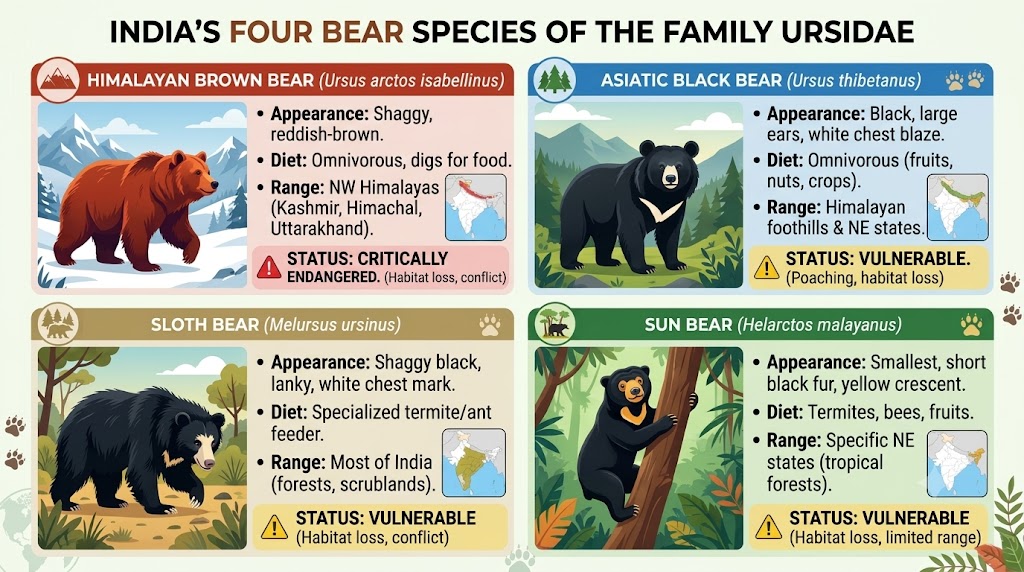
|
Parameter |
Himalayan Brown Bear (Ursus arctos isabellinus) |
Asiatic Black Bear (Ursus thibetanus) |
Sloth Bear (Melursus ursinus) |
Sun Bear (Helarctos malayanus) |
|
Geographic Range |
High-altitude alpine meadows of Upper Himalayas (J&K, Ladakh, HP, Uttarakhand). |
Himalayan forest belt and hilly regions of Northeast India. |
Central India, Western Ghats, Vindhyas, Satpuras, & Himalayan foothills. |
Highly restricted presence in dense tropical forests of Northeast India. |
|
Key Characteristics |
Large size; herbivorous/omnivorous; adapted to cold alpine ecosystems. |
Arboreal tendencies; V-shaped white patch on chest; fruit & nut eater. |
Myrmecophagous (termite/ant feeder); shaggy coat; prominent V or Y chest mark. |
Smallest bear species; short sleek coat; horseshoe-shaped chest mark. |
|
IUCN Status |
Critically Endangered (Subspecies level) / Least Concern (Global species level). |
Vulnerable. |
Vulnerable. |
Vulnerable. |
|
WPA 1972 Schedule |
Schedule I. |
Schedule I. |
Schedule I. |
Schedule I. |
Strategic Importance
Reference



