The Return of the Spotted Sprint
A Morning in the Undergrowth
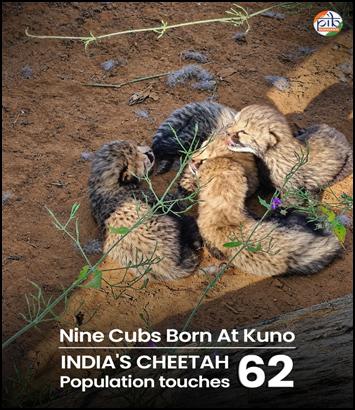
- Project Cheetah recorded two successive litters at Kuno National Park in October and November 2026, adding nine cubs.
- The births indicate successful adaptation, breeding and improving habitat suitability, advancing India's goal of establishing a self-sustaining cheetah population.
A New Generation at Kuno
Location: Kuno National Park, Sheopur district, Madhya Pradesh.
Two Recent Litters
- 5 October 2026: KJP21, a 32-month-old India-born female, gave birth to five cubs. She became the third India-born female to reproduce after Mukhi and KGP12.
- The father was a Botswana-origin male, introducing new genetic lineage into the India-born population.
- 20 November 2026: KOMG 3, a 30-month-old Botswana-origin female, gave birth to four cubs.
- She became the first Botswana-origin female to reproduce in India and the second recorded instance of wild breeding outside Closed Natural Areas (CNAs) since 2022.
Population Status (November 2026)
- Total population: 62 cheetahs
- India-born cheetahs: 43 (nearly 70%)
- New cubs: 9
From Reintroduction to Natural Reproduction
Where Did Our Cheetahs Go?
- Cheetahs were declared extinct in India in 1952. The last confirmed sighting was in 1947 in the Sal forests of present-day Koriya, Chhattisgarh.
- Major causes: excessive hunting, poaching, habitat loss, declining prey, climate pressures and low reproductive rates.
Project Cheetah – Timeline
- September 2022: Eight cheetahs introduced from Namibia at Kuno.
- February 2023: Twelve cheetahs arrived from South Africa.
- February 2026: Nine cheetahs (6 females and 3 males) arrived from Botswana.
- Implemented by MoEFCC through the National Tiger Conservation Authority (NTCA), it is the world's first intercontinental translocation of a large wild carnivore for reintroduction.
A Population Growing From Within
- November 2025: Mukhi became the first India-born female to reproduce, giving birth to five cubs.
- Subsequently, KGP12 and KJP21 also reproduced.
- Breeding by India-born females indicates local adaptation and successful completion of the reproductive cycle.
- Introducing animals from Namibia, South Africa and Botswana strengthens genetic diversity, disease resistance and long-term population resilience.
The Science Behind the Recovery
- Kuno was selected based on habitat suitability, prey availability and low human disturbance.
- Relocation of 24 villages involving 1,545 families made 6,258 hectares available for conservation.
- Key interventions: grassland restoration, prey augmentation and water management.
- Scientific monitoring includes satellite collars, camera traps, field observations and veterinary assessments.
- Cheetahs undergo staged release from Closed Natural Areas into open landscapes.
- Cub survival beyond one year is an important indicator of programme success.
Grasslands, Prey and Local Communities
- Cheetah is a flagship and umbrella species for conserving grasslands, open forests and semi-arid ecosystems.
- Major prey: chital, sambar, nilgai, chinkara, chousingha and blackbuck. Chital accounts for around 75% of recorded kills.
- Over 450 Cheetah Mitras operate across 80 villages.
- Around 380 direct jobs have been generated, while villages receive 5% of eco-tourism revenue.
The Road Ahead
- Target: Establish a self-sustaining metapopulation of 60–70 cheetahs by 2032 across approximately 17,000 sq. km.
- Kuno National Park: Principal reintroduction site.
- Gandhi Sagar Wildlife Sanctuary: Second site; first two cheetahs, Prabash and Paavak, shifted in April 2025.
- Veerangana Durgavati Tiger Reserve: Third cheetah habitat in Madhya Pradesh, with two cheetahs released in October 2026.
- Additional habitats are being assessed to ensure wider population distribution.
Conclusion
India's cheetah programme is transitioning from translocation to natural reproduction. Habitat restoration, genetic diversity, scientific monitoring and community participation are crucial to achieving a viable, self-sustaining cheetah population by 2032.



