Mains: GSIII – Environment| Infrastructure
Why in News?
Urban expansion and hostile architectural designs are increasingly restricting animals' access to shelter, nesting spaces and safe movement, raising concerns over urban biodiversity and animal welfare.
What is Hostile Architecture?
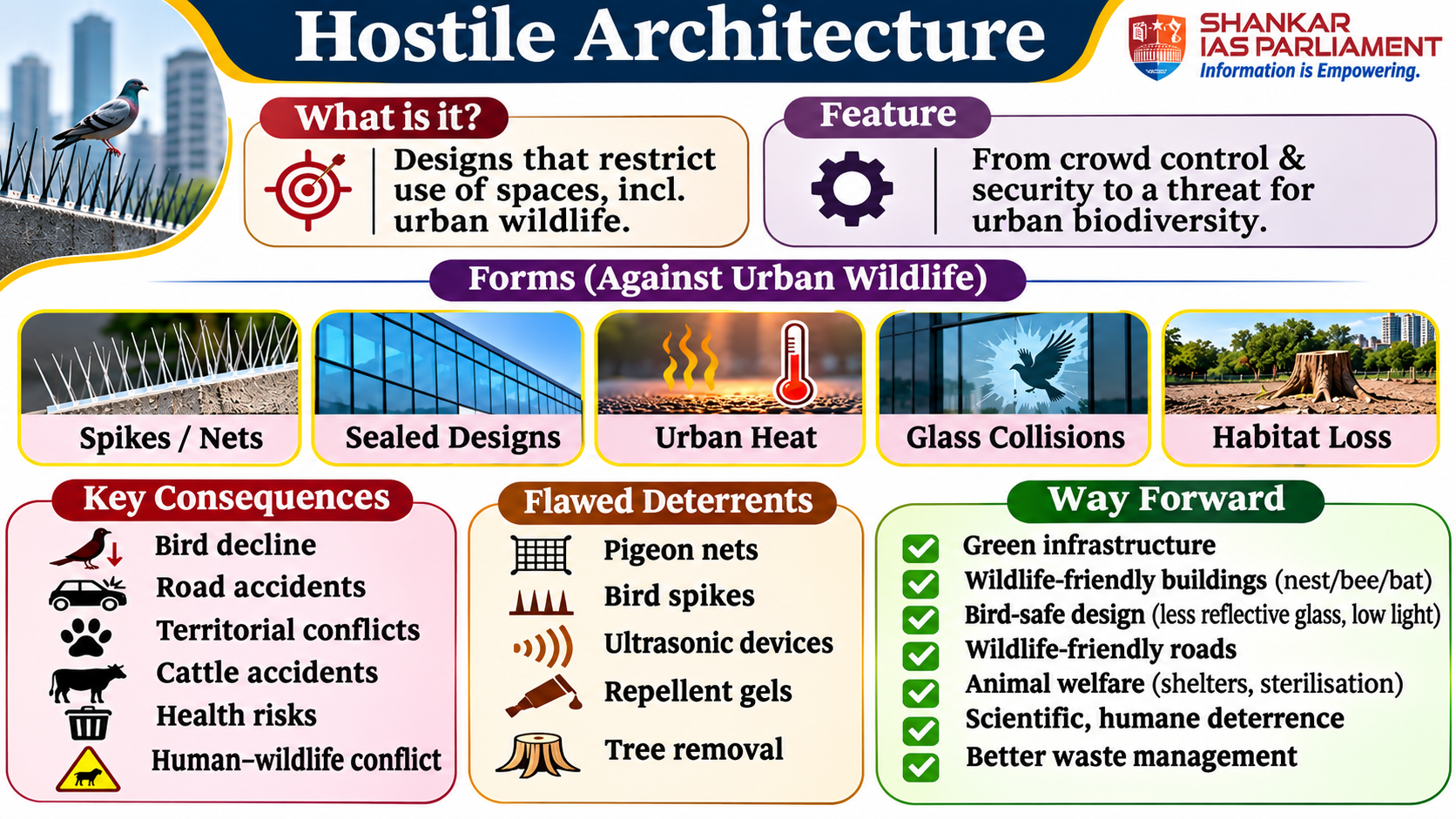
- Hostile architecture – It refers to design choices in public spaces and buildings that deliberately or unintentionally restrict their use by certain groups, including animals.
- Feature – Originally associated with preventing anti-social activities and homelessness, it increasingly affects urban wildlife.
What are the different Forms of Hostile Architecture Against Urban Wildlife?
- Physical deterrents – Bird spikes, balcony nets, broken glass and spiked compound walls prevent animals from perching, nesting or entering spaces.
- Modern building design – Smooth concrete, glass surfaces and sealed openings eliminate nesting crevices and sheltered spaces available in traditional buildings.
- Urban heat island effect – Concrete and asphalt absorb heat, making urban surfaces uncomfortable for animals and birds.
- Glass collisions – Reflective and transparent glass causes bird collisions, while bright artificial lights disorient migratory birds.
- Habitat loss – Tree removal, vegetation depletion and shrinking green spaces reduce shelter, food and breeding opportunities.
What are the Flawed Methods of Animal Deterrence?
- Pigeon nets – Poorly maintained nets trap and injure birds and monkeys.
- Sharp anti-bird spikes – Steel spikes can injure birds and other animals.
- Ultrasonic repellers – Often ineffective under real-world conditions and may distress non-target animals.
- Repellent gels – Can glue birds' feathers together and affect non-target species.
- Tree removal – Cutting trees to prevent bird-related nuisances reduces biodiversity and increases local temperatures.
- Event-based exclusion – Fencing, glass fragments, metal pieces and animal relocation during high-security events can cause injuries.
What are the Major Consequences for Urban Wildlife?
- Declining bird populations – Lack of nesting spaces contributes to the decline of urban species such as sparrows.
- Road accidents – Noise, lights and the absence of animal-crossing signs cause road injuries and fatalities.
- Territorial conflicts – Dense urban construction intensifies territorial behaviour among street dogs.
- Cattle accidents – Poor visibility on unlit roads increases collisions involving cattle and buffaloes.
- Waste-related health risks – Open garbage exposes animals to toxic materials, diseases and contaminated food.
- Human-wildlife conflict – Garbage attracts free-ranging dogs, pigs and potentially leopards into human settlements.
What is the Way Forward?
- Green infrastructure – Restore urban vegetation, conserve mature trees and expand avenue trees and native bushes.
- Wildlife-friendly buildings – Incorporate nest boxes, bee boxes, bat shelters, openings and sheltered spaces.
- Bird-safe architecture – Reduce reflective glass, improve visibility of glass surfaces and minimise unnecessary artificial lighting.
- Ecologically sensitive lighting – Use warm amber lights below 2,700 K, reduce illumination to around 10–20 lux on pathways and install light hoods.
- Wildlife-friendly roads – Construct low-height medians and small openings to facilitate movement of smaller animals.
- Animal welfare infrastructure – Establish shelters for dogs, sterilisation programmes and cattle pound houses.
- Scientific deterrence – Replace harmful deterrents with evidence-based, humane alternatives.
- Improved waste management – Eliminate open dumping to reduce disease risks and prevent wildlife attraction into urban settlements.
What lies ahead?
- Urban planning must move beyond human-centric infrastructure towards inclusive, biodiversity-sensitive and humane design.
- Integrating wildlife corridors, native vegetation, animal shelters and safe mobility into urban development can reduce human-animal conflicts.
Reference
The Hindu| Hostile architecture: keeping wildlife out of urban India



