Mains: GS II – Indian Polity, and Governance
Why in News?
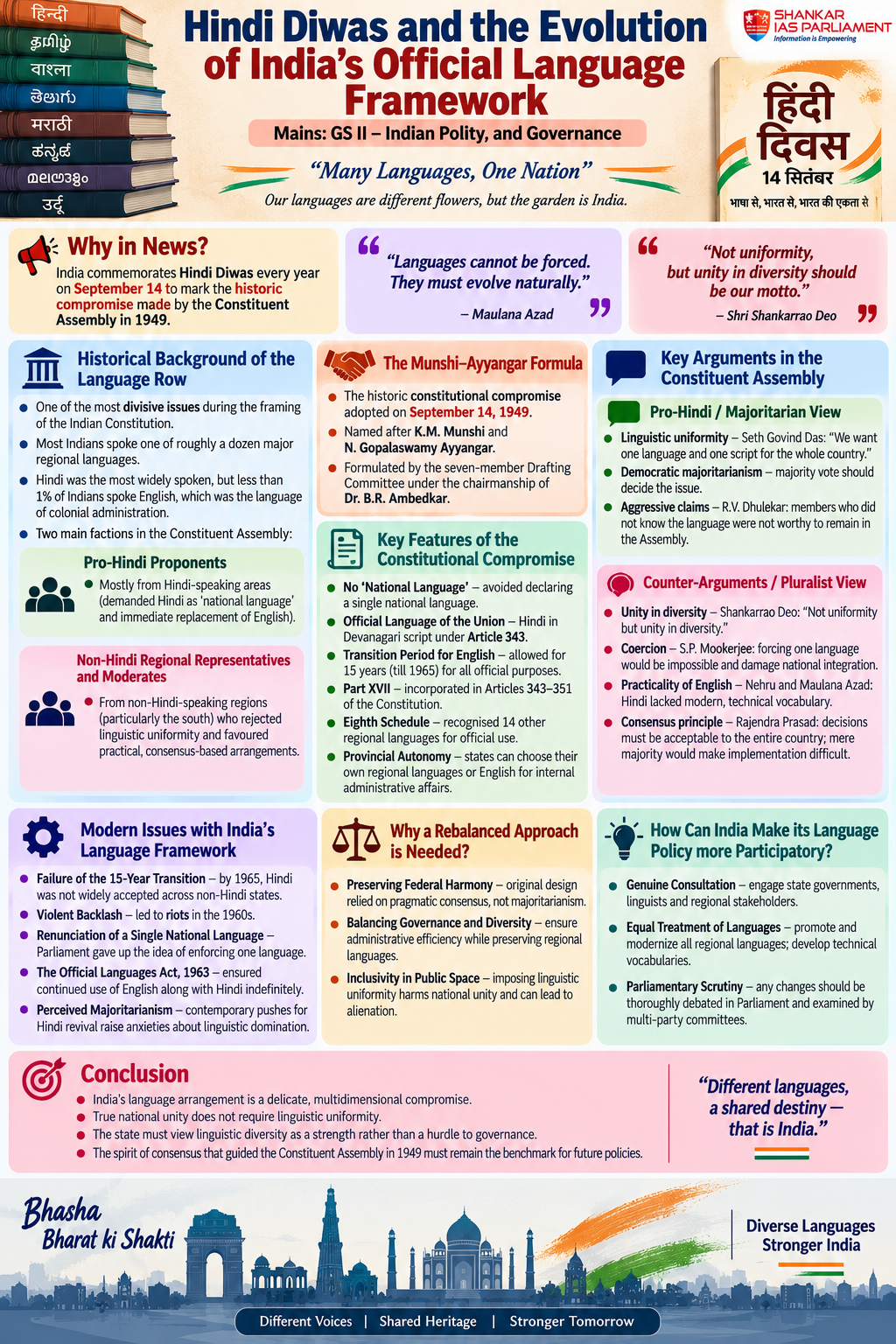
India commemorates Hindi Diwas every year on September 14 to mark the historic compromise made by the Constituent Assembly in 1949.
What is the Historical Background of the Language Row?
- The Core Conflict – The language question was one of the most divisive and contentious issues during the framing of the Indian Constitution.
- The Demographic Reality – At Independence, most Indians spoke one of roughly a dozen major regional languages.
- While Hindi was the most widely spoken language, English was the language of colonial administration even though less than 1 per cent of Indians spoke it.
- The Main Factions – The dispute involved two main political factions in the Constituent Assembly –
- Pro-Hindi Proponents – Representatives from the Hindi-speaking areas (mostly north-central India) who aggressively demanded that Hindi be declared the 'national language' and replace English immediately.
- Non-Hindi Regional Representatives and Moderate Leaders – Representatives from non-Hindi-speaking regions (particularly the south) and moderate Congress leaders who rejected linguistic uniformity and favored practical, consensus-based legal arrangements.
What is the Munshi–Ayyangar Formula?
- The Munshi–Ayyangar Formula – It is the historic constitutional compromise adopted by the Constituent Assembly on September 14, 1949.
- It was named after KM Munshi and N Gopalaswamy Ayyangar, who served on the seven-member Drafting Committee under the chairmanship of Dr. B.R. Ambedkar.
What are the key features of the Constitutional Compromise?
- No 'National Language' – The formula deliberately avoided declaring a single national language for the country.
- Official Language of the Union – It designated Hindi in the Devanagari script as the 'official language of the Union' under Article 343.
- Transition Period for English – It allowed English to continue to be used 'for all official purposes' of the Union for a period of 15 years from the commencement of the Constitution (until 1965).
- Part XVII of the Constitution – The formula was later incorporated into Articles 343–351 of the Constitution.
- Eighth Schedule – The framework recognized 14 other regional languages for official use to preserve provincial identity.
- Provincial Autonomy – State governments were permitted to choose their own regional languages or English to conduct internal state administrative affairs.
What were the key arguments in the Constituent Assembly?
Pro-Hindi / Majoritarian View –
- Linguistic Uniformity – Leaders like Seth Govind Das argued that a multilingual society was incompatible with Indian unity, stating, "We want one language and one script for the whole country."
- Democratic Majoritarianism – Proponents demanded a simple majority vote to decide the language issue.
- They argued that democracy can only function when the majority opinion is honored and accepted respectfully by the minority.
- Aggressive Claims – RV Dhulekar famously made an aggressive plea for Hindustani in constitution-making, stating that members who did not know the language were not worthy to remain in the Assembly.
Counter-Arguments / Pluralist View –
- Unity in Diversity – Shri Shankarrao Deo of Bombay stressed that the foundational principle of the new republic should be "not uniformity but unity in diversity."
- Coercion – SP Mookerjee of Bengal warned that forcing one language upon all citizens through constitutional coercion would be impossible to achieve and would damage national integration.
- Practicality of English – Moderate leaders like Jawaharlal Nehru and Maulana Azad emphasized that Hindi lacked the modern, technical vocabulary required to govern a modern State.
- Azad noted that languages cannot be forced but must evolve naturally over time.
- Consensus Principle – Assembly President Rajendra Prasad argued that language decisions must be acceptable to the entire country, warning that a decision passed by a mere majority without widespread approval would make implementing the Constitution extremely difficult.
What are the Modern Issues with India’s Language Framework?
- Failure of the 15-Year Transition – When the transition period ended in 1965, Hindi was still not widely accepted or used by the Union government across non-Hindi states.
- Violent Backlash – The attempt to phase out English led to a series of violent riots in non-Hindi-speaking states during the 1960s.
- Renunciation of a Single National Language – Following these protests, Parliament effectively renounced the ideal of enforcing a single Indian national language.
- The Official Languages Act, 1963 – To resolve the crisis, Parliament enacted this law to ensure that English would continue to be used as an official language along with Hindi indefinitely.
- Perceived Majoritarianism – Contemporary pushes for Hindi promotion often revive old anxieties regarding linguistic domination and the sidelining of regional identities.
Why the Language Framework Needs a Rebalanced Approach?
- Preserving Federal Harmony – The original constitutional design succeeded because it relied on a "pragmatic consensus-seeking approach" rather than a strict majoritarian vote and any modern change must respect this federal balance.
- Balancing Governance and Diversity – There remains a critical need to balance administrative efficiency at the Centre with the preservation of regional languages listed in the Eighth Schedule.
- Inclusivity in Public Space – Imposing linguistic uniformity harms national unity. Forcing language policies can lead to alienation among linguistic minorities.
How Can India make its Language Policy more Participatory?
- Genuine Consultation – The Union government should engage in meaningful dialogue with state governments, linguists, and regional stakeholders rather than taking top-down administrative actions.
- Equal Treatment of Languages – Promote and modernize all regional languages, helping them develop technical and scientific vocabularies as envisioned by early leaders.
- Parliamentary Scrutiny – Any proposed modifications to official language policies should be thoroughly debated in Parliament and examined by multi-party committees representing various states.
Conclusion
- The history of Hindi Diwas shows that India’s constitutional arrangement is a delicate, multidimensional compromise.
- True national unity in a civilizational state like India does not require linguistic uniformity.
- Moving forward, the state must view linguistic diversity as a strength rather than a hurdle to governance.
- The spirit of consensus that guided the Constituent Assembly in 1949 must remain the benchmark for all future language policies.
Reference
Indian Express | Hindi Diwas



