Why in News?
Recently the United States has publicly acknowledged that it has deployed active “on-orbit space control weapons”, marking the first such public admission by a country, which has rised concerns over weaponisation of outer space.
What is Weaponisation of Space?
- Weaponsation of space – It is the placement of offensive or defensive combat weapons in Earth's orbit or outer space, transforming space into an active warfighting domain.
Militarisation of Space refers to the passive or supportive use of outer space for military operations, including GPS guidance, communications, intelligence gathering etc.
- Space-based military capabilities can broadly include:
- Earth-to-space weapons – Missiles or other systems used to destroy satellites.
- Space-to-Earth weapons – Space-based systems capable of attacking ground targets.
- Space-to-space weapons – Systems designed to target satellites or other space assets.
- Non-kinetic weapons – Jamming, cyberattacks and other methods that disrupt satellite communications, navigation and space infrastructure.
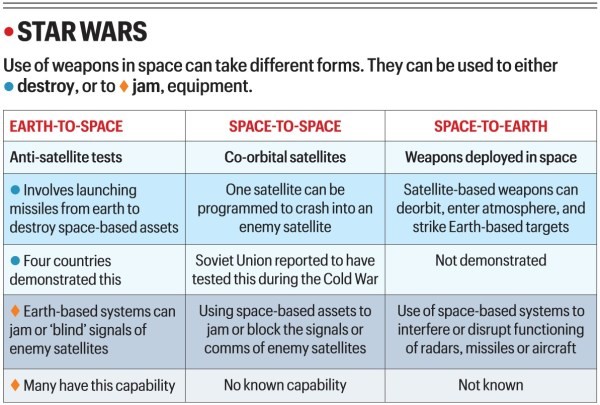
4 countries — US, Russia, China and India have demonstrated Anti-Satellite (ASAT) capabilities by destroying their own satellites in tests.
- Growing Counter-Space Capabilities – The strategic importance of space has increased with dependence on satellites for:
- Communication and internet services
- Navigation and GPS
- Intelligence, surveillance and reconnaissance
- Missile warning and military operations
- Weather forecasting and disaster management
- The Russia-Ukraine conflict has demonstrated that cyberattacks on satellite ground infrastructure and GPS interference can disrupt critical space-enabled services
- It can be done without physically destroying satellites.
|
Outer Space Treaty
|
- The Outer Space Treaty, 1967 is the principal international legal framework governing outer space.
- It prohibits placing nuclear weapons and other weapons of mass destruction in orbit or on celestial bodies.
- Promotes the use of outer space for peaceful purposes.
- However, it does not explicitly prohibit conventional weapons in space.
- It also does not comprehensively regulate
- Earth-to-space weapons,
- Anti-satellite systems,
- Cyberattacks or electronic warfare.
- Thus, there exists a significant legal gap between existing space law and modern counter-space technologies.
Military use of space is not itself prohibited under the Outer Space Treaty.
|
What are the Major Concerns associated with Weaponisation of Space?
- Arms race in space – Deployment of weapons may encourage competing powers to develop offensive and defensive counter-space capabilities.
- Space debris – Kinetic ASAT attacks can generate debris, threatening satellites and human spaceflight.
- Strategic instability – Attacks on satellites can disrupt communications, navigation and early-warning systems, potentially escalating terrestrial conflicts.
- Weak international regulation – Existing treaties have not kept pace with cyber, electronic, kinetic and autonomous space technologies.
Challenges in Regulating Space Warfare
- Legal ambiguity – Existing treaties do not comprehensively cover conventional and emerging counter-space weapons.
- Attribution difficulty – Cyber and electronic attacks can be difficult to trace.
- Dual-use technologies – Civilian and military applications often overlap.
- Private-sector involvement – Commercial satellites complicate traditional state-centric regulation.
- Verification challenges – Monitoring the nature and purpose of space-based systems is difficult.
- Strategic mistrust – Major powers may view transparency measures as potentially compromising national security.
What Could be done?
- Strengthen International Space Law – Develop legally binding rules covering conventional weapons and counter-space capabilities.
- Update the existing legal framework to address emerging technologies.
- Prevent an Arms Race – Strengthen UN-led negotiations to prevent an arms race in outer space.
- Promote international cooperation for peaceful use of space.
- Promote Responsible Behaviour – Establish norms against debris-generating ASAT tests and other harmful activities.
- Encourage responsible use of counter-space capabilities.
- Enhance Space Security – Improve Space Situational Awareness (SSA) and space-debris monitoring through international cooperation.
- Develop mechanisms for early warning and information sharing.
- Build Confidence and Transparency – Promote confidence-building measures, transparency and advance notification of potentially destabilising activities.
- Protect Civilian Space Infrastructure – Strengthen safeguards for critical satellites against cyberattacks, jamming and electronic interference.
What lies ahead?
- The US announcement highlights a widening gap between rapidly evolving space warfare capabilities and existing international law.
- The challenge is not merely to prevent weapons of mass destruction in space, but to develop a comprehensive framework that ensures outer space remains secure.
- The outer space must be sustainable and accessible for peaceful civilian and scientific purposes.
Reference
The Indian Express| Is the weaponisation of space legal?



