Mains: GS II – Polity & Governance
Why in News?
Recently, the Supreme Court upheld the constitutional validity of hanging as a method of executing the death penalty.
What is hanging as a method of execution?
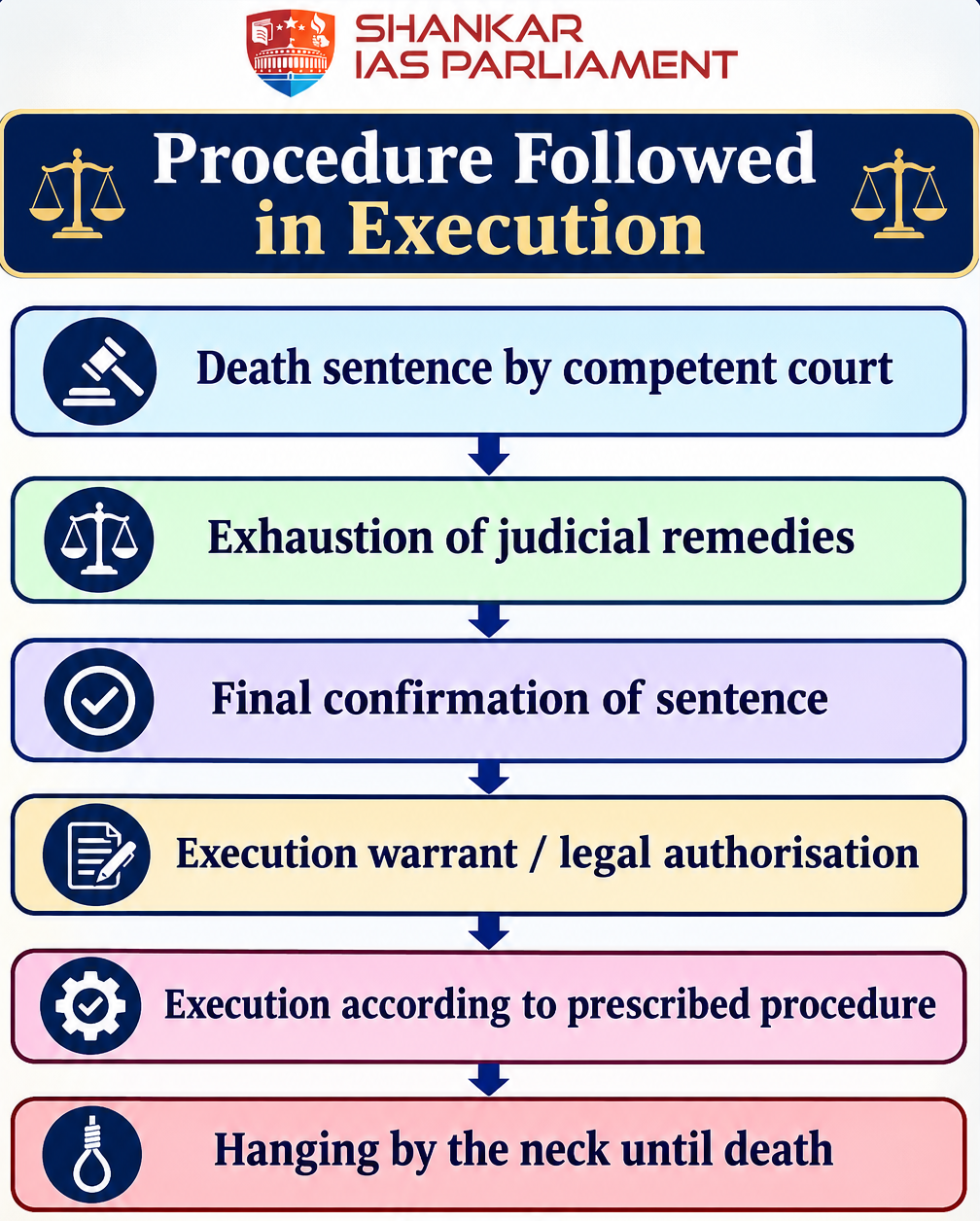
Hanging – It is a method of execution in which death results from the suspension of the body by a noose.
It meant to cause a fracture-dislocation at the C2-C3 vertebrae and bring about near-instant unconsciousness.
Long-drop method – It is commonly employed in India, is intended to induce rapid unconsciousness by causing cervical spine injury.
Dependence on Variables – It depends on variables such as the length of the drop, individual body characteristics, and correct procedural administration.
What is the constitutional and legal provisions of execution?
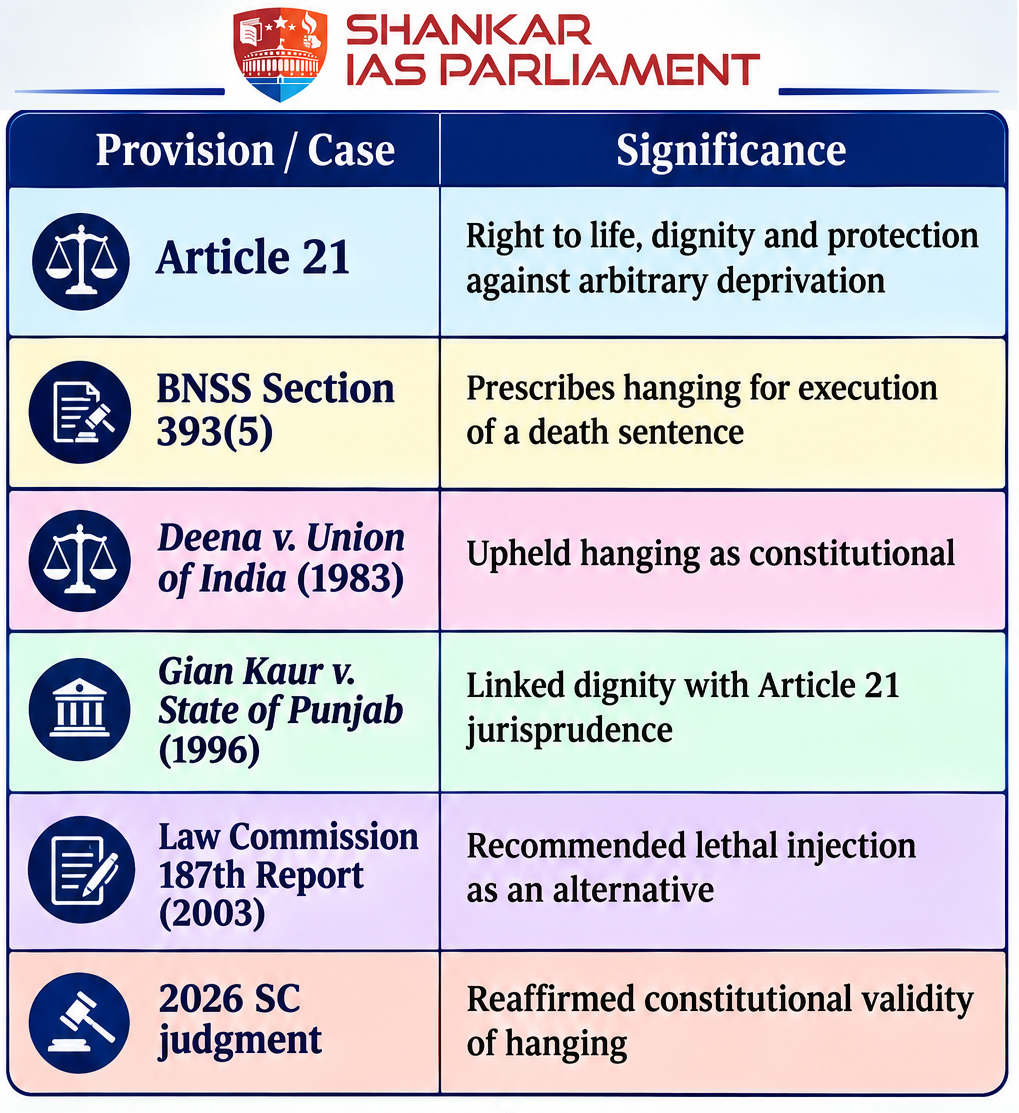
Constitutional provision – Article 21 safeguards the right to life and personal liberty.
Judicial interpretation has broadened the scope of Article 21 to include the right to dignity.
The Supreme Court has affirmed that constitutional protections continue to apply following the imposition of a death sentence.
Consequently, individuals on death row must be treated with decency, dignity, and procedural fairness.
While the death penalty may be constitutionally permissible, its implementation must adhere to constitutional standards of dignity and non-brutality.
Bharatiya Nagarik Suraksha Sanhita (BNSS) – It stipulates that any individual sentenced to death must be "hanged by the neck till he is dead."
This provision maintains the precise statutory language and historical context of Section 354(5) of the former Code of Criminal Procedure (CrPC), 1973, which originated in 1861.
What is the evolution of hanging as a method of execution in India?
Colonial Period – During British rule, hanging emerged as the primary legally sanctioned method of civilian execution.
This execution framework was integrated into the criminal procedure system instituted in colonial India.
Post-Independence – India continued to permit capital punishment, subjecting its practice to constitutional review.
Article 21 shifted the discourse from the permissibility of state executions to the manner in which executions must be conducted.
Deena v. Union of India, 1983 – The Supreme Court affirmed the constitutional validity of hanging as a method of execution.
The Court evaluated medical evidence, expert testimony, and potential alternative methods of execution.
When properly administered, hanging was deemed sufficiently rapid, reliable, and non-barbaric.
Gian Kaur v. State of Punjab, 1996 – The Court analyzed the connection between Article 21 and the principle of death with dignity.
This decision reinforced the jurisprudential significance of dignity within the framework of Article 21.
Law Commission's 187th Report, 2003 — The report recommended the introduction of lethal injection as an alternative method of execution.
However, Parliament did not adopt this recommendation.
Supreme Court Judgment, 2026 – The Supreme Court declined to revisit the Deena precedent.
The Court determined that the evidence presented did not demonstrate that hanging had become constitutionally impermissible.
However, the Court acknowledged that future scientific or empirical findings could warrant reconsideration of the method.
What are the other global standards of execution?
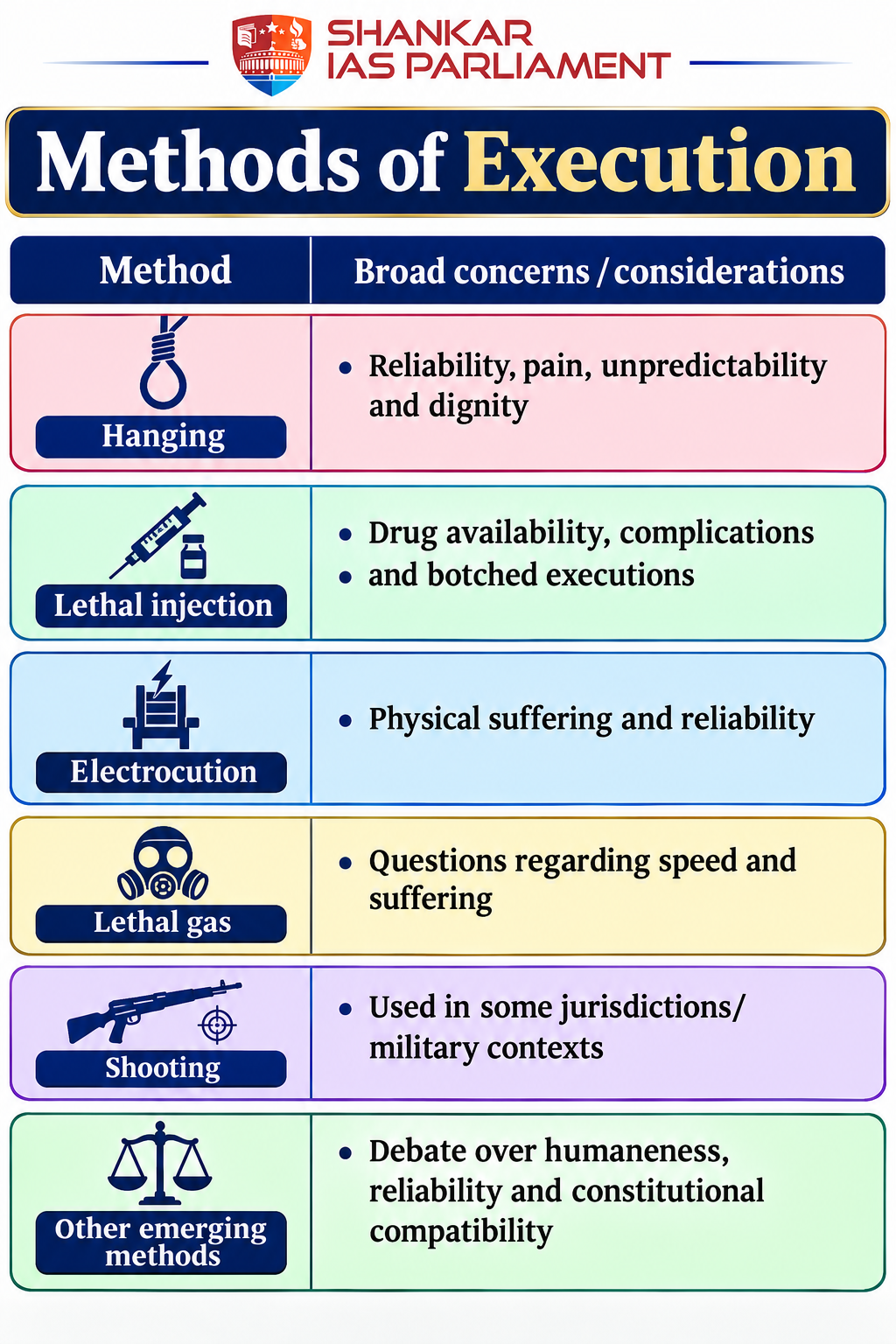
There is no universally accepted method that automatically satisfies the dignity standard.
Each method raises questions of reliability, suffering, medical ethics and procedural safeguards.
Why did the court retain it?
Judicial precedent – In Deena, the court upheld hanging as a method of execution after considering medical and expert evidence.
No decisive new evidence – The petitioners failed to establish that subsequent scientific evidence fundamentally undermined the legal basis established in Deena.
Legislative reaffirmation – Parliament retained hanging as a method of execution during the enactment of the BNSS.
Section 393(5) of the BNSS, where a person is sentenced to death, the sentence directs that the person be hanged by the neck until dead.
This provision maintains the framework historically established under the Code of Criminal Procedure (CrPC).
No clearly superior alternative – The Court determined that lethal injection, electrocution, lethal gas, and shooting had not been demonstrated to offer a constitutionally superior alternative to hanging.
What are the existing challenges?
Scientific uncertainty – The consistency with which hanging produces rapid unconsciousness remains a central issue in the scientific assessment of execution methods.
Dignity vs. death penalty – Even if capital punishment is constitutionally permissible, the State is obligated to ensure that the execution process does not become unnecessarily cruel or degrading.
Colonial legacy – A significant normative question persists:
It remains to be determined whether a method inherited from colonial criminal law can satisfy the requirements of contemporary constitutional morality.
Lack of empirical evidence – The relatively low number of executions in India in recent decades has hindered comprehensive empirical assessment of execution methods.
Psychological suffering – The constitutional debate encompasses not only the moment of execution but also the prolonged uncertainty and psychological suffering experienced by individuals on death row.
Alternatives remain contested – Substituting hanging with an alternative method does not inherently resolve concerns regarding human dignity.
What are the steps to be taken?
Independent scientific review – The method should be regularly reassessed using current medical and forensic evidence.
Examine alternative methods – The Union Government should evaluate the legal feasibility of introducing a safer and more predictable method.
Evidence-based policymaking – Future policy decisions should be informed by the following considerations:
Medical evidence,
Forensic research,
Comparative international experience,
Human-rights standards.
Strengthen procedural safeguards – Strict compliance with all procedural safeguards must be ensured prior to execution.
Address death-row psychological suffering – The dignity of prisoners must be upheld throughout the period preceding execution.
Periodic legislative review – Parliament should conduct periodic reviews of the statutory method rather than permitting historical provisions to persist solely due to legislative continuity.
What lies ahead?
The Supreme Court has not rendered the debate permanently closed.
Its judgment allows for future reconsideration should scientific, medical, or empirical evidence establish that hanging contravenes the constitutional requirement of dignity.
Reference
The Indian Express | Hanging as a Constitutional Mode of Execution



