Why in news?
Recent study by the University of New South Wales analyzed the impact of DFCs on India’s economy, particularly the WDFC.
What is a dedicated freight corridor?
- Dedicated Freight Corridors (DFCs) – They are specialized rail routes created solely for the transportation of freight, independent of passenger rail traffic.
- Exclusive for Freight - Unlike mixed-use rail networks, DFCs focus exclusively on freight, allowing for the transit of heavier, longer, and double-stack container trains at higher speeds.
- Dedicated Freight Corridor Corporation of India Limited – To undertake planning & development, mobilization of financial resources, construction, operation & maintenance, and business development of the dedicated freight corridors.
- Significance - The primary goal of these corridors is to increase the efficiency, speed, and capacity of freight transportation across the country.
|
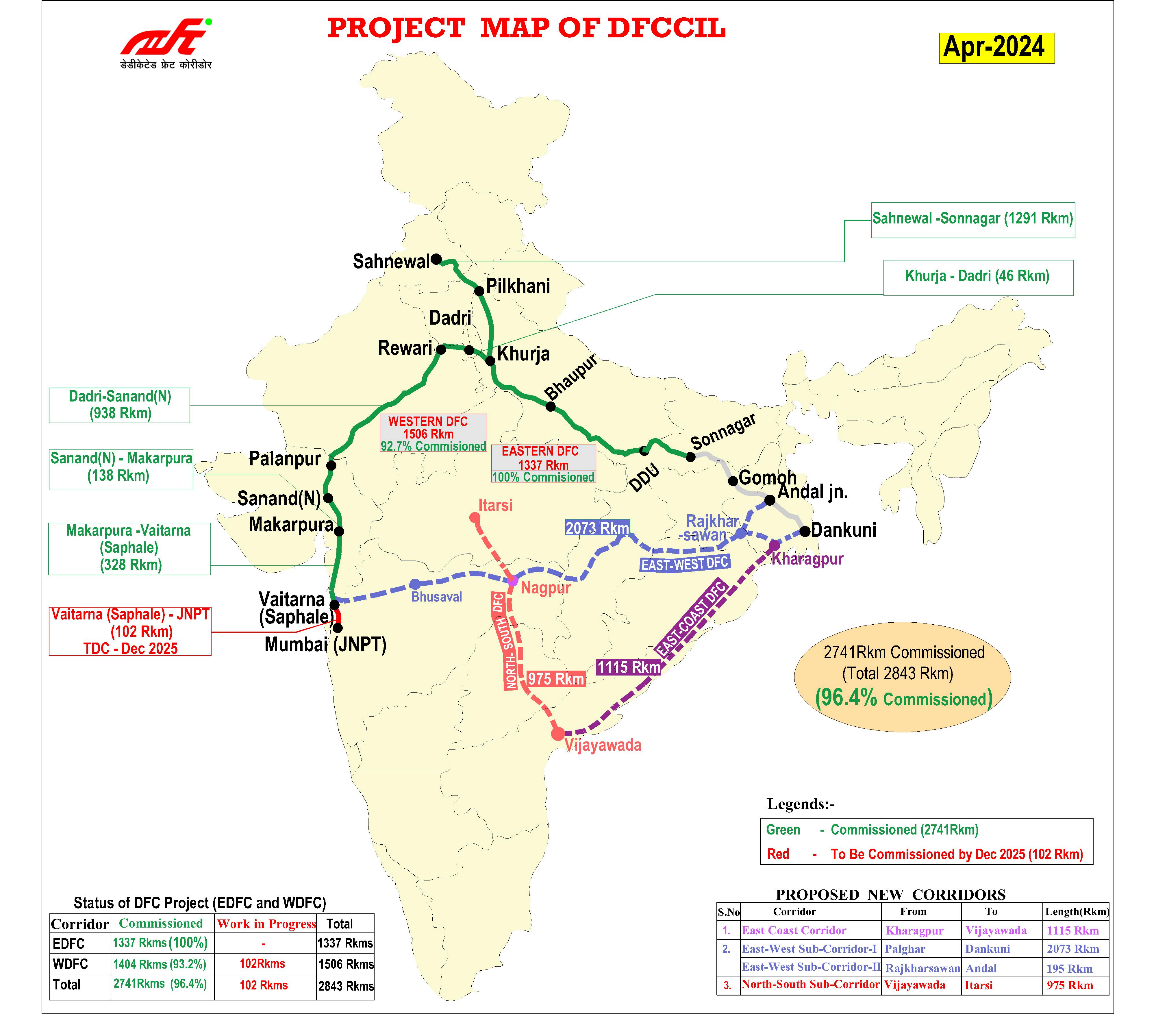
Dedicated Freight Corridors in India
|
|
Corridor
|
Route
|
Length
|
|
Eastern Dedicated Freight Corridor (EDFC)
|
From Ludhiana in Punjab to Dankuni in West Bengal
|
1,337 km
|
|
Western Dedicated Freight Corridor (WDFC)
|
From Jawaharlal Nehru Port in Mumbai to Dadri in Uttar Pradesh
|
1,506 km
|
|
Proposed Corridors
|
|
East Coast Corridor
|
Kharagpur to Vijayawada
|
1,115 km
|
|
East-West Sub-corridor I
|
Palghar to Dankuni
|
2,073 km
|
|
East-West Sub-corridor II
|
Rajkharsawan to Andal
|
195 km
|
|
North-South Sub-corridor
|
Vijayawada to Itarsi
|
975 km
|
The National Rail Plan envisages increasing rail’s share of freight traffic to 45% by 2030.
|
Dedicated Freight Corridor Corporation of India (DFCCIL)
|
- The Dedicated Freight Corridor Corporation of India Limited (DFCCIL) is a special purpose vehicle established in 2006 for constructing, operating, and maintaining the DFCs.
- DFCCIL has been instrumental in managing the extensive and complex task of building and commissioning these corridors.
- Vision – To create a partnership with Indian Railway for retaining and expanding the market share of railways through efficient and reliable service with customer focus.
- Mission – To build a corridor with appropriate technology that enables Indian Railways to regain its market share of freight transport by creating additional capacity and guaranteeing efficient, reliable, safe, and cheaper options for mobility to its customers
- To set up Multimodal logistic parks along the DFC to provide complete transport solution to customers.
|
Why the DFCs are vital for economic Growth?
- Enhanced Freight Efficiency - DFCs allow faster and more efficient freight transportation, which is critical for industrial productivity.
- Improves Industrial Productivity - DFCs enable industries to maintain leaner inventories and rely on timely deliveries, reducing costs across the supply chain.
- Logistic Cost Reduction – Dedicated fright route reduces the transportation cost of goods.
- Reduction in Commodity Price - With reduced travel time and costs, the DFCs have directly impacted commodity prices, making goods more affordable.
- According to an Australian study, freight cost reduction on the DFCs has led to a 0.5% decrease in the prices of transported goods, which has positive ripple effects across various sectors of the economy.
- Boost to Railway Revenue - The increased efficiency and dedicated freight handling capacity of the DFCs have contributed substantially to Indian Railways’ revenue.
- The Australian study indicated that between FY 2018–19 and FY 2022–23, the DFCs contributed to 2.94% of the growth in rail revenues.
- Reduce Rail Congestion - Over 52% of passenger traffic and 58% of freight traffic concentrated on just 16% of the rail route length.
- The DFCs help alleviate this pressure by providing a separate channel for freight, thereby freeing up capacity for passenger trains on other routes.
- Greater Economic Benefits, especially in states with lower per-capita GDP, suggesting that these corridors have a ‘social-equalizing effect.
- Equitable Growth - Reduced transportation costs in economically disadvantaged regions, the DFCs help stimulate local economies and increase access to affordable goods(On the growth track)
- Support Regional Trade – DFCs connects different regions to promote economic hubs, fostering regional equity.
- Export Growth – Improvement in connectivity to major ports makes India more competitive in global trade.
- Sustainable Growth – Usage of DFCs reduces carbon emission from road transport and help achieving sustainable goal 11.
- It is expected that DFC will save more than 450 million ton of CO2 in first 30 years of operation.
SDG 11 mandates to provide access to safe, affordable, accessible and sustainable transport systems for all.
What lies ahead?
- Create an integrated freight network and enhance India’s economic resilience.
- Conduct comprehensive studies to quantify the economic impact of DFCs and identify ways to optimize future corridor designs and operational strategies.
- Promotion of multimodal logistics to integrate other mode of transports with freight corridors.
- As DFCCIL continues its work, and studies validate the DFCs' impact, these corridors will shape India’s industrial landscape, fostering regional equity and sustainable growth for decades to come.
Reference
The Indian Express | Dedicated Freight Corridors Improving India’s GDP



