Why in news?
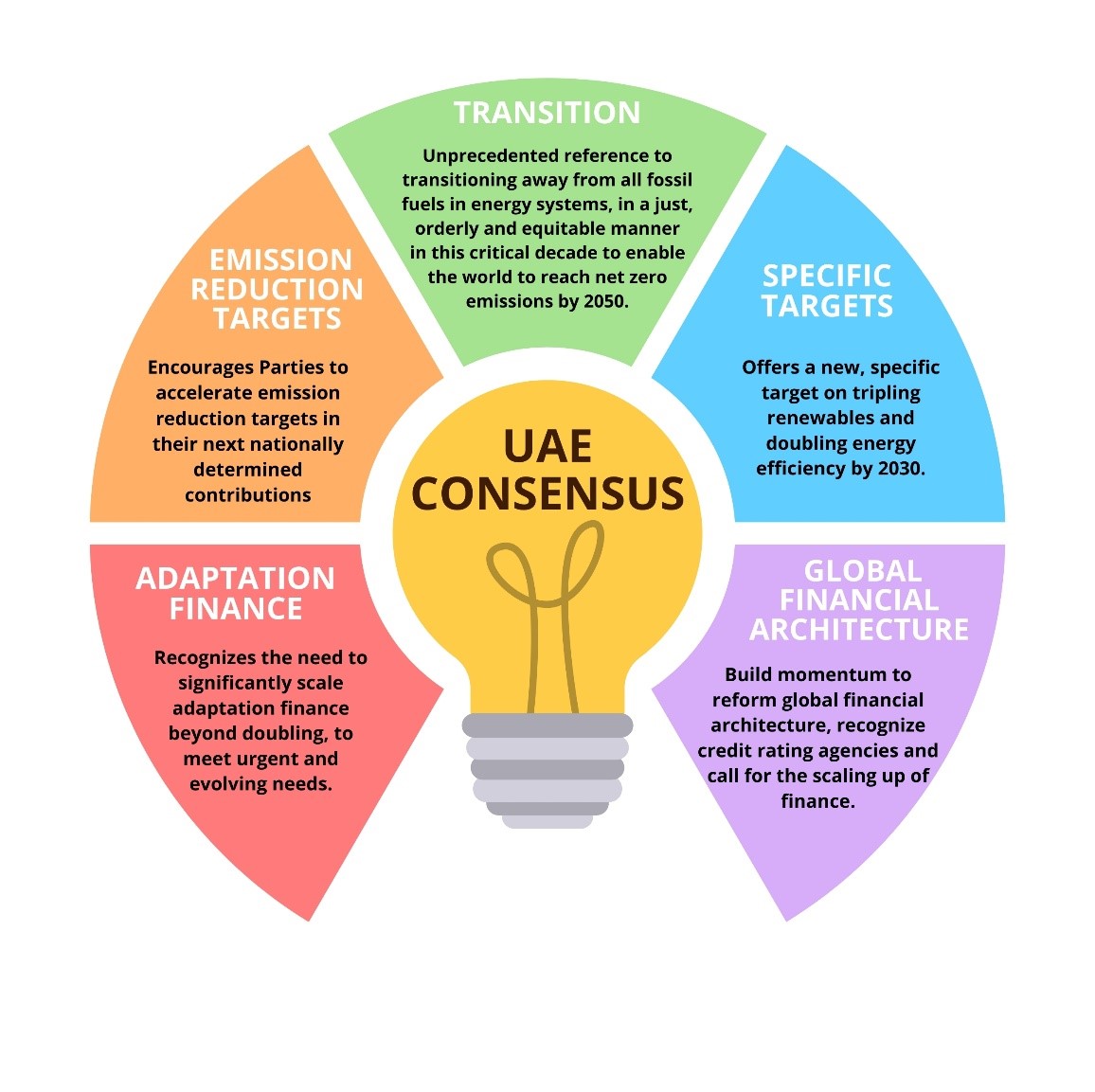
The Conference of Parties (COP-28) has been recently concluded in Dubai, United Arab Emirates (UAE) with the adoption of UAE Consensus.
|
Status of Greenhouse Gas (GHG) Emissions
|
- G20 countries represent around 75% of global GHG emissions.
- The US, the UK and the EU are considered to be responsible for 50% of all emissions.
- India is responsible for only 4% of historical emissions.
- China, the world’s biggest emitter in the last 15 years, is responsible for 30% of global emissions every year.
|
What is COP all about?
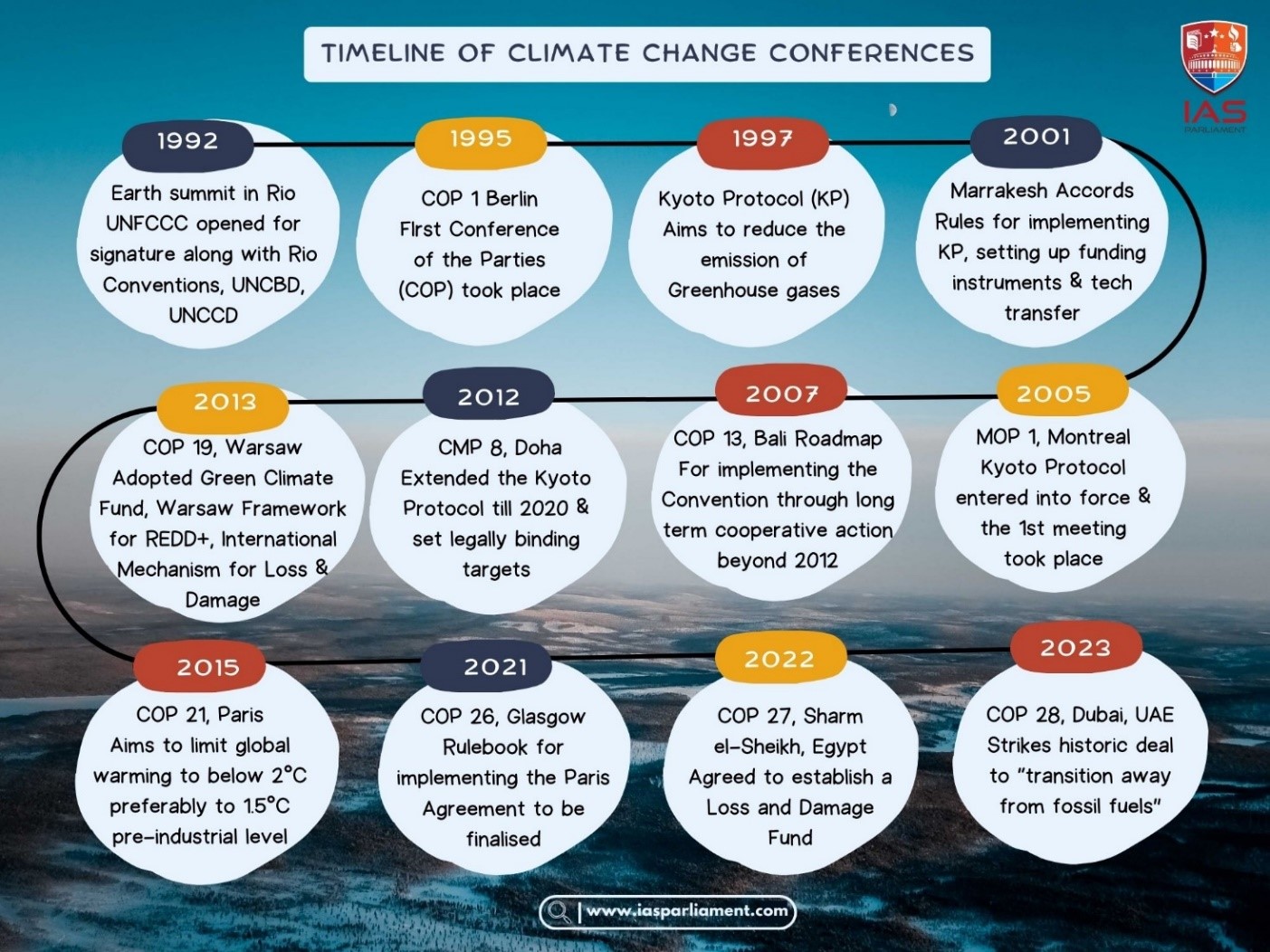
- The COP is the main decision-making body of the United Nations Framework Convention on Climate Change (UNFCCC).
- It brings together the 198 Parties (including the European Union) to negotiate and agree on how to tackle climate change, reduce emissions and limit global warming.
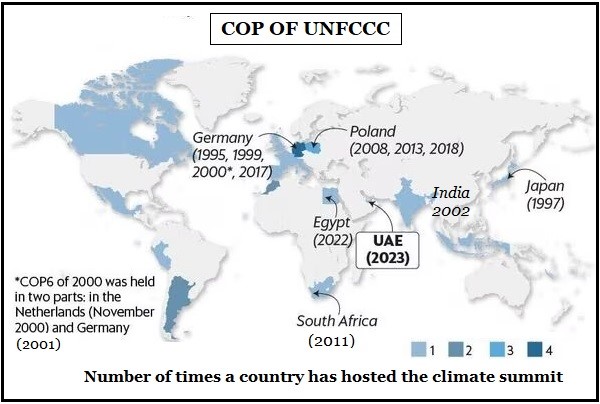
- The inaugural gathering took place in Berlin, Germany, in 1995.
- The COP secretariat is headquartered in Bonn.
- The COP Presidency rotates among the 5 recognized UN regions - Africa, Asia, Latin America and the Caribbean, Central and Eastern Europe and Western Europe and others.
- COPs (28) are organized into 2 distinctive areas.
- The Blue Zone - A UNFCCC-managed site that is only open to UN-accredited participants.
- The Green Zone - Managed and delivered by the COP28 UAE Presidency, and is open to everyone.
- To know more about COP-27, click here: Part -I & Part - II
 What about COP28?
- Host of COP28 - Dubai, The UAE
|
UNFCCC
|
- The UNFCCC was formed in 1994 to stabilize GHG emissions and to protect the earth from the threat of climate change.
- The participants at COPs are signatories to UNFCCC and have been meeting every year since 1995.
- At present, the UNFCCC has 198 members.
- It is one of the 3 Rio Conventions which includes Convention on Biological Diversity (CBD), Convention to Combat Desertification (UNCCD).
|
- It appointed the chief executive of the state-owned oil company, Sultan al-Jaber, as COP28 president.
- The UAE is one of the world's top 10 oil-producing nations.
- US President Joe Biden and China's Xi Jinping did not attend the event, but both countries were represented.
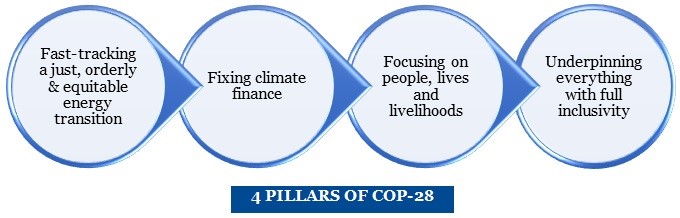
- 4 themes - The 4 crosscutting themes are technology & innovation, inclusion, frontline communities and finance.
- It also focuses on the progress towards the existing Paris goal of limiting the global average temperature rise to well below 2°C above pre-industrial levels, and pursue efforts to limit it to 1.5°C.
Paris Agreement is a legally binding international treaty on climate change that was launched in 2015 and was adopted by 196 countries.
Meetings at 2023 UN Climate Change Conference, Dubai – It includes
- 28th session of the Conference of the Parties (COP 28)
- 5th session of the decision-making body of the Paris Agreement (CMA 5)
- 18th session of the decision-making body of the Kyoto Protocol (CMP 18)
- The World Climate Action Summit (WCAS) - It was held during the COP 28 where world leaders presented their progress and ambitions, providing guidance for the remainder of the COP.
|
QUICK FACTS
|
|
India’s Updated Nationally Determined Contribution (NDC)
|
- This update translates the ‘Panchamrit’ announced at COP 26 into enhanced climate targets.
- Emissions intensity – It is the total amount of emissions emitted for every unit of GDP.
- The goal to reduce emissions intensity and improve energy efficiency was not sector specific.
- Reducing emission intensity of GDP by 45% below 2005 levels by 2030.
- Status -India had already achieved 21% of its emissions intensity as a proportion of its GDP in line with its commitment.
- Non fossil fuel-based energy – To meet 50% of cumulative electric power installed capacity from non-fossil fuel-based energy resources by 2030.
- Power - 500 GW of non-fossil fuel installed power generation capacity by 2030.
- Absolute Emission - Cutting absolute emissions by one billion tonnes, presumably from projected business-as-usual (BAU) 2030 levels.
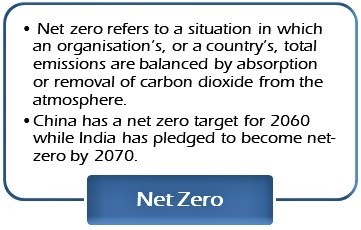
- Net-zero emissions – To be achieved by 2070.
|
To know about UNFCCC COP-28 Part 2, click here
To download full pdf, click here



