Why in news?
The 1st Africa Climate Summit (ACS23) held in Nairobi culminated in the ‘Nairobi Declaration’, giving the continent a common voice ahead of upcoming key global engagements.
What is the African Climate Summit 2023 about?
- Theme- Driving Green Growth and Climate Finance Solutions for Africa and the World
- Location - Nairobi, Republic of Kenya
- Host- Co-hosted by the Republic of Kenya, the African Union Commission (AUC)
- Aim- To position Africa in solidarity with the rest of the world for global climate action.
- Participants - Government representatives, policymakers, civil society organizations, the private sector, multilateral institutions, and youth representatives from Africa and beyond
- Focus areas- Nexus between climate change and Africa’s development reality, with special emphasis on increasing investment in climate action in Africa.
- The event was dominated by discussions about how to mobilize financing to adapt to
- Increasingly extreme weather,
- Conserve natural resources and
- Develop renewable energy.
- Nairobi declaration- It will form the basis of Africa’s negotiating position at COP28 climate summit in United Arab Emirates.
What are the focus areas of the summit?
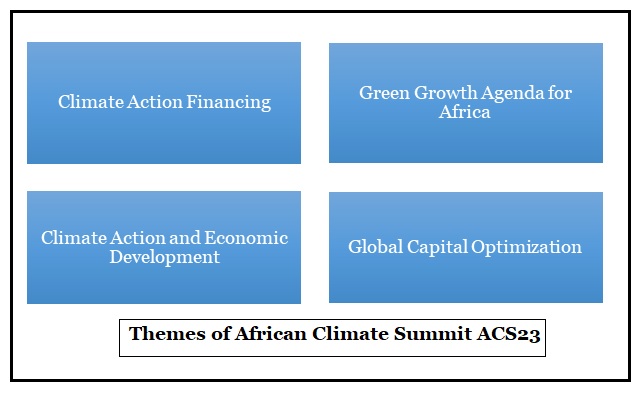
- Thematic areas
- Nature Capital
- Climate Finance
- Renewable Energy and Energy Transition
- Green Minerals and Manufacturing
- Sustainable Agriculture
- Land Use, Oceans and Water
- Sustainable Infrastructure and Urbanisation
- Adaptation and Resilience
- The summit committed to achieve 3 climate finance goals
- More financing
- Targeted financing
- Cheaper higher risk appetite financing
What are the key outcomes of Nairobi declaration?
- The summit culminated in the Nairobi Declaration, an eleven-point call to action proclaiming African States' unified stance on climate action.
Climate financing
- Demands - At the Summit, African leaders called for a significant overhaul of the global financial system and their demands included
- Improved access to concessional loans
- Fulfilment of a 14-year-old promise by developed nations to mobilize USD 100 billion annually for climate adaptation and mitigation
- Establishment of a carbon markets initiative to fund renewable energy infrastructure.
- Investments - During the Summit, donor nations and multilateral organizations pledged approximately USD 26 billion for climate investments.
To meet the emission reduction targets outlined in the Paris Agreement, Africa requires a substantial USD 2.8 trillion by 2030.
Global taxes and funding mechanisms
- Global Fossil Fuel Tax- It advocated for targeted taxes on sectors like aviation and maritime, the removal of fossil fuel subsidies worldwide, and the implementation of a global fossil fuel tax.
- Carbon Border Adjustment Mechanisms (CBAM) - It can be deployed as a tax for targeted mitigation and adaptation efforts.
- Financial Transaction Tax- Exploring this tax on a global scale is another potential avenue for generating significant revenue.
- Global Climate Finance Charter- It will be developed through the UN General Assembly and the COP processes by 2025.
- Debt - It recommends extending the debt repayment period and instituting a 10-year grace period.
Decarbonisation
- Urgent action- The summit calling for immediate action by developed countries to reduce carbon emissions for equality and shared prosperity.
- Steps to reduce emission-
- Adherence to Paris Agreement,
- Accelerate phasing down coal and
- Operationalise Loss and Damage facility agreed at COP27.
G20 countries are responsible for around 80% of global greenhouse gas emissions.
What are the shortcomings of the summit?
- Western delegates - The proliferation of Western delegates in the Summit is said to have compromised Africa’s push for climate justice.
- Carbon market- Africa’s endorsement to carbon market has been described by many countries as a “bogus solution,” to the effects of climate change.
- A new report released by Power Shift Africa states that Africa should not adopt carbon credits as they are like a silver bullet and painkillers for rich polluters.
- Exclusion of health- Health is not included in the main agenda, despite extricable link with the climate change.
- The exclusion happened against the backdrop of 23% of diseases globally being attributed to climate change, whilst the percentage is slightly higher in sub-Saharan Africa at 29%.
References
- Down to Earth- African climate summit ends with Nairobi declaration
- African Union- Nairobi declaration
- World Economic Union- Africa Climate Action Taxes



