Why in news?
Recently, 1 year anniversary of India’s cheetah reintroduction programme was observed with the 1st batch of 8 cheetahs from Namibia arrived on September 17, 2022.
Why is the cheetah being brought back?
- Asiatic cheetahs – Once abundant in India, cheetah was officially declared extinct by the Indian government in 1952.
- Reasons - Over-hunting, decimation of its relatively narrow prey base species and loss of its grassland-forest habitat.
- Cheetah Reintroduction– India carried out negotiations with Iran in 1970s for reintroducing Asiatic Cheetah but it didn’t take off.
- In 2009, a plan was endorsed to reintroduce Cheetahs in India but it was shot down by the Supreme Court.
- Later, in 2020, the Supreme Court cleared the move on an experimental basis.
- Need for introduction– To establish a viable cheetah metapopulation in India and provides space for the expansion of the cheetah within its historical range.
- As it is a flagship species, the conservation of the cheetah will revive grassland-forests habitat.
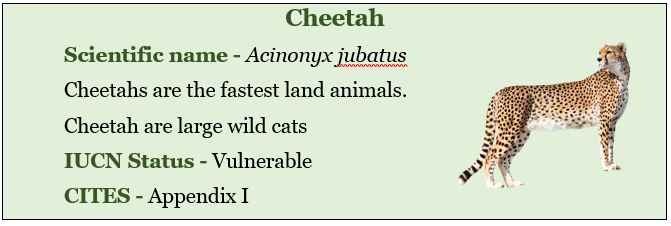
What is Project Cheetah?
- Project Cheetah is India’s cheetah relocation programme and the 1st intercontinental reintroduction of a wild, large carnivore species.
- Aim- To bring in 5-10 animals every year, over the next decade, until a self-sustaining population of cheetahs is established.
- Reintroduction- The African cheetahs are translocated from the forests of South Africa and Namibia to the Kuno National Park in Madhya Pradesh.
- Implementing body - The National Tiger Conservation Authority (NTCA) under the Ministry of Environment, Forest, and And Climate Change
- Assisted by - The Cheetah Conservation Fund (CCF)
To know more about Cheetah reintroduction programme, click here
Status of Project Cheetah
- Total Imports – 20 adult African cheetahs have been imported so far.
- Death – Of the 20 adult cheetahs imported, 6 of the 12 cheetahs which came from Africa have died.
- Additionally, 3 of the four cubs have died and the only remaining cub is being hand reared as its mother has rejected it.
- Current status - The surviving 14 adult cheetahs and 1 cub are in captivity.
- The current status doesn’t indicate any progress to achieve the stated goal of Project Cheetah.
- Additional sites being prepared – Gandhi Sagar Wildlife Sanctuary and Nauradehi Wildlife Sanctuary, both in Madhya Pradesh.
Why are the reasons attributed to the death of Cheetahs?
- Premedical condition – The 1st cheetah which died is said to have a renal condition even before translocation.
- Extreme weather conditions – The death of the cubs born in India are attributed to heat wave conditions.
- Captive conditions – One of the females died when authorities attempted to get the cheetah to mate inside the enclosure.
- Organ failure –Cardio-pulmonary failure is another cause but what caused it has still not been determined.
- Unknown causes – The last three deaths occurred during the monsoon with no definite cause.
What are the issues associated?
- Higher quarantine time – It took more than 50 days for the first two cheetahs and more than 70 days for the last of the eight cheetahs to be released into larger enclosure.
- It is not clear if scientific assessments of prevalence of diseases were carried out and what the results were, as there is nothing in the public domain.
- Faulty selection process – It allowed the import of animals which were ill and behaviorally unfit for release in the wild.
- 3 of the eight cheetahs that were part of the first batch of cheetahs from Namibia, did not meet the criteria prescribed in the Action Plan.
- No separation of male and female – Certain events like the birth of a litter, the fatal mauling of a female by two males and the death of a male while a female was in the same enclosure was against the given norms.
- Implementation failure – Neither the mentioned timelines nor the stated sequence of release has been followed.
- Impact on other endangered species – It probably diverted financial resources from much needed conservation projects like the Great Indian Bustard and the translocation of Asiatic lions.
- Habitat conservation- Given the challenges that the cheetahs have faced in surviving even in captivity and the lack of suitable habitats for them, using African cheetahs to conserve grasslands and grassland-dependent species is clearly a faulty strategy.
What lies ahead?
- Need to incorporate the best available scientific knowledge in planning, implementation and monitoring of a project of this scale.
- Focus on the establishment of high-quality habitats covering at least 5,000 square kilometres before bringing more cheetahs from Africa.
Cheetahs are a low-density species, existing at best at 1-2 per 100 sq km and with a unique spatial ecology. The introduced cheetahs will need about 5,000 sq km of good-quality habitat to establish a viable population in India.
- Make wider consultation involving scientists and conservationists.
- Authorities need to reassess the approach to prevent deaths, especially when the animals are in captivity.
- Be cognizant of the effects of long periods of captivity on the fitness of these cats to be released to run free in the wild.
- Need to determine if the African cheetahs are susceptible to certain insects and parasites in India, and if the radio collars provide a micro-environment conducive for these to thrive.
Quick Facts
Action Plan for Cheetah Reintroduction in Indian States
- Quarantine for 30 days in a predator-proof enclosure at the site of release.
- Monitor animals for manifestation of any sickness as per the regulation of import of live animals under the Livestock-Importation Act, 1898.
- Do a scientific assessment to establish the prevalence of potential carnivore pathogens/diseases at the release sites.
- The selection of animals suitable for release will be verified by CTF/WII after necessary vaccinations and health checks.
- Separation of male coalitions and females in adjoining compartments so that they can know each other before release.
- Radio-collared male (coalitions) would be released from the holding enclosure first after an appropriate period (1 to 2 months).
- The females shall be released, after radio collaring, 1-4 weeks after the males.
References
- The Hindu| One year report of Project Cheetah
- IE| Deviations from Action Plan



