Why in news?
Recently, the 7th assembly of Global Environment Facility (GEF) was conducted in Vancouver, Canada.
What is Global Environment Facility (GEF)?
- About - It is the largest source of multilateral funding for biodiversity globally, and distributes more than 1 billion dollar a year on average to address inter-related environmental challenges.
- Origin - GEF was originated by France with a 1989 proposal to formulate financing responses to mounting concern over global environmental problems.
- It was established as a pilot program in 1991 through arrangements between 3 implementing agencies,
- World Bank
- UN Development Programme (UNDP)
- UN Environment Programme (UNEP)
- Purpose- To provide concessionary and additional funding for the incremental costs of achieving global environmental benefits, with an initial endowment of around USD 1 billion.
- Evolution - In 1992, GEF was established.
- By 1994, the GEF became a separate institution, hosted but not administered by the World Bank, which operates as a key mechanism for global environment
- Functions- It provides fund for biodiversity, climate change, international waters, land degradation, persistent organic pollutants (POPs), mercury, sustainable forest management, food security, and sustainable cities in developing countries.
- It has served as an operating entity of the financial mechanism since the United Nations Framework Convention on Climate Change’s (UNFCCC), 1994.
- Special Funds- The special funds set up and managed by the GEF are
- The Special Climate Change Fund (SCCF) - It supports adaptation and technology transfer in all developing country parties to the UNFCCC, supporting both long-term and short-term adaptation activities in water resources management, land management, agriculture etc.,
- The Least Developed Countries Fund (LDCF) - It is established under the UNFCCC to address the special needs of the Least Developed Countries (LDCs) that are vulnerable to the adverse impacts of climate change.
- Adaptation Fund - GEF provides the secretarial services to adaptation fund which was established under the Kyoto Protocol in 2001.
The Kyoto Protocol aims to limit or reduce the greenhouse gas emissions by 3 market-based mechanisms – emissions trading, clean development mechanism and joint implementation.
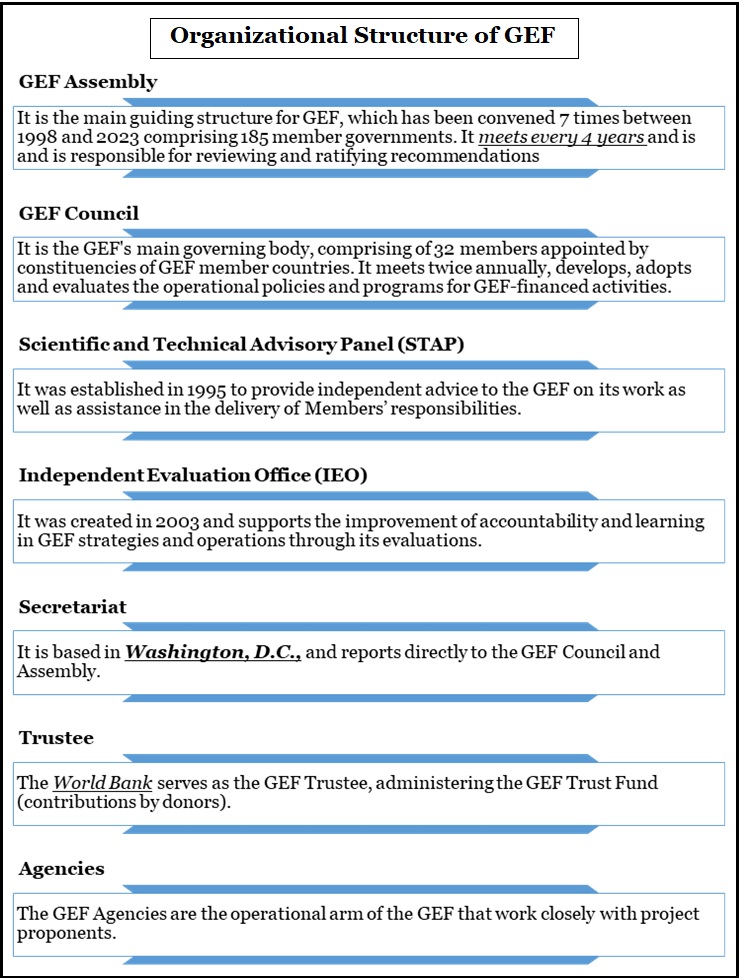
What are the financing mechanisms of GEF?
- The GEF provides funding to assist developing countries in meeting the objectives of international environmental conventions. It serves as a "financial mechanism" to 5 conventions.
- Convention on Biological Diversity (CBD)- It is a multilateral treaty established in Rio Earth summit 1992.
- It has three main goals-
- Conservation of biological diversity
- Sustainable use of its components
- The fair and equitable sharing of benefits arising from genetic resources.
- United Nations Framework Convention on Climate Change (UNFCCC)- It is an international environmental treaty to combat dangerous human interference with the climate system, by stabilizing greenhouse gas concentrations in the atmosphere.
- It was established in 1992 Rio Earth summit.
- Kyoto Protocol was the implementation of measures under UNFCCC.
- Stockholm Convention- It is an international environmental treaty, signed in 2001 to eliminate or restrict the production and use of persistent organic pollutants (POPs).
- UN Convention to Combat Desertification- It is a convention to combat desertification and mitigate the effects of drought through national action programs.
- It is the only convention stemming from a direct recommendation of the Rio Conference's Agenda 21, and adopted in 1994.
- Minamata Convention on Mercury- It is an international treaty designed to protect human health and the environment from anthropogenic emissions and releases of mercury and mercury compounds.
- It was adopted in 2013 at a diplomatic conference held in Kumamoto, Japan.
- Montreal Protocol- It is an international treaty designed to protect the ozone layer by phasing out the production of numerous substances that are responsible for ozone depletion which entered into force in 1989.
- GEF is not formally linked to this protocol, but supports implementation of the protocol in economies in transition.
- Multilateral agreements- It is associated with many global and regional multilateral agreements that deal with international waters or transboundary water systems.
- The Global Ship Ballast Water Treaty
- The UN Law of the Sea Treaty
- The MARPOL treaty for shipping (International Convention for the Prevention of Pollution From Ships)
- The UN Agreement on conservation and management of straddling fish stocks and highly migratory fish stocks.
The Green Climate Fund (GCF) which aspires to collect $100 billion financing target by 2020, was launched in 2010. It is managed independently.
What are the key outcomes of the 7th GEF Assembly?
- Global Biodiversity Framework Fund - It ratified the Global Biodiversity Framework Fund, a new source of funding for protecting endangered species and their ecosystems globally, which was approved by the GEF Council.
- Youth Leaders Learning Exchange- It stressed the importance of universal access to education for girls and boys, and engaging youth, women, and Indigenous leaders in sustainable solutions.
- Indigenous and Local Knowledge Event- It is organised to study the overlap between indigenous peoples’ lands and biodiversity hotspots.
- It emphasized the importance of oral history and the voices of indigenous peoples in Arctic and Amazon.
- GEF Partnership Forum- It is the 1st ever GEF Partnership Forum, which created a space for indigenous peoples, youth, women, and representatives from civil society to discuss ways the GEF can support their recognition and empowerment.
- Intergenerational Fireside Chat- This event discussed the devastation of recent and ongoing wildfires as well as the role of fire as a place for gathering, connecting, and storytelling.
- Forum Confabs- It is an informal gathering that were held during the Partnership Event.
- Intergenerational Collaboration for our Future- It discussed how the GEF Partnership should engage youth on a long term basis.
- Women’s Leadership in Environmental Action- It seeks elaboration on women’s leadership and gender-responsive actions in environmental programs and initiatives.
- Indigenous Stewardship of the Global Environment- It discussed the GEF’s support in harnessing indigenous knowledge systems and the importance of working in a holistic manner to elevate the rights of indigenous people.
- Inclusive GEF Assembly Challenge Program- It is a new funding initiative providing up to USD 100,000 to each of 23 winners.
- Net Zero Nature-positive World- It discussed the role of international finance institutions in supporting countries raising ambition in climate and nature.
References
- IISD- GEF 7th assembly summary report
- GEF- About Global Environment Facility



